
Industrial Fruit & Vegetable Processing Solutions: Engineering for Maximum Yield & Hygienic Excellence
Driven by global demand for fresh-cut convenience salads, IQF frozen fruits, aseptic juices, and ready-to-eat produce, commercial food processors face escalating challenges in microbial safety (HACCP/FDA/EHEDG), raw material yield preservation, and water conservation. Traditional semi-manual operations suffer from 8%–15% cellular damage, severe enzyme browning, high water consumption, and inconsistent knife-cut precision.
Drawing on engineering practices seen in global benchmark plants (such as Kronen, Tomra, and JBT FoodTech), HSYL delivers fully integrated, turnkey fruit and vegetable processing lines engineered from food-grade AISI 304/316 stainless steel. Our modular lines combine multi-stage turbulence bubble washing with closed-loop water recycling, optical/mechanical sorting, precision 3D cutting, and automated modified atmosphere packaging (MAP) — enabling industrial processors to cut operating overhead while meeting the world's most stringent food hygiene standards.
Targeted Processing Line Configurations
We customize end-to-end processing systems for four primary industry segments, matching unique raw material textures and preservation criteria:
- • Helical non-submerging flume wash prevents leaf tear
- • Water-chilled flume conveying retards microbial growth
- • Low-G variable frequency centrifugal spin dewatering
- • Modified Atmosphere Packaging (MAP) for 7–12 days shelf life
- • High-density hydraulic destoner & soil separation drum
- • Micro-layer carborundum abrasive / steam peeling (<6% loss)
- • High-capacity 3D dicer for cubes, strips, crinkle cuts
- • Anti-oxidation dipping flume locks natural raw color
- • Precise PLC steam blanching (±0.5°C enzyme deactivation)
- • Two-stage counterflow ice water plunge chilling (<4°C)
- • Dual-frequency air-knife & vibratory dewatering grid
- • Zero-clumping raw material presentation into freezer
- • Roller sorting conveyor with inverted fruit rotation
- • Auto-pitting, destoning and hot/cold-break crushers
- • Double-stage turbo refiner screens (0.4mm–1.2mm mesh)
- • Tubular pasteurizer and aseptic bag-in-box filling ready
End-to-End Modular Equipment Workflow
Our modular machinery is engineered with open-frame sanitary architecture, tool-free belt release, and full CIP integration:


Critical Processing Challenges & Engineering Countermeasures
Why do leading food processors choose specialized engineering over off-the-shelf single machines? Here is how our line solves the 5 most expensive processing vulnerabilities:
Cellular Crushing & Fast Enzymatic Browning
Standard mechanical slicing tears plant cells instead of making a clean cut. Damaged cell walls release Polyphenol Oxidase (PPO), causing fresh cut lettuce, apples, and potatoes to turn brown within 2 to 4 hours, forcing heavy chemical treatment.
German Hardened Precision Blades & Water Cushion Discharge
Equipped with ultra-thin Swedish/German stainless steel blades rotating up to 3,000 RPM, achieving surgical micro-cuts that preserve cell walls intact. Fresh produce is immediately discharged onto chilled water flumes to stop oxidation without excessive preservatives.
Result: Shelf Life Extended by 300% · Firm Crispness PreservedExcessive Water Consumption & High Effluent Surcharges
Traditional washing systems consume 8–15 m³ of fresh potable water per ton of vegetables. Escalating municipal water tariffs and industrial effluent treatment penalties heavily erode processor profit margins.
Multi-Stage Counter-Current Filtration & Ozone Recycling System
Our integrated water recovery system routes overflow through wedge-wire rotary screens, hydrocyclone sand desanding cones, and automatic ozone sanitizing skids, recycling up to 65%–70% of process water while keeping microbial counts well below safety limits.
Result: Saves Up to 65% Fresh Water · 40% Reduction in Sewage FeesListeria / E. Coli Cross-Contamination & Biofilm Formation
Closed hollow frames, dead corners, and non-removable conveyor beds accumulate plant juices and dirt, fostering persistent bacterial biofilms that fail routine ATP and microbial swabs.
EHEDG-Compliant Open Sanitary Construction & Fast CIP Washdown
Built with 45° self-draining tubular frames in AISI 304 stainless steel, tool-less quick-release belts (stripped in under 3 minutes), and IP69K waterproof washdown drives. Automated CIP spray balls ensure spotless chemical sanitation in every cycle.
Result: 100% Zero Dead-Corner Cleanability · 50% Shorter Cleaning DowntimeHigh Peeling Loss Rate & Inconsistent Cut Sizing
Uncontrolled peeling abrasive drums shave off 18% to 25% of root vegetables, throwing valuable edible flesh into the waste chute. Inconsistent dicing generates unusable off-cuts and high giveaway.
Digital Depth-Controlled Peeling & Precision 3D Slicing
PLC-monitored peeling cycles with high-resolution weight-loss timers control peeling depth within micrometers. Combined with synchronized 3D dicing, cutting yield consistency achieves ±0.5mm dimensional uniformity with scrap rates under 3%.
Result: Peeling Waste Reduced from 20% to <7.5% · Yield Gain of 120+ Tons/YearSevere Labor Shortages & Peak-Season Inefficiency
Manual sorting, trimming, and bagging require 25 to 50 workers per shift. High staff turnover, wage inflation, and repetitive strain injuries create severe delivery bottlenecks during seasonal harvest windows.
Continuous PLC Synchronized Line with Central HMI Control
The entire line is interlocked with intelligent sensors; downstream pauses automatically throttle upstream conveyors to prevent line jams. The complete 2 T/h line requires only 3 to 5 supervisory operators for raw material staging and final boxing.
Result: 60%–70% Labor Reduction · Payback Period Within 8–14 MonthsProduction Line Capacity & Engineering Specification Matrix
Select from our standard industrial configurations or request a custom plant layout engineered to your floor plan:
| Model Spec | Target Output | Recommended Scope | Installed Power | Fresh Water Usage | Labor Crew | Footprint Needed |
|---|---|---|---|---|---|---|
| HSYL-FV-500 | 300 – 600 kg/h | Central Kitchens, Pilot Plants, Specialty Salad Packhouses | 14 – 22 kW | 0.8 – 1.2 m³/h (with recycle) | 2 – 3 Operators | 40 – 65 m² |
| HSYL-FV-2000 | 1,500 – 2,500 kg/h | Commercial Packhouses, Supermarket Cold Chain Hubs | 38 – 58 kW | 1.8 – 2.8 m³/h (with recycle) | 3 – 5 Operators | 90 – 160 m² |
| HSYL-FV-5000 | 4,000 – 6,000 kg/h | Industrial Food Processors, Large-Scale Canning & IQF Plants | 85 – 140 kW | 3.5 – 5.0 m³/h (with recycle) | 5 – 8 Operators | 220 – 380 m² |
Proven Industrial Performance: Real Case Studies
Review how food processing leaders transformed their plant economics with HSYL turnkey solutions:
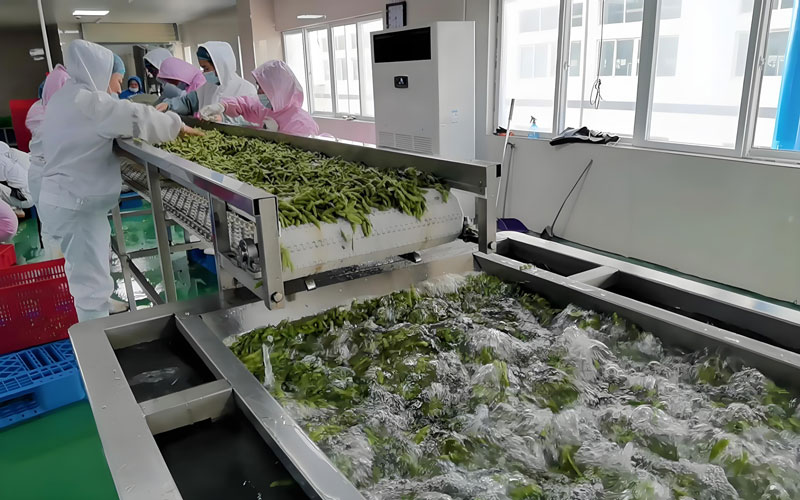
Case 1: Large Fresh-Cut Distribution Hub (Southeast Asia) – 20 Tons/Day Capacity
The client delivers prepared leafy greens and fresh cut vegetables to over 300 supermarket outlets and restaurant chains. The previous semi-manual washing and chopping line suffered from 9.2% raw material loss, uneven cut sizes, and frequent delivery delays during holiday demand spikes.
- ◉ Solution: Installed a fully automated HSYL-FV-2000 fresh-cut processing line with multi-stage helical bubble washing, non-bruising spin drying, and dual MAP packaging lines.
- ◉ Daily Output: Surpassed 20 metric tons per day, increasing overall processing throughput by 65%.
- ◉ Yield Gain: Raw material loss decreased from 9.2% down to 5.4%, saving ~220 tons of fresh produce each year.
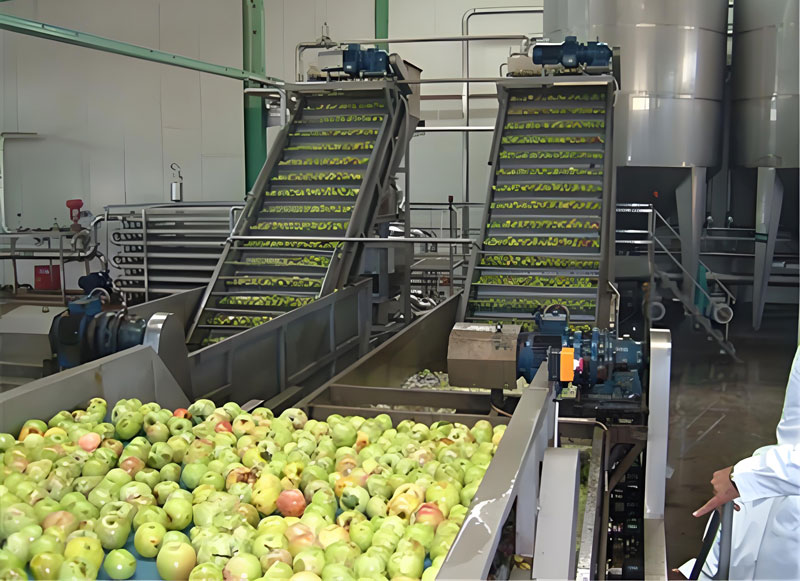
Case 2: EU-Export Fruit Puree & Juice Processing Plant – Zero Microbial Audit Defect
An export-oriented fruit processing enterprise supplying concentrated purees and frozen fruit chunks to European retail buyers. Outdated washing and sorting equipment failed rigorous pesticide residue and microbial tests, putting valuable export contracts at risk.
- ◉ Solution: Upgraded the raw material receiving, brush washing, destoning, steam blanching, and aseptic bag filling line with certified AISI 316 contact surfaces and automated CIP clean-in-place.
- ◉ Quality Validation: 100% compliance with EU pesticide residue thresholds and passed unannounced HACCP & ISO 22000 microbial audits with zero non-conformances.
- ◉ Efficiency: Reduced peeling flesh loss by 32% and increased export order shipment volumes by 42%.
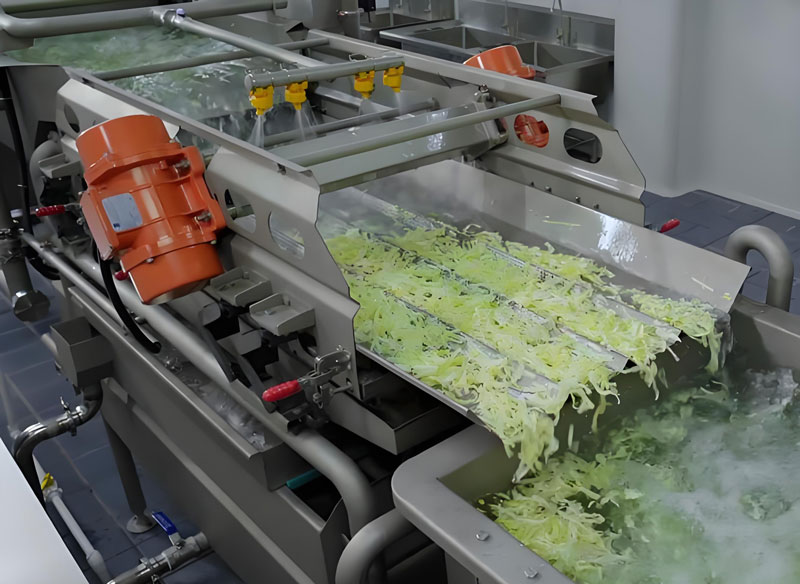
Case 3: Quick-Service Restaurant Central Kitchen – Precision Dicing & Extended Freshness
Supplying daily diced root vegetables and shredded salads to 180 fast-casual dining restaurants. Manual prep caused noticeable texture and dimension differences between batches, resulting in food waste in store kitchens and customer complaints.
- ◉ Solution: Deployed automated continuous washers, high-speed 3D precision dicers, and nitrogen-flushed MAP tray packaging equipment.
- ◉ Cut Consistency: Dicing dimensional uniformity reached ±0.5mm across potatoes, onions, and bell peppers.
- ◉ Shelf-Life: Fresh produce shelf-life extended from 48 hours to 7 days under cold chain logistics, cutting store-level kitchen prep labor by 55%.