
How to Stop Your Mousse/Cheese Cakes from Sticking and Crumbling when Cutting
The Structural Physics: How to Stop Your Mousse and Cheese Cakes from Sticking and Crumbling During Industrial Slicing
- Friction elimination at 20kHz: Replacing passive steel blades with active resonant titanium stops high-fat adhesion instantly.
- Waste mitigation economics: Halting edge crumbling recovers up to 12% of total daily raw material costs in high-throughput bakeries.
- Thermal window expansion: Advanced acoustic cutting geometry allows slicing at elevated temperatures (-5°C instead of heavy-frozen -18°C), drastically reducing blast freezer energy loads.
As a senior engineering director at HSYL with over 20 years spent commissioning commercial Food Processing Machinery across global markets, I constantly see plant managers misdiagnosing a fundamental physics problem as an operator error. When dealing with high-fat, highly viscous delicate pastries, slicing is rarely about simple sharpness. If you are operating a high-volume bakery and notice that operators are constantly stopping the line to wipe down sticky mechanical blades, or if your QA team is rejecting portions due to smeared layers and crumbling edges, the core equipment architecture is forcing a geometric failure on the cellular structure of your product.
I have audited hundreds of facilities where standard mechanical down-cutters were destroying profit margins on premium desserts. This article breaks down the exact thermodynamic and mechanical reasons why your high-value mousse and cheese cakes stick to standard blades, and details the industrial engineering solutions required to achieve a mathematically perfect, smear-free yield at commercial scale.
The Cellular Mechanics of Failure: Why Standard SUS304 Blades Drag and Mutilate
Understanding the root cause of sticking requires looking at the viscoelastic mechanics of dairy-based cakes. Mousse and heavy cheese cakes consist of suspended fat globules, stabilized air matrices, and high ambient moisture. When a standard stainless steel (SUS304 or SUS316) blade passes through this structure, it generates massive mechanical shear stress.
Surface Tension Profiles and Fat Adhesion
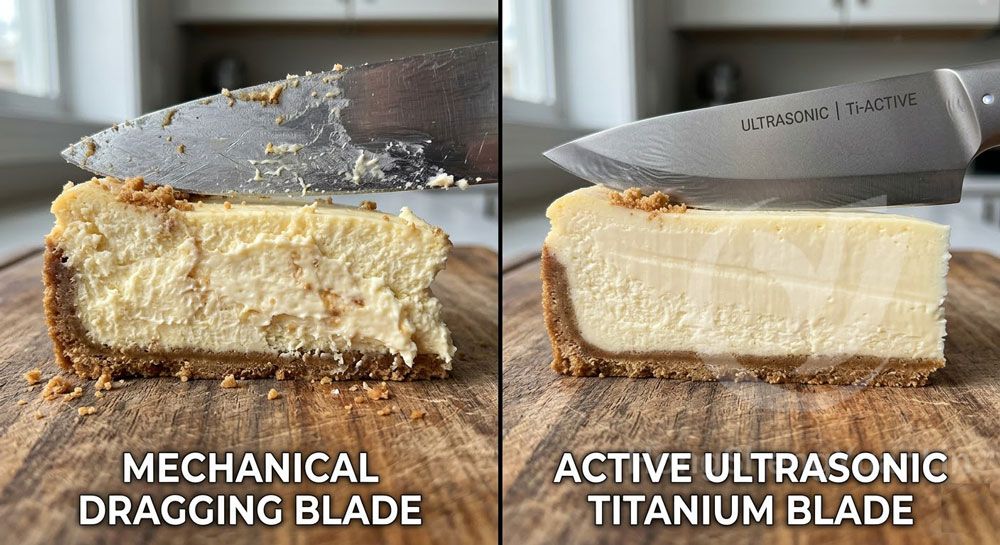
Mechanical blades act as wedges. As the steel forces the pastry apart, the friction generates localized micro-heating along the blade edge. This temporary thermal spike melts the microscopic fat networks in the cheese or mousse. Once melted, the fat acts as an industrial adhesive, bonding the cake crumb instantly to the side of the steel blade. By the second or third stroke in a high-speed payload capacity cycle, the blade is completely coated in sticky residue. The subsequent cuts no longer slice; they tear and drag, leading directly to collapsed cake sidewalls and massive crumbling on the exit stroke.
The Cross-Contamination of Multi-Layer Aesthetics
If your product design features alternating layers of vanilla sponge, dark chocolate mousse, and fruit compote, a stuck mechanical blade creates severe cross-contamination risks. The sticky residue is dragged from the top chocolate layer straight down into the pristine vanilla base. In the premium bakery sector, aesthetic presentation dictates retail pricing. A smeared slice is an unsalable defect. Attempting to solve this by slowing down the blade RPM equivalent or increasing the downward hydraulic pressure only exacerbates the structural crumbling.
The Acoustic Solution: Deploying 20kHz Frictionless Barriers
To eliminate the tearing effect, you cannot simply sharpen the steel. You must alter the friction coefficient at the point of contact. This is precisely why the industry has shifted toward ultrasonic slicing technology for highly viscous goods. Instead of using mechanical force, an ultrasonic system uses high-frequency acoustic vibrations.
How the Resonance System Defeats Adhesion
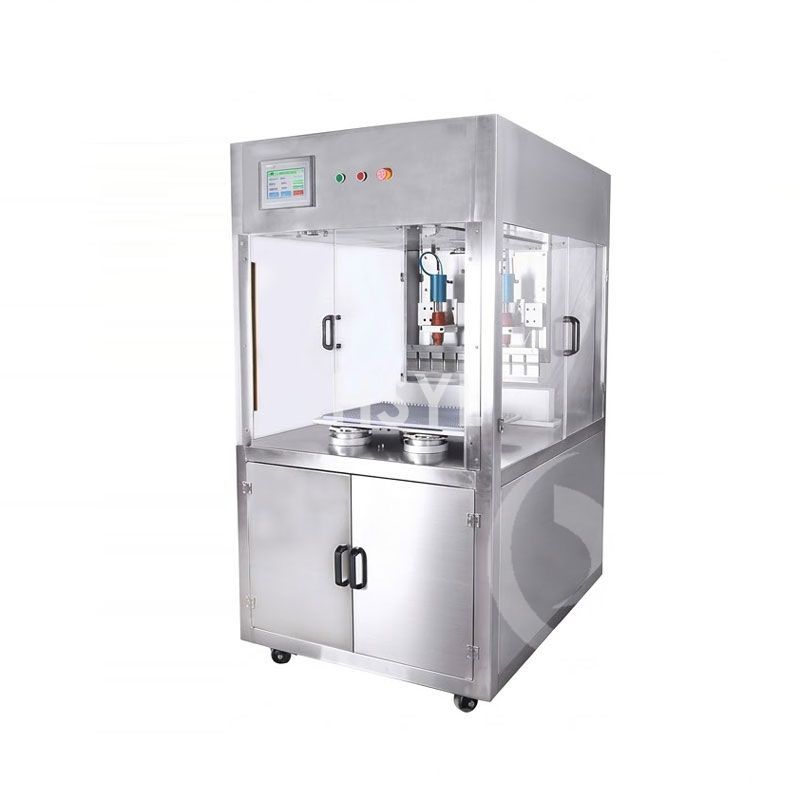
An industrial ultrasonic cutting system consists of a generator, a piezoelectric converter, a booster (to amplify the wave amplitude), and a sonotrode (the actual titanium blade). The generator converts standard electrical current into a high-frequency signal, typically 20,000 to 35,000 cycles per second (20kHz - 35kHz). This signal forces the titanium blade to expand and contract microscopically tens of thousands of times per second.
Because the blade is vibrating at such a massive frequency, it creates a microscopic frictionless barrier between the titanium surface and the fat molecules of the mousse cake. The cake literally cannot touch the blade long enough to adhere. The friction coefficient drops to near zero, meaning there is zero localized heat generation, zero fat melting, and structurally zero blade drag. The titanium slices through the delicate air matrix of the pastry without compressing it, maintaining absolute geometric integrity from the top crust to the bottom sponge.
Thermal Profiling: The HSYL Friction Drag Coefficient Matrix
Throughout my deployment of customized engineering layouts, I have observed that most bakeries attempt to solve their mechanical crumbling issues through extreme freezing. They will blast freeze cheese cakes down to -18°C or -20°C to artificially harden the fat structure before using a guillotine slicer. This is an immense, hidden operational expenditure (OpEx). Running blast freezers for extended dwell times destroys energy efficiency metrics.
Based on our laboratory stress tests at HSYL, we developed a specific calculation model for optimizing ambient slicing parameters over long-term operations.
The HSYL Wear Coefficient Model (Simplified):
Friction Load = (Cake Moisture % × Fat Density) ÷ (Ultrasonic Amplitude + Thermal Viscosity Index)
Instead of freezing cakes down to brick-like hardness at -18°C, an optimized 20kHz ultrasonic titanium blade geometry allows for flawless slicing when the core temperature is merely -2°C to -5°C (mildly chilled). By altering the amplitude of the ultrasonic booster to match the specific fat density of the recipe, plant managers can cut blast freezing dwell times by nearly 45%. This represents a massive reduction in kilowatt-hour consumption per pallet, while simultaneously eliminating the heavy mechanical shock that can prematurely fracture rigid frozen cake layers.
CapEx vs. OpEx: Financial Analysis of System Migrations
Upgrading from a legacy pneumatic guillotine to a fully servo-driven ultrasonic layout requires an initial capital expenditure justification. High-volume procurement managers must look beyond the sticker price and calculate the cumulative yield preservation. A crumbled cake slice that gets thrown into the rework bin or discarded is literal money falling off the conveyor belt.
| Operational Metric | Standard Mechanical Slicer | Automated Ultrasonic System (HSYL Specs) |
|---|---|---|
| Average Yield Rate | 86% - 89% (High crumbling and edge loss) | 99.2% - 99.8% (Zero drag loss) |
| Required Product Core Temp | -18°C (Requires extensive blast freezing) | -2°C to -6°C (Massive energy savings) |
| Accuracy Profile (Tolerance) | ± 3.0 mm (Varies with mechanical compression) | ± 0.5 mm (Consistent portion control) |
| Line Stoppage for Blade Wiping | Every 15-20 cycles | Zero required during active shifts |
Consider a plant producing 10,000 premium cheese cake portions daily. If a mechanical slicer crushes or tears edges on just 8% of the inventory, the factory loses 800 portions. At a wholesale value of $1.50 per slice, that is $1,200 of daily revenue destroyed via structural fragmentation. By deploying a high-end ultrasonic matrix on an automated gantry, that 8% waste vanishes, essentially paying off the equipment procurement within the first fiscal quarter.
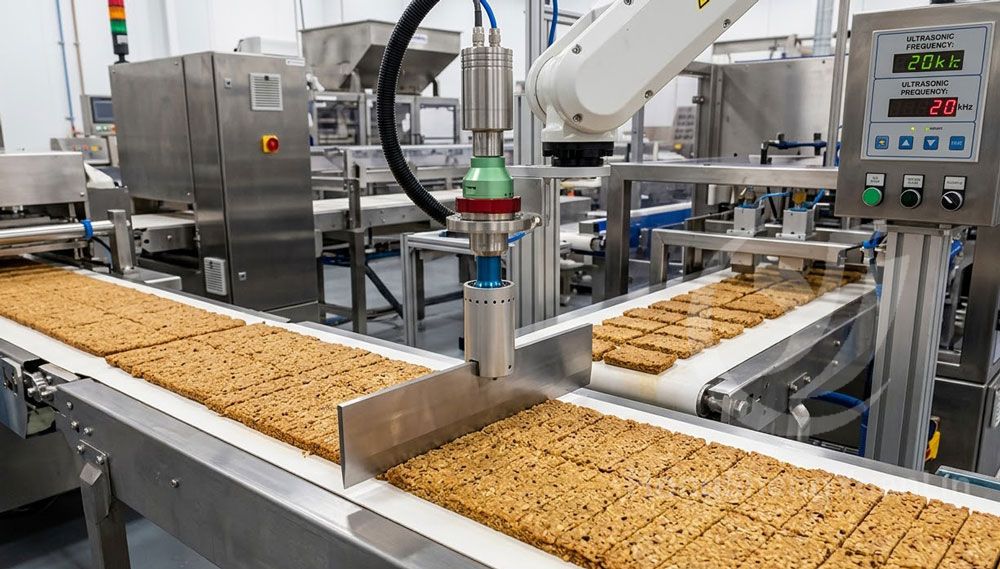
Maintaining the Sterile Standard: Enhancing CIP Cleaning Protocols
Integration into a broader factory layout means the cutting module must align with severe international food safety standards. While standard mechanical racks have tight crevices that harbor listeria and biofilm colonies, modern ultrasonic sonotrodes are crafted from solid-block aviation-grade titanium (Ti-6Al-4V). The surface is completely non-porous.
It is vital that any new cake slicing machinery supports stringent CIP (Clean-In-Place) washdown dynamics to prevent biological cross-contamination risks. The sealing around the ultrasonic converter housing must carry a high Ingress Protection rating (such as IP65 or IP69K), allowing hot foam sanitation protocols to blast the conveyor tracks without causing electrical faults within the delicate piezoelectric acoustic stacks. Ensuring strict compliance with FDA and HACCP contamination control guidelines is non-negotiable when engineering custom cutting heads into wet-wash down environments.
The Factory Floor Audit: 3 Daily Checks for Cake Slicer Reliability
For plant managers transitioning to advanced acoustic slicing, preserving the resonance integrity of the machine ensures zero-defect operations. I strongly advise adopting these three strict verification protocols before initiating the morning production run:
1. Verify Acoustic Resonance Output: Never run the blade through dense frozen materials if the generator displays fluctuating wattage. A healthy 20kHz system should pull stable, minimal baseline wattage when idling in the air. Spontaneous power spikes indicate a cracked titanium blade or loose booster stud.
2. Align the Servo-Driven Conveyor Phasing: The precision of the slice depends entirely on the synchronization between the blade's downward Z-axis plunge and the conveyor belt's X-axis indexing. A micro-delay in the PLC timing code can cause the blade to clip the side of an advancing mousse cake, creating artificial crumbling.
3. Monitor Ambient Staging Temperatures: While ultrasonic blades handle warmer cakes effectively, highly inconsistent staging (e.g., a pallet left out on the dock for 40 minutes before loading) changes the core viscosity mid-run. Ensure your staging buffers keep the pastry locked inside that optimal -5°C thermal window.
Future-Proofing Your High-Volume Bakery Layout
Settling for smeared aesthetics and jagged edges is an outdated compromise in today's precision food manufacturing sector. Transitioning from aggressive mechanical chopping to friction-free acoustic resonance will immediately optimize your payload capacity, protect your raw material margins, and ensure that every single premium dessert shipped looks microscopically perfect.
If your facility is currently losing margin to aggressive blade smearing, or if your blast freezer energy bills are eroding your bottom line, it is time to evaluate a structural production upgrade. We invite production directors and head engineers to send us specific facility blueprints or complex pastry profiles. Our engineering group at HSYL will configure a customized energy-efficiency layout drawing and calculate exactly how an intelligent customized cake production line can streamline your throughput. Partnering with proven leading food production line manufacturers ensures that your next capital expansion is engineered for maximum uptime and absolute geometric perfection.
Frequently Asked Questions
How do ultrasonic titanium blades compare to standard stainless steel when cutting high-fat desserts?
Why does my mousse cake crumble at the bottom sponge layer during automated slicing?
Can an ultrasonic cake cutter slice completely frozen bakery goods?
Must-Read Blogs For Chain Restaurants Owner

 Electric Cooked Meat Slicer
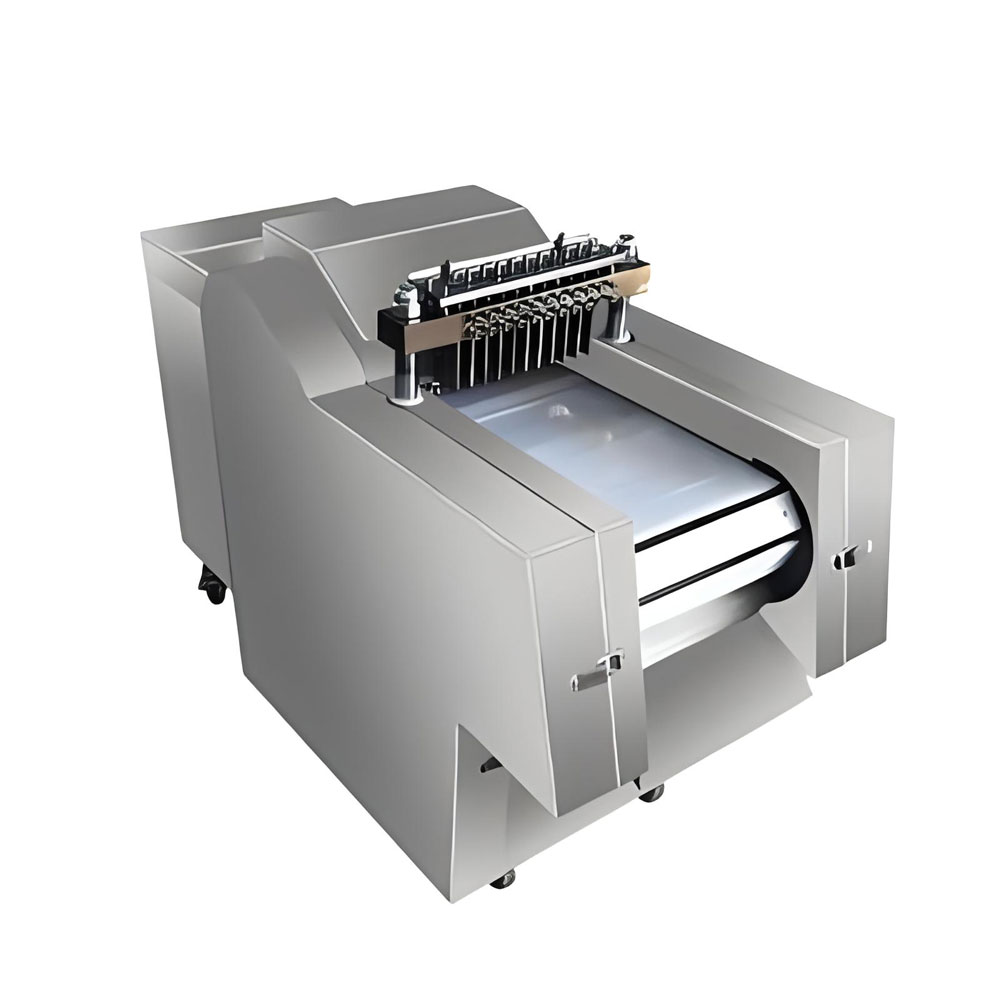 Automatic Chicken Cutting Machine
 Bean Product Production Line
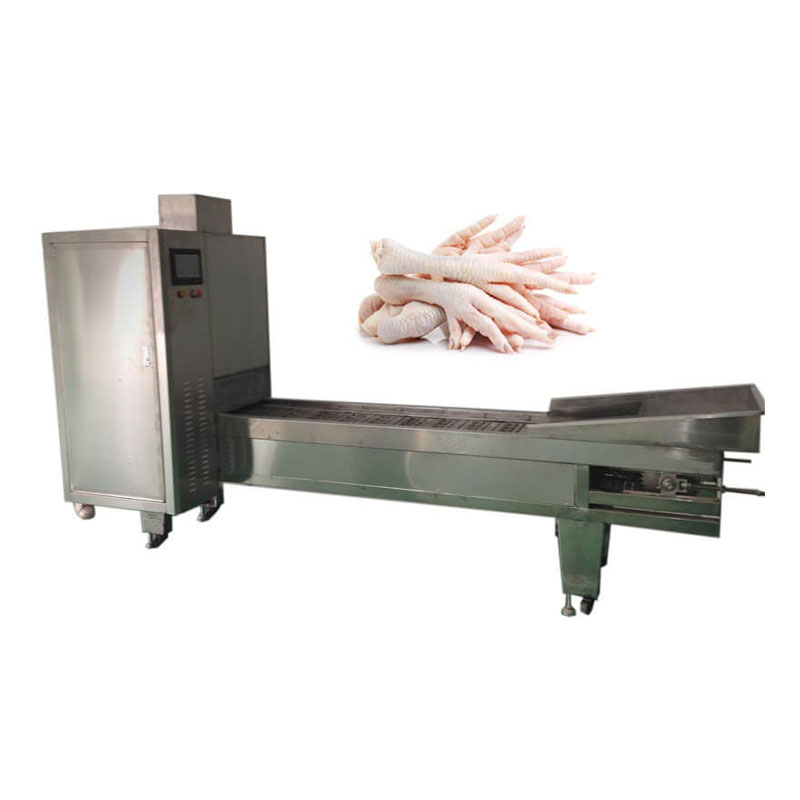 Chicken Feet Cutting Machine
Ready to Get Started?