
Reduce Cake Cutting Waste by 30% | Industrial Yield Guide
- The Giveaway Crisis: A 2-millimeter deviation per slice in an industrial slab cake can silently erode annual profit margins by up to 14%.
- Defeating Deflection: Shifting from outdated pneumatic cylinders to precise servo-driven cutting heads completely eliminates blade deflection on rigid frozen pastries.
- The Vision-Guided Recapture: Integrating active topography 3D scanning prevents edge loss by dynamically adjusting slice parameters to the exact baked dimensions of every individual pan.
As the senior engineering director at HSYL with over 20 years spent debugging and commissioning high-throughput baked goods facilities globally, I have audited plants that mistakenly accepted a 15% to 20% edge trim loss as an unavoidable operational reality. It is not. The moment a commercial bakery scales beyond single-rack artisan batches into multi-shift industrial payload capacities, structural waste becomes the absolute largest financial leak. You invest massive capital in premium proprietary ingredients, vacuum precision mixing, and highly calibrated multi-zone tunnel ovens, only to literally chop away up to a third of your profit margin at the very final slicing stage.
This deep-dive engineering analysis will dissect exactly why legacy mechanical guillotines hemorrhage raw material through structural blade deflection and gross volumetric giveaway. More importantly, we will map out how adopting automated, calculation-driven cutting architectures mathematically guarantees a dramatic and permanent waste reduction for modern food processors.
The Illusion of Automation Accuracy: Why Pneumatic Cylinders Create Massive Volumetric Giveaway
"Volumetric giveaway" is undoubtedly the most dangerous operational metric in commercial baking because it rarely triggers an immediate Quality Control alarm. If your retail packaging explicitly states a net weight of 150 grams per slice, but your slicer regularly cuts at 162 grams to "play it safe" and avoid regulatory under-weight penalties, you are fundamentally giving away 8% of your product for free. Across a daily run of tens of thousands of portions, that accumulates into crippling financial losses.
The Downfall of Compressible Air in Machining
In legacy processing equipment, the downward cutting stroke is almost exclusively powered by unregulated pneumatic air cylinders. From a physics standpoint, forced air is inherently compressible. When a standard steel blade meets aggressive resistance against a dense, chilled layer of brownie base or a frozen fruit matrix, the pneumatic stroke hesitates for a fraction of a millisecond. This pneumatic hesitation allows the cutting blade to drift laterally within the product.
Even a structural drift of just 1.5 millimeters across a 600mm x 400mm commercial baking tray creates entirely asymmetrical wedge slices. The top of the cake measures perfectly, while the bottom base bulges wider. This slight trapezoidal effect forces QC inspectors to either discard the wedge into the rework scrap bin or let an oversized portion pass down the line. Over a fiscal year, eliminating this pneumatic drift is directly proportional to recapturing hundreds of thousands of dollars.
Absolute Rigidity: Defeating Blade Deflection Through Servo-Driven Multi-Axis Systems
To cure the lateral drift problem, the mechanical drive system of the slicer must permanently transition from compressible pneumatics to absolute rigid mechanics. Precision demands electrical exactness.
Closing the Feedback Loop for Impeccable Geometry
By replacing air cylinders with high-torque synchronized servomotors traversing on precision linear ball-screw guideways, the blade executes a mathematically absolute vertical plunge. A servo motor operates on a rapid closed-loop electrical feedback system, constantly reading and reporting its positional encoder thousands of times a second. When the blade encounters sudden internal resistance—such as a baked-in walnut cluster or a deeply frozen layer of caramel—the drive train immediately commands higher electrical torque to push through without deflecting off course.
This servo authority ensures a mechanically true 90-degree cut regardless of the structural resistance of the baked good. Eradicating the trapezoidal wedge effect means every slice on a 64-portion grid is geometrically identical, completely eliminating the need for safety overweight buffers.
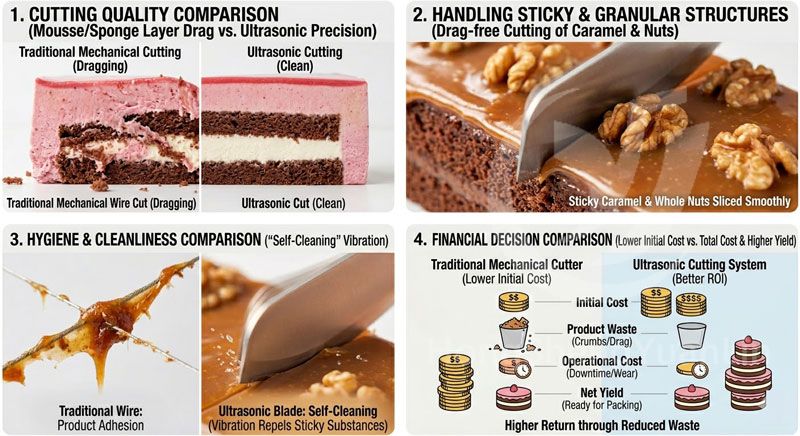
The HSYL Edge Loss Formula: Calculating Your True Financial Scrap Profile
When executing consulting walkthroughs with bakery plant owners, I frequently encounter a psychological blind spot regarding the true financial cost of off-cuts (the crusts and uneven, domed edges arbitrarily trimmed off before retail portioning). Often, accounting teams calculate the waste burden solely based on the raw bulk costs of flour, sugar, and dairy. Structurally, this is an egregious operational error.
The Cumulative Operational Waste (COW) Metric
By the absolute moment the slab cake reaches the slicing station, it has already absorbed intensive direct labor, heavy refrigeration electricity, baking gas inputs, and packaging overhead. I developed the Cumulative Operational Waste (COW) Multiplier to force a highly realistic viewpoint during capital expenditure evaluations.
Cumulative Loss = Total Measured Scrap Weight × (Raw Material Procurement Cost + Process Energy Overhead + Direct Allocated Labor Cost)
If your baking pan leaves a 2cm irregular baked edge that the slicer is programmed to trim, and you are processing 5,000 sheet pans per day, you aren't merely losing cheap batter. You are losing the massive electrical energy consumed running your spiral freezers and firing your tunnel ovens to effectively bake waste. By tightening trimming margins by just 15mm on the horizontal perimeter through precise automated grid alignment, industrial facilities recover a staggering daily volume of highly sellable, premium product.
Vision-Guided Topography: Synchronizing the Blade to the Absolute Reality of the Bake
It is an unavoidable truth in massive scale bakery operations: no two cakes bake absolutely identically. Fluctuating oven drafts, slight pan warping over a lifecycle, and uneven batter viscosity mean center pans might rise 5mm higher and spread wider than corner pans in the exact same rack oven.
Eliminating the Blind Slicing Program
If your automated slicing machine runs on a blind, static numerical grid program, it assumes every single incoming product is a perfect, mathematical rectangle. Because real-world cakes are not perfect rectangles, operators are forced to program excessively wide, conservative trim margins to guarantee that every final portion falls within the pristine 'center cut' zone. This outdated methodology intentionally throws away perfectly good cake edge just to ensure cosmetic safety.
The modern engineering solution we heavily deploy relies on robust 3D optical laser scanning positioned directly upstream of the active cutting head. As the full slab advances on the sanitary conveyor, optical sensors instantly map the true outer perimeter, height, and topography of that specific, unique bake. The onboard industrial PLC then instantly recalculates the X and Y coordinate cutting axes on the fly to maximize the geometric yield for that exact slab. It actively chases the irregular outer edges to secure an extra row of marketable portions that a static program would have blindly categorized as scrap.
Yield Matrix: The Brutal Financial Reality of Equipment Upgrades
When a production team fights for board-level approval to upgrade slicing hardware, engineering managers must present brutal, irrefutable data metrics representing daily savings. Abstract concepts of automation are insufficient; hard material recovery drives the capital expenditure sign-off.
| Critical Operational Yield Metric | Legacy Blind Pneumatic Slicer | Vision-Guided Servo System (HSYL Target Specs) |
|---|---|---|
| Average Imposed Trim Margin | 25mm to 35mm per sheer horizontal edge | 10mm to 12mm (Active tracking prevents over-trim) |
| Tolerated Volumetric Giveaway | +8% to +14% extra weight per portion | < 1.5% (Statistically insignificant loss profile) |
| Total Rework/Scrap Volume | 12% to 18% (Blade deflection and irregular wedge off-cuts) | Consistently < 2.5% (Flawless orthogonal geometry) |
| Operator Safety Exposure Risk | Very High (Constant manual jam clearing and wiping) | Virtually Zero (Automated spacing and washdown) |
Compliance Integration: Marrying Waste Reduction with Ultimate Operator Safety
The core philosophy of food factory modernization dictates that eradicating waste usually synergizes with safety. The operational mandate is incredibly clear: permanently removing human hands from the active cutting matrix eliminates both arbitrary physical waste variables and severe corporate liability.
A fully automated cutting cell wrapped in interlocked polycarbonate transparent safety guarding completely alters the manufacturing plant's risk index. When upgrading your floor out of manual knife constraints or dangerous semi-manual lever slicing, ensuring strict adherence to OSHA machine guarding compliance standards is as structurally critical as any yield metric on your spreadsheet. You engineer the environment to protect the premium pastry from biological contamination, but you ultimately protect the workforce from the extreme traumatic hazards of high-cycle industrial blades acting under heavy torque.
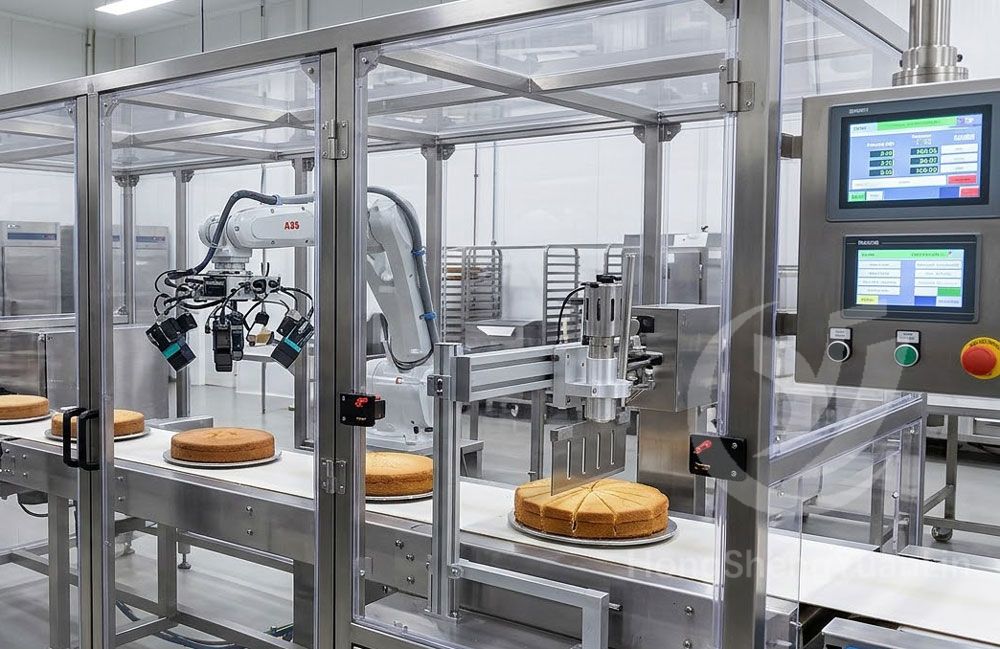
A Plant Manager's Immediate 3-Point Yield Forensic Audit
Before ever drafting an RFQ (Request for Quote) for new slicing machinery, I strongly advise dispatching your line maintenance and Quality Control leads onto the factory floor today to tangibly measure these three stealthy waste vectors:
1. Forensically Weigh the "Perfect" Output Slices: Pull 100 randomly selected finished portions directly off the immediate outfeed belt. If your contractual target net weight is 120g and the actual scale average consistently pulls at 133g, your legacy blade drift is openly stealing your raw mass.
2. Interrogate the End-of-Shift Trim Box Destinies: Pull the massive end-of-shift off-cut and rework bins. Manually sort the actual hardened, burnt, or severely sloped crust from perfectly viable, beautifully layered straight cake edge that was arbitrarily trimmed off solely due to a rigidly blind, conservative static slicing program.
3. Relentlessly Track Blade Re-tensioning and Cleaning Frequency: Record exactly how many individual times per production shift a line technician is forced to pause the belt to adjust, thoroughly wipe, or mechanically true the blade assembly. Every solitary stoppage implicitly signifies a dangerous drift in cutting tolerance, directly causing a cascading accumulation of rejected scrap product downstream.
Future-Proofing Your Yield Margins
Accepting a 20% scrap bin loss as a normal cost of doing bakery business is a deeply archaic, anti-lean mindset that will eventually destroy your competitive pricing leverage. Instead of battling the relentless symptoms of sloppy cuts, you must attack the structural architecture of the bottleneck.
Transitioning comprehensively to integrated, intelligent machinery via automated food production lines permanently locks down your yield metrics into predictable, highly profitable columns. If you are entirely ready to stop indirectly subsidizing the scrap bin with premium ingredients, our systems engineering department is ready to mathematically analyze your current trim metrics. Send us your daily extrusion and yield data logs, and we will forensically model exactly how a perfectly integrated, customized cake production line will systematically erase your volumetric giveaway and violently rescue your ultimate profit margin.
Frequently Asked Questions
What is volumetric giveaway in cake manufacturing?
How much money can a vision-guided cake slicer save an industrial bakery?
Why are servo-driven slicers better than pneumatic cake slicers?
Must-Read Blogs For Chain Restaurants Owner

 Automatic Chicken Cutting Machine
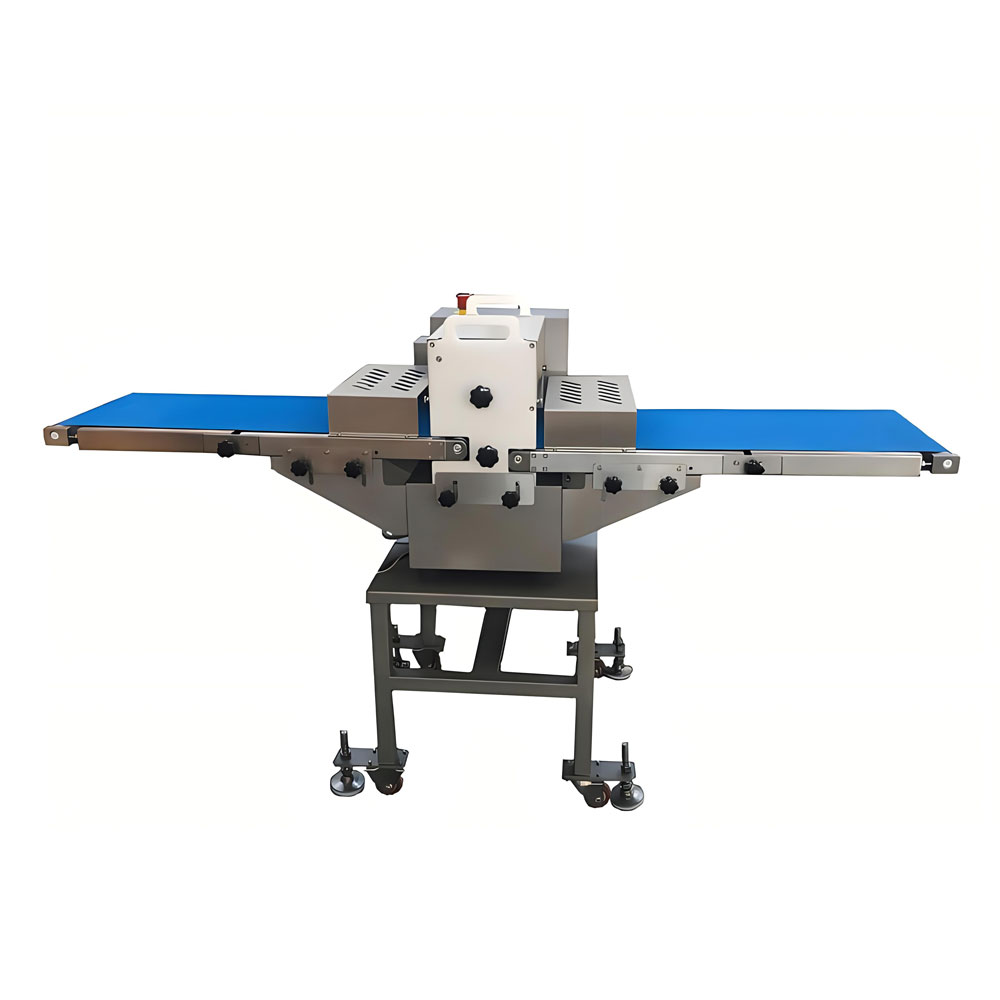 Fresh Meat Slicing Portioning Machine
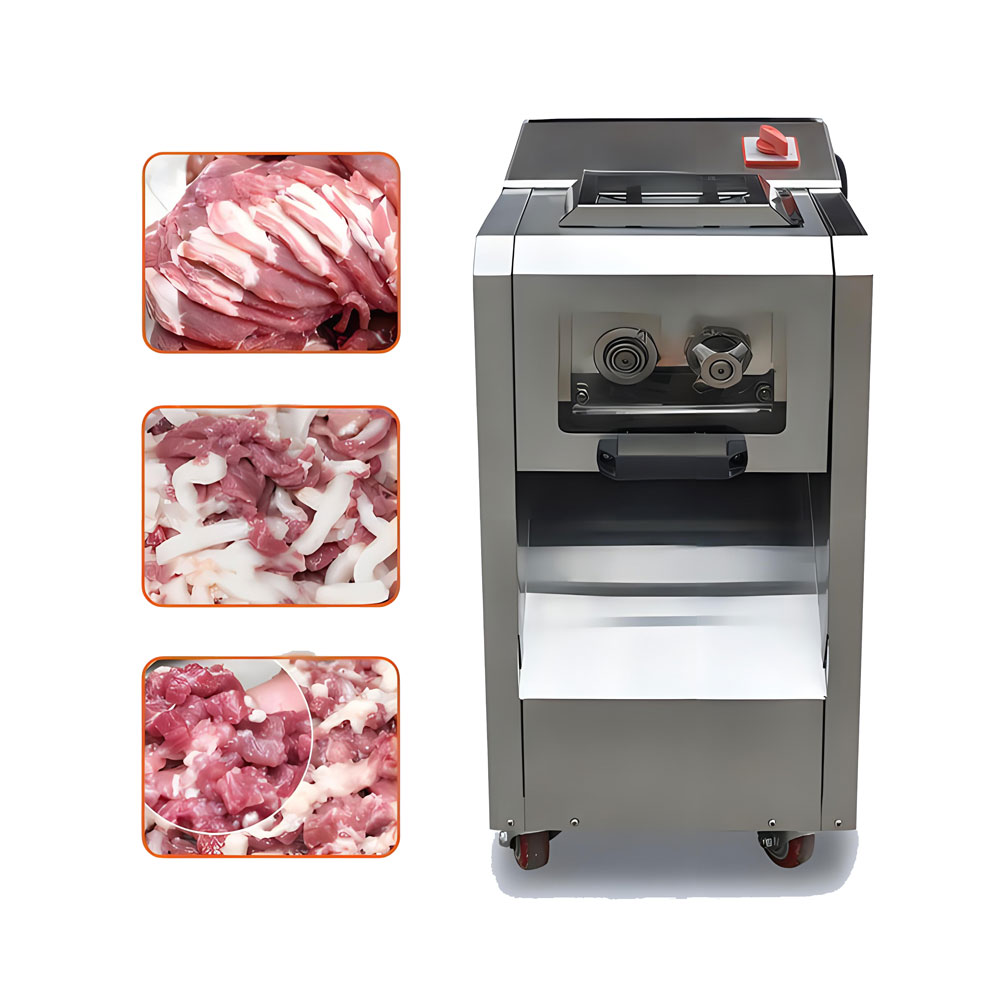 Frozen Meat Cutting Machine
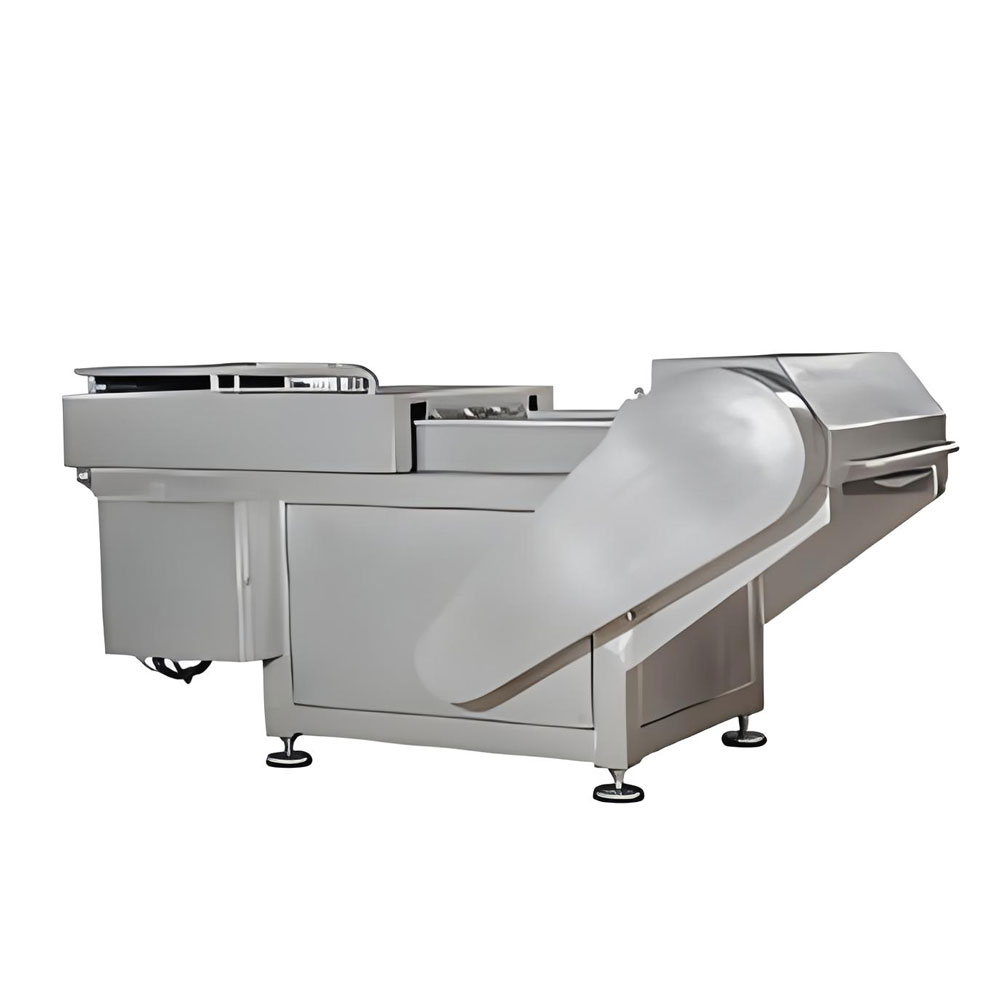 Industrial Frozen Meat Slicing Machine
Ready to Get Started?