
Difference between Tinplate Cans and Glass Jar Vacuum Sealing
In industrial food and beverage packaging, vacuum sealing is not a marginal detail—it is a core process that directly affects shelf life, product safety, production efficiency, and long-term operating cost. The difference between tinplate cans and glass jar vacuum sealing is therefore a critical decision point for factory owners, production managers, and engineering teams designing or upgrading packaging lines.
Both tinplate cans and glass jars are mature, widely adopted packaging formats. Each has its own sealing mechanics, equipment architecture, hygiene considerations, and operational trade-offs. In real factories, the choice is rarely aesthetic; it is driven by product characteristics, thermal process requirements, logistics constraints, regulatory compliance, and total cost of ownership across years of operation.
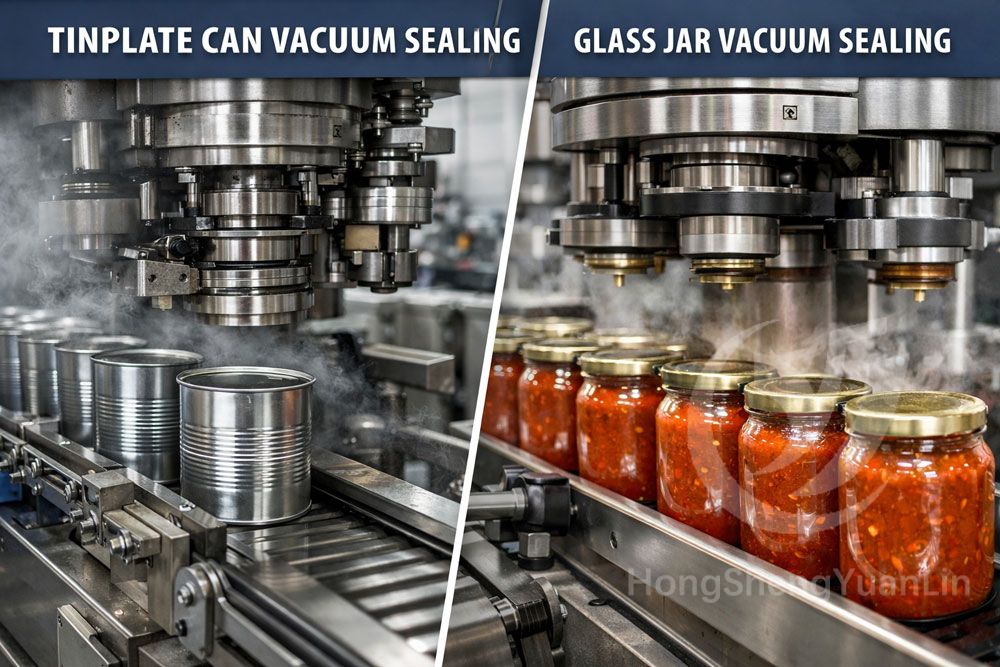
This article examines the difference between tinplate cans and glass jar vacuum sealing from an engineering and production perspective. It is written for industrial buyers who need to understand how these systems actually perform on the factory floor, how they integrate into automated lines, and how they impact yield, labor, scalability, and compliance in real-world manufacturing environments.
Understanding Tinplate Can and Glass Jar Vacuum Sealing Systems
To evaluate the difference between tinplate cans and glass jar vacuum sealing, it is essential to understand how each system achieves vacuum and hermetic closure within an industrial production line.
Tinplate Can Vacuum Sealing: How It Works
Tinplate cans are typically sealed using a double seaming process. The vacuum is created either mechanically or thermally during seaming, depending on product and line configuration.
In most food canning lines, vacuum is achieved through:
Steam injection before seaming, displacing air inside the can
Mechanical vacuum chambers integrated into the seamer
Heat-induced vacuum formation during retorting and cooling
The double seamer mechanically interlocks the can body flange and the lid curl into a hermetic seal consisting of multiple compressed metal layers. This seal is highly resistant to internal pressure changes, making it suitable for high-temperature retort processing.
From an engineering standpoint, tinplate vacuum sealing is a high-speed, mechanically robust process optimized for continuous, large-volume production.
Glass Jar Vacuum Sealing: How It Works
Glass jar vacuum sealing relies on a lug cap or twist-off cap system combined with thermal vacuum formation. The process generally follows these steps:
Product filling into glass jars
Application of caps with controlled torque
Heat treatment (hot filling, pasteurization, or sterilization)
Vacuum formation during cooling as internal pressure drops
The seal integrity depends on:
Cap liner material and compression
Glass finish tolerances
Accurate torque control during capping
Unlike metal double seams, glass jar seals are elastomer-based and rely on precise mechanical adjustment and thermal conditions to maintain long-term vacuum.
From a production perspective, glass jar vacuum sealing is more sensitive to variability in materials, temperature, and handling.
Core Industry Problems Addressed by Vacuum Sealing
When evaluating the difference between tinplate cans and glass jar vacuum sealing, buyers should consider how each system addresses key production challenges common across food and beverage manufacturing.
Labor Cost and Automation Efficiency
Tinplate can lines are typically designed for high automation and minimal manual intervention. Modern canning lines integrate depalletizing, rinsing, filling, seaming, retorting, labeling, and packing into continuous systems with low labor per unit output.
Glass jar lines, while also automated, often require:
More careful handling to prevent breakage
Additional inspection steps for cracks or chips
Slower changeovers due to cap and jar variations
As labor costs rise, especially in developed markets, the automation advantage of tinplate can vacuum sealing becomes more pronounced in high-volume operations.
Yield Loss and Product Waste
Yield loss can occur due to seal defects, container damage, or process instability.
Tinplate cans offer:
Low deformation risk
High tolerance to thermal stress
Minimal breakage-related waste
Glass jars are more vulnerable to:
Breakage during conveying or thermal processing
Seal failures due to cap or liner inconsistencies
Higher rejection rates if handling is not optimized
In practice, factories with aggressive throughput targets often see lower overall yield loss with tinplate cans.
Hygiene and Food Safety Risks
From a hygienic design standpoint, both systems can meet strict food safety standards, but they do so differently.
Tinplate can systems:
Use fully enclosed metal containers
Are compatible with aggressive CIP/SIP protocols
Minimize micro-leak risks when seam integrity is well controlled
Glass jar systems:
Rely on elastomer liners that must maintain elasticity over time
Require strict control of glass cleanliness and finish quality
Are more sensitive to particulate contamination on sealing surfaces
In high-risk products such as meat, seafood, or low-acid foods, the sealing robustness of tinplate cans is often preferred.
Product Consistency and Shelf Stability
Vacuum consistency directly affects oxygen levels, oxidation, and microbial growth.
Tinplate cans typically deliver:
Highly consistent vacuum levels
Excellent oxygen barrier properties
Long shelf life even in challenging distribution conditions
Glass jars provide:
Good visibility and premium perception
Slightly higher oxygen permeability at the seal interface
Greater dependency on cap and liner quality for long-term stability
This difference is particularly relevant for export-oriented manufacturers with extended supply chains.
Scalability and Future Expansion
Scalability is a strategic consideration. Tinplate can vacuum sealing lines are inherently modular and can be expanded by:
Adding parallel seamers
Increasing retort capacity
Upgrading conveying and accumulation systems
Glass jar lines can scale as well, but expansion often requires:
Larger floor space due to handling buffers
Additional breakage mitigation systems
More complex cap and jar logistics
For factories planning multi-shift, high-volume production, scalability often favors tinplate solutions.
Key Technical Differences from an Engineering Perspective
The difference between tinplate cans and glass jar vacuum sealing becomes most evident when examining core technical parameters.
Seal Integrity and Mechanical Strength
Tinplate double seams are metal-to-metal structures with defined overlap, thickness, and compression values. They are measurable, inspectable, and highly repeatable.
Glass jar seals rely on:
Elastic deformation of liners
Consistent torque application
Uniform glass finish dimensions
From a quality assurance standpoint, double seams offer more objective inspection criteria and lower variability.
Thermal Process Compatibility
Tinplate cans are optimized for:
High-temperature retorting
Rapid pressure changes
Long sterilization cycles
Glass jars can also be retorted, but require:
Slower heating and cooling curves
Careful pressure balancing to prevent breakage
Higher energy input per unit
This impacts not only safety but also energy efficiency and cycle time.
Line Speed and Throughput
Industrial tinplate can lines commonly operate at:
200–600+ cans per minute per lane
Continuous operation with minimal stoppages
Glass jar lines typically run at:
Lower speeds due to handling constraints
More frequent micro-stoppages related to jams or inspections
For large-scale processors, this difference directly affects cost per unit.
Typical Industrial Applications and Production Scenarios
In real factories, the choice between tinplate cans and glass jar vacuum sealing is often product-driven.
Tinplate cans are widely used for:
Canned meat and poultry
Seafood and fish products
Vegetables and legumes
Ready meals and soups
Pet food and industrial food ingredients
Glass jars are commonly used for:
Sauces, jams, and condiments
Pickled vegetables
Premium or artisanal food products
Products requiring visual appeal
Many manufacturers operate both systems in parallel, using tinplate for volume-driven SKUs and glass for premium lines.
Capacity Options and Selection Guidance
Selecting between these systems requires realistic throughput planning.
Key considerations include:
Target hourly and daily output
Available factory space and layout
Product changeover frequency
Future SKU expansion plans
For tinplate can vacuum sealing, buyers should evaluate:
Seamer head count and configuration
Retort or sterilizer capacity matching
Accumulation and buffering design
For glass jar vacuum sealing, buyers should focus on:
Capper torque accuracy and repeatability
Glass handling and conveying design
Inspection systems for cracks and seal defects
A common mistake is undersizing the sealing or thermal process stage, which creates bottlenecks downstream.
Buyer Benefits and Long-Term ROI Considerations
From a total cost of ownership perspective, the difference between tinplate cans and glass jar vacuum sealing is not limited to initial equipment price.
Tinplate can systems often deliver:
Lower labor cost per unit
Higher uptime and OEE
Lower packaging loss
Longer shelf life and broader distribution reach
Glass jar systems offer:
Higher perceived product value
Strong brand differentiation
Flexibility for small-batch or premium products
The optimal choice depends on whether the business model prioritizes volume efficiency or market positioning.
Customization, Integration, and Engineering Support
No two factories are identical. In practice, both tinplate and glass jar vacuum sealing systems require customization.
This may include:
Integration with upstream filling systems
Matching sterilization or pasteurization processes
Adapting to existing conveyors or utilities
Designing for specific hygiene zoning requirements
Experienced manufacturers collaborate closely with customer engineering teams to adapt sealing technology to real process constraints rather than forcing standard layouts.
Standards, Certifications, and Compliance Requirements
Both systems can be designed to meet international standards when properly engineered.
Common requirements include:
CE conformity for machinery safety
HACCP-aligned hygienic design
ISO 9001 manufacturing and quality control
FDA-oriented food contact and sanitation principles
For export-oriented producers, documentation, validation, and traceability are as important as mechanical performance.
Conclusion: Choosing the Right Vacuum Sealing Technology
Understanding the difference between tinplate cans and glass jar vacuum sealing is essential for making informed, long-term production decisions. Each system has clear strengths, limitations, and ideal use cases. The right choice depends on product characteristics, throughput targets, hygiene requirements, and strategic growth plans.
For manufacturers evaluating new lines or upgrades, early-stage process discussion, realistic capacity matching, and engineering collaboration are critical. A well-selected vacuum sealing system does more than close a container—it stabilizes production, protects product value, and supports sustainable factory operations over years of service.
Frequently Asked Questions
Is vacuum level more stable in tinplate cans than glass jars?
Which packaging is better for high-temperature sterilization?
Does glass jar vacuum sealing require more maintenance?
Can both systems be integrated into automated lines?
Which option has lower packaging loss?
Is glass jar sealing suitable for large-scale production?
How does container choice affect export logistics?
Must-Read Blogs For Chain Restaurants Owner

 YL-W-01 Commercial Water Purification Equipment
 Meat Processing Line Equipment
 Industrial Microwave Drying Machine
 YL-W-06 Commercial Water Purification Equipment
Ready to Get Started?