
Commercial Kitchen Galvanic Corrosion: Dissimilar Metals, Galvanic Series and Isolation
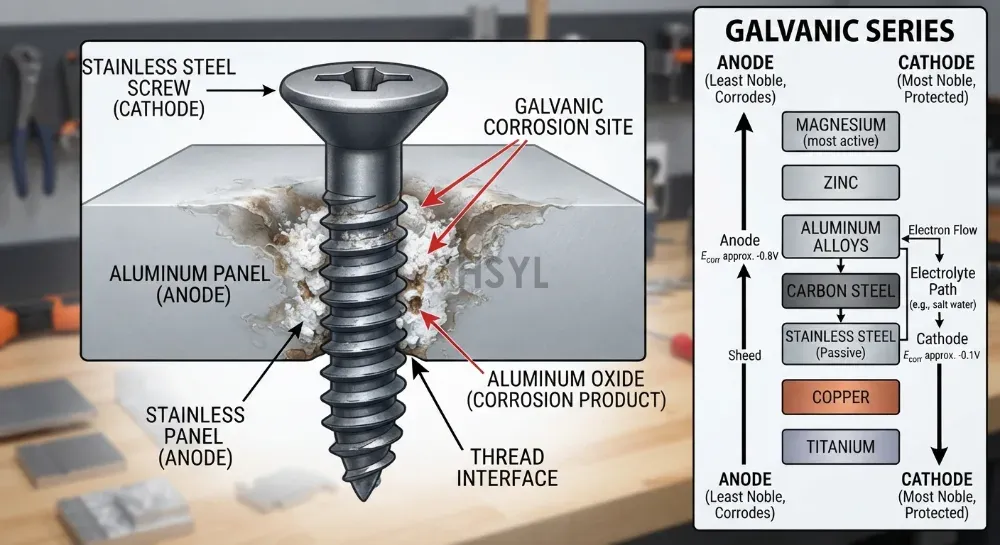
Galvanic corrosion in commercial kitchen equipment is the electrochemical corrosion that happens when two dissimilar metals touch in the presence of an electrolyte — water, food brine, cleaning solution. The more active metal becomes the anode and corrodes; the more noble metal becomes the cathode and is protected. A stainless screw in an aluminum panel, a brass fitting on a steel pipe, a galvanized bracket on a stainless frame — each is a galvanic pair that will corrode in a wet kitchen. The galvanic series ranks metals from active to noble; the contact pair rules say which combinations are allowed and which are forbidden; the isolation methods break the contact when the pair cannot be avoided. This article provides the galvanic series, the contact pair matrix, and the isolation method framework for kitchen equipment.
The scope covers galvanic corrosion between dissimilar metals in commercial kitchen equipment. It covers galvanic series, contact pairs, area ratio, and isolation. It does not cover stainless grade selection (covered in CK-01) or fastener selection (covered in CK-P1-16). A compliant commercial kitchen equipment solution specifies contact pair rules and isolation methods per joint.
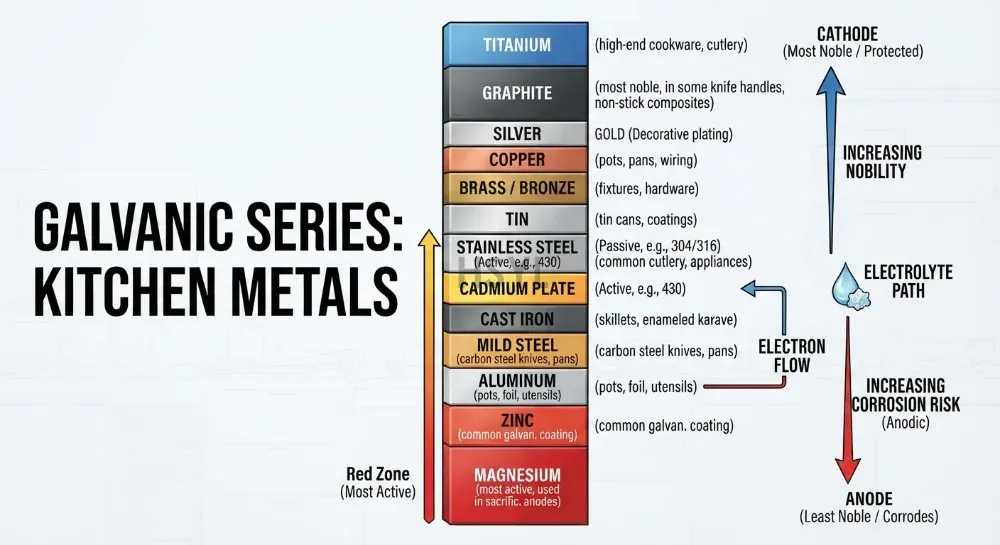
The Galvanic Series for Kitchen Metals
The galvanic series ranks metals from most active (anode, corrodes first) to most noble (cathode, protected). In a galvanic pair, the active metal corrodes. The further apart two metals are in the series, the faster the active one corrodes.
| Rank (active → noble) | Metal | Typical kitchen use | Relative position |
|---|---|---|---|
| 1 (most active) | Zinc (galvanized coating) | Galvanized brackets, ducts | Anode — corrodes first |
| 2 | Aluminum (3003, 6061) | Trims, panels, hoods | Active |
| 3 | Carbon steel (uncoated) | Structural frames, legs | Active |
| 4 | Brass (Cu-Zn) | Fittings, valves (water) | Mid |
| 5 | Copper | Water lines (some) | Mid-noble |
| 6 | 304 stainless (passive) | Standard food-contact grade | Noble |
| 7 | 316 stainless (passive) | Aggressive food contact | Noble |
| 8 (most noble) | Titanium, graphite | Specialty, gaskets | Cathode — protected |
The series depends on the electrolyte — in salt water (brine, sea food), the differences are larger; in fresh water, smaller. A 304-to-316 pair is close enough to be safe; a zinc-to-stainless pair is far apart and will corrode the zinc rapidly.
Contact Pair Matrix
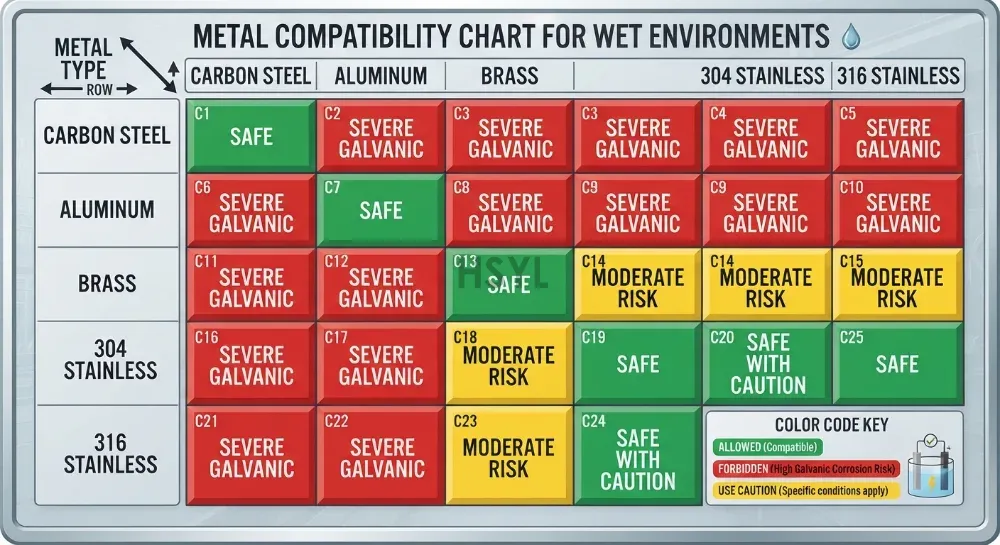
The contact pair matrix says which metal pairs are allowed (close in the series) and which are forbidden (far apart). Forbidden pairs require isolation or material substitution.
| Pair | Relative gap | Status | Action |
|---|---|---|---|
| 304 ↔ 316 | Small | Allowed | No isolation needed; both noble |
| 304 ↔ 430 | Small-mid | Allowed (with caution) | Acceptable in dry; isolate in wet |
| Stainless ↔ Brass | Mid | Caution | Isolate in wet; brass is fitting-only |
| Stainless ↔ Carbon steel | Mid-large | Forbidden in wet | Isolate or substitute; carbon steel rusts |
| Stainless ↔ Aluminum | Large | Forbidden | Isolate (gasket/coating); aluminum corrodes |
| Stainless ↔ Galvanized (zinc) | Very large | Forbidden | Substitute galvanized with stainless or coat |
| Aluminum ↔ Copper | Mid | Caution | Isolate in wet; aluminum corrodes |
Material note: The contact pair matrix is a starting point, not a universal spec. The electrolyte (water chemistry, salt, acid), the area ratio, and the temperature all shift the boundary. A pair that is "caution" in a dry kitchen may be "forbidden" in a seafood kitchen with brine. Document the contact pair per joint in the equipment specification.
Area Ratio and Isolation
The area ratio — the ratio of cathode area to anode area — determines how fast the anode corrodes. A small anode (e.g., a carbon steel fastener) touching a large cathode (e.g., a stainless panel) corrodes fast, because the small anode carries all the galvanic current. A large anode (e.g., a steel frame) touching a small cathode (e.g., a stainless screw) corrodes slower. This is why fastener galvanic pairs are the most dangerous — the fastener is the small anode.
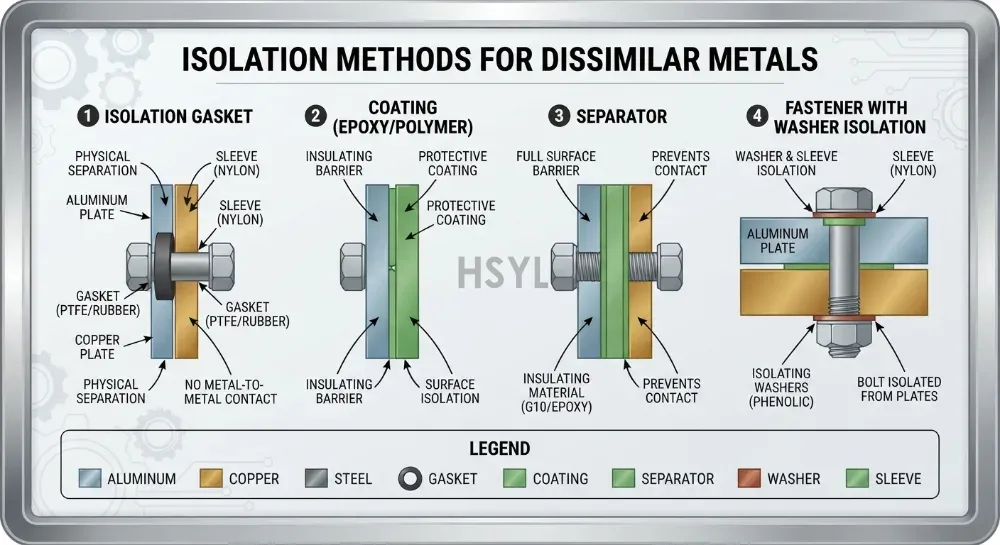
Isolation breaks the galvanic contact. Three methods are common:
- Isolation gasket. A non-conductive gasket (EPDM, PTFE, nylon) between the two metals. Used for panel-to-panel and fitting-to-panel joints.
- Coating. A coating (epoxy, powder, paint) on one or both metals. Used for structural joints where a gasket is not practical. The coating must be intact — a scratch exposes the metal and creates a galvanic cell.
- Isolating fastener. A fastener with isolating washer and sleeve ( nylon, PTFE). Used where a stainless fastener must hold a dissimilar metal panel.
The commercial electromagnetic cooker and the single tank electric fryer both use stainless bodies — the galvanic risk is at the fasteners, fittings, and brackets. A stainless screw in a stainless panel is safe; a stainless screw in an aluminum bracket needs an isolating washer.
Scope, Sources and Limitations
Scope. This article covers galvanic corrosion between dissimilar metals in commercial kitchen equipment. It covers galvanic series, contact pairs, area ratio, and isolation. It does not cover stainless grade selection or fastener selection.
Limitations. All galvanic series and contact pair rules are drawn from publicly available corrosion engineering material. Actual contact pair evaluation depends on electrolyte chemistry, temperature, area ratio, and equipment design. HSYL does not publish project-specific isolation specifications without verified evidence.
Source basis. Galvanic series and contact pair principles are consistent with ASTM G82 (galvanic corrosion) and ASM corrosion engineering reference.
Galvanic Corrosion Resources
Three resources complement this galvanic corrosion content. The kitchen solutions page carries the full scope. The electromagnetic cooker page carries a stainless-body equipment example. The fryer page carries another stainless-body example. The stainless steel selection article (CK-01) and the fastener selection article (CK-P1-16) carry the related material and fastener specifications.
- Commercial kitchen equipment solution — the full kitchen scope where contact pair and isolation rules apply.
- Commercial electromagnetic cooker — a stainless-body equipment with galvanic risk at fasteners and brackets.
- Single tank single basket electric fryer — a stainless-body equipment with galvanic risk at fittings and brackets.
Next Step: Audit Your Kitchen Contact Pairs
Send HSYL your equipment list, contact pair locations, current material combinations, and electrolyte conditions (water, brine, acid). HSYL will return a pre-filled contact pair matrix with allowed/forbidden status for your joints and an isolation specification template for your equipment.
Frequently Asked Questions
What is galvanic corrosion and why does it matter in commercial kitchen equipment?
Which metal contact pairs are forbidden in commercial kitchen equipment?
What is the area ratio effect in galvanic corrosion?
How do I isolate dissimilar metals in kitchen equipment?
Can HSYL specify the contact pair and isolation for every joint in my kitchen equipment?
Must-Read Blogs For Chain Restaurants Owner

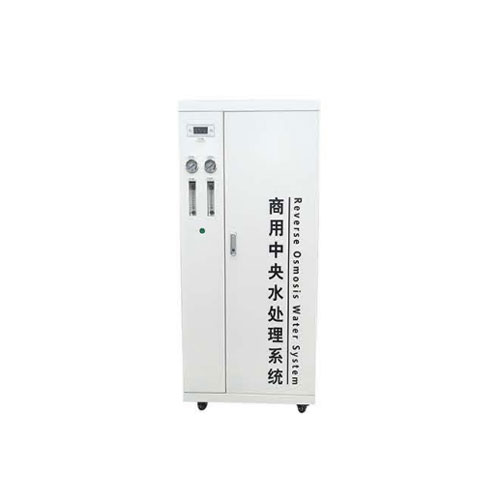 YL-W-06 Commercial Water Purification Equipment
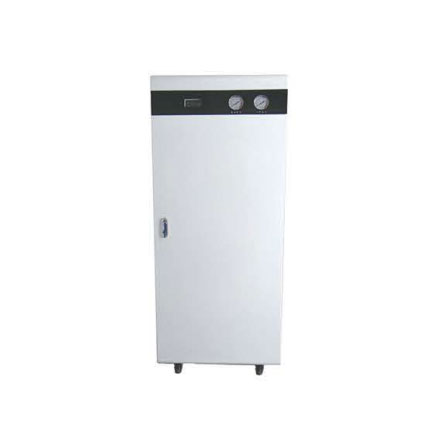 YL-W-05 Commercial Water Purification Equipment
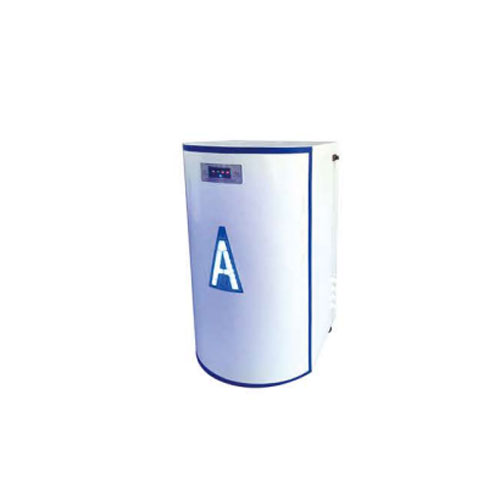 YL-W-04 Commercial Water Purification Equipment
 YL-W-03 Commercial Water Purification Equipment
Ready to Get Started?