
Commercial Kitchen Gasket and Seal Selection: Food-Grade Silicone, EPDM, NBR and FKM
The gasket on a commercial kitchen steamer, fryer, fridge, or sink is not a generic rubber strip — it is a material engineered for a specific temperature, a specific food medium, and a specific cleaning chemical. Silicone handles high heat and food contact; EPDM handles steam and cleaning chemicals; NBR handles fat and oil; FKM handles aggressive chemicals and high temperature. A gasket that is right for a steamer will fail in a fryer; a gasket that is right for a fridge will swell in a sink drain. Specifying one elastomer for the whole kitchen is either under-specifying where a higher-grade is needed, or over-spending where a lower-grade would do. This article compares the four elastomers, maps each to the kitchen application where it fits, and lists the gasket failure modes to avoid.
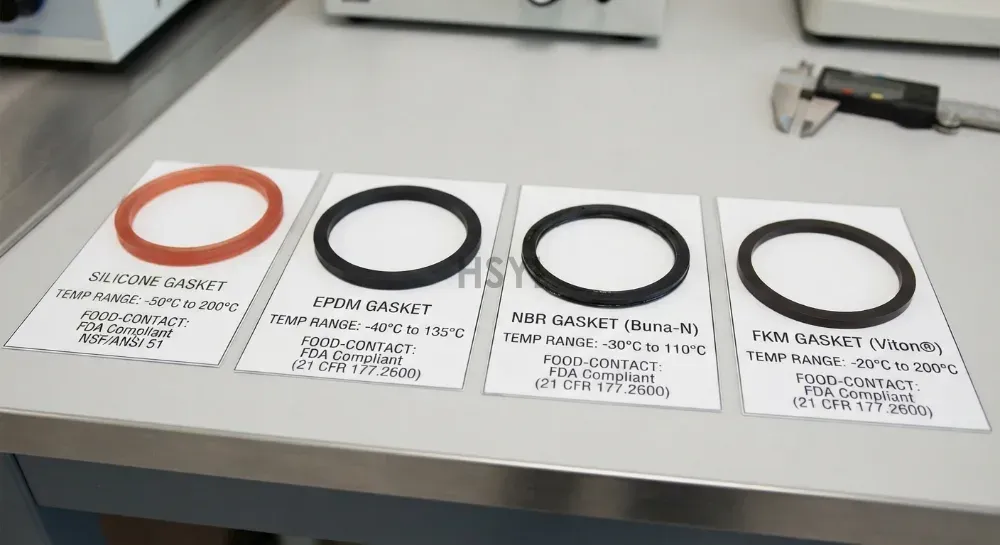
The scope covers gasket and seal selection for commercial kitchen equipment. It covers elastomer types, temperature ranges, food-contact compliance, and chemical resistance. It does not cover stainless grade selection (covered in CK-01), heat source, or CIP cleaning. A compliant commercial kitchen equipment solution specifies gasket material by application, not a single elastomer for the whole kitchen.
Four Elastomers and Their Properties
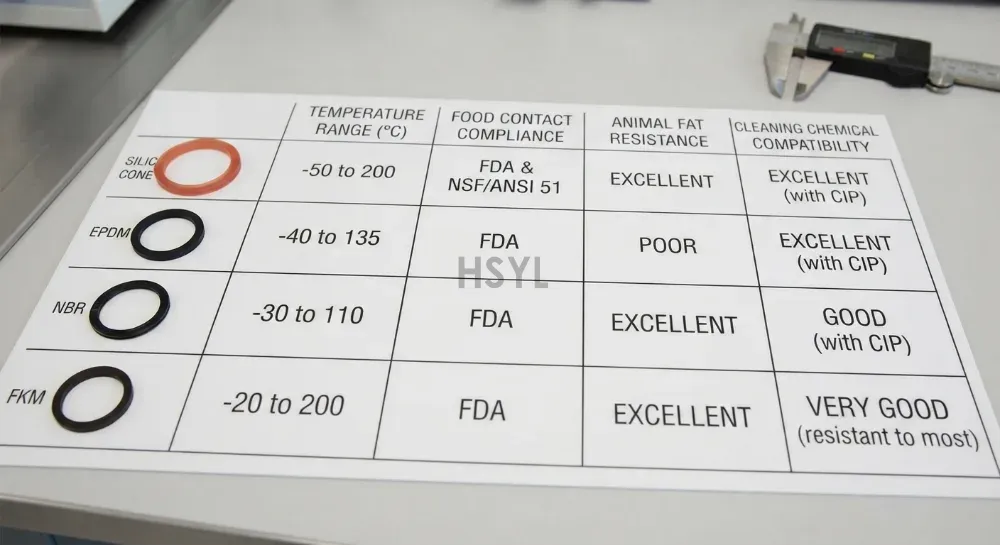
The four elastomers differ in temperature range, food-contact compliance, fat resistance, and cleaning chemical resistance. The differences drive which gasket goes where.
| Elastomer | Temp range (°C) | Food contact | Fat/oil resistance | Cleaning chemical | Relative cost |
|---|---|---|---|---|---|
| Silicone (VMQ) | -50 to +230 | Yes — FDA 21 CFR 177.2600 | Poor — swells in fat | Good — mild detergent | Medium |
| EPDM | -40 to +150 | Yes — FDA 21 CFR 177.2600 | Poor — swells in oil | Excellent — strong detergent, acid, base | Lower |
| NBR (nitrile) | -30 to +120 | Yes — FDA 21 CFR 177.2600 (specific grades) | Excellent — fat and oil | Good — mild detergent; poor in strong acid | Lower |
| FKM (Viton) | -20 to +200 | Limited — only specific grades | Excellent — fat, oil, fuel | Excellent — strong acid, base, solvent | Higher |
The temperature range is the key number — a steamer gasket at 130°C cannot use NBR (limit 120°C); a fryer gasket at 180°C cannot use EPDM (limit 150°C). The food-contact compliance is non-negotiable for any gasket that touches food. FDA 21 CFR 177.2600 is the U.S. food-contact rubber standard; EU 1935/2004 is the EU equivalent.
Application-by-Elastomer Map
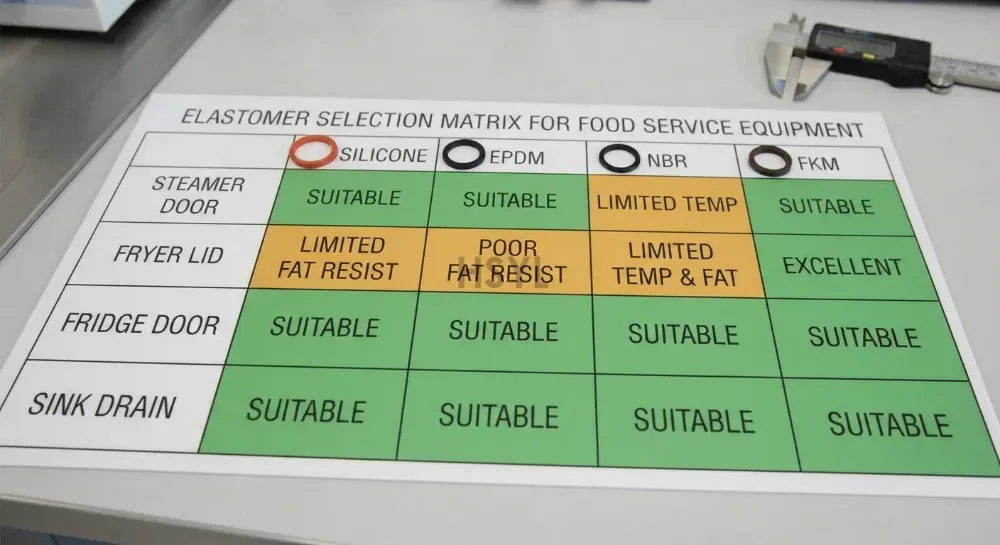
The table below maps kitchen applications to the appropriate elastomer, based on the temperature, the food medium, and the cleaning protocol.
| Application | Conditions | Recommended elastomer | Rationale |
|---|---|---|---|
| Steamer door gasket | Steam at 100–130°C, food contact, frequent cleaning | Silicone or EPDM | Silicone for high temp; EPDM if steam + strong cleaner |
| Fryer lid gasket | Oil at 170–190°C, fat contact | FKM (or high-temp silicone) | FKM handles oil + high temp; silicone if food-contact cert required |
| Refrigerator door gasket | Cold at -5 to +5°C, food contact, condensation | EPDM or silicone | Both handle cold; EPDM for cleaning chemical resistance |
| Oven door gasket | Hot air at 150–250°C, food splatter | Silicone or FKM | Silicone for food contact + temp; FKM for aggressive soil |
| Sink drain gasket | Water at 20–80°C, food soil, detergent | EPDM | EPDM handles water + detergent; not for fat |
| Mixer bowl seal | Food contact, fat, intermittent cleaning | NBR (or EPDM) | NBR for fat resistance; EPDM if no fat |
Material note: The application-by-elastomer map is a starting point, not a universal spec. Local regulation, specific food chemistry, and cleaning concentration may shift the boundary. A gasket in a coastal kitchen exposed to salt spray may need FKM where an inland kitchen uses EPDM. Document the gasket material per application in the equipment specification.
Gasket Failure Modes
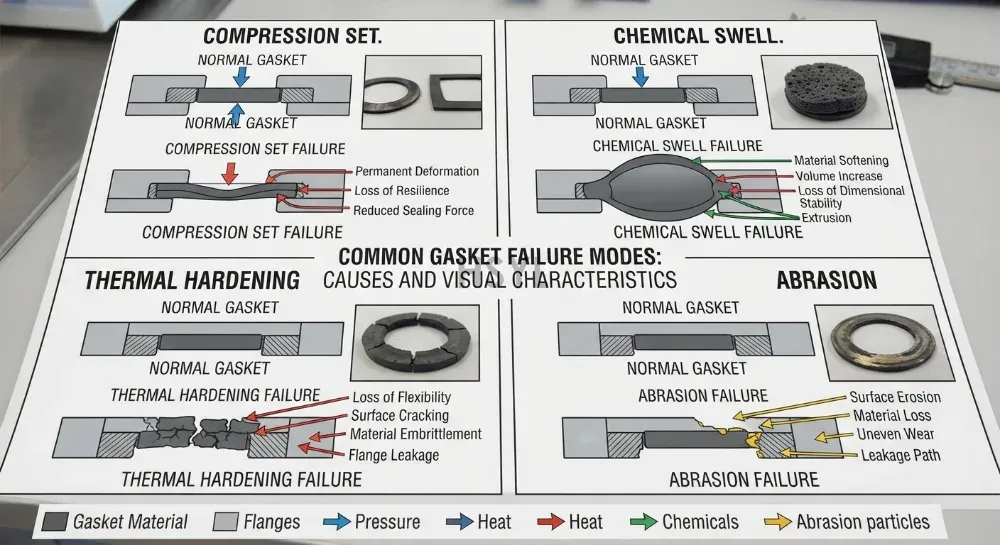
Four gasket failure modes are common in kitchen equipment. Each has a cause and a correction.
| Failure mode | Cause | Correction |
|---|---|---|
| Compression set | Gasket does not return to shape after compression; age, heat, wrong material | Select material with low compression set; replace on schedule |
| Chemical swell | Gasket absorbs oil or solvent, swells and softens; wrong material for medium | Match elastomer to medium (NBR/FKM for fat, not silicone) |
| Thermal hardening | Gasket hardens and cracks at high temp; material exceeds temp limit | Select material within temp range (silicone/FKM for high temp) |
| Abrasion/wear | Gasket abraded by friction or compression cycle; wrong hardness or design | Select correct hardness (Shore A 50–70); design for even compression |
The double-door steaming cabinet and the double-door sterilizer both have door gaskets that seal steam or hot air at 100–130°C. Silicone is the standard for these — it handles the temperature, is food-contact compliant, and resists compression set over many door cycles.
Scope, Sources and Limitations
Scope. This article covers gasket and seal selection for commercial kitchen equipment. It covers elastomer types, temperature ranges, food-contact compliance, and chemical resistance. It does not cover stainless grade selection, heat source, or CIP cleaning.
Limitations. All elastomer properties and application recommendations are drawn from publicly available material engineering and food-safety material. Actual gasket selection depends on local regulation, specific food chemistry, cleaning protocol, and equipment design. HSYL does not publish project-specific gasket specifications without verified evidence.
Source basis. Elastomer properties are consistent with ASTM D2000 (rubber classification), FDA 21 CFR 177.2600 (food-contact rubber), EU 1935/2004 (food-contact materials), and EHEDG hygienic design guidelines.
Gasket and Seal Resources
Three resources complement this gasket content. The kitchen solutions page carries the full scope. The steaming cabinet page carries a steam-door gasket example. The sterilizer page carries a hot-air gasket example.
- Commercial kitchen equipment solution — the full kitchen scope where gasket-by-application specification applies.
- Double-door steaming cabinet — a steam-door gasket application.
- Double-door sterilizer — a hot-air gasket application.
Next Step: Map Your Kitchen Gaskets
Send HSYL your equipment list, gasket locations, temperature range, food medium, and cleaning chemical. HSYL will return a pre-filled application-by-elastomer map with material and temp range for your applications and a gasket specification template for your equipment.
Frequently Asked Questions
Which gasket material is best for a commercial kitchen steamer door?
Can I use the same gasket material for a fryer and a steamer?
What is FDA 21 CFR 177.2600 and why does it matter for kitchen gaskets?
How do I know if a gasket is failing due to compression set or chemical swell?
Can HSYL specify the gasket material for every application in my kitchen?
Must-Read Blogs For Chain Restaurants Owner

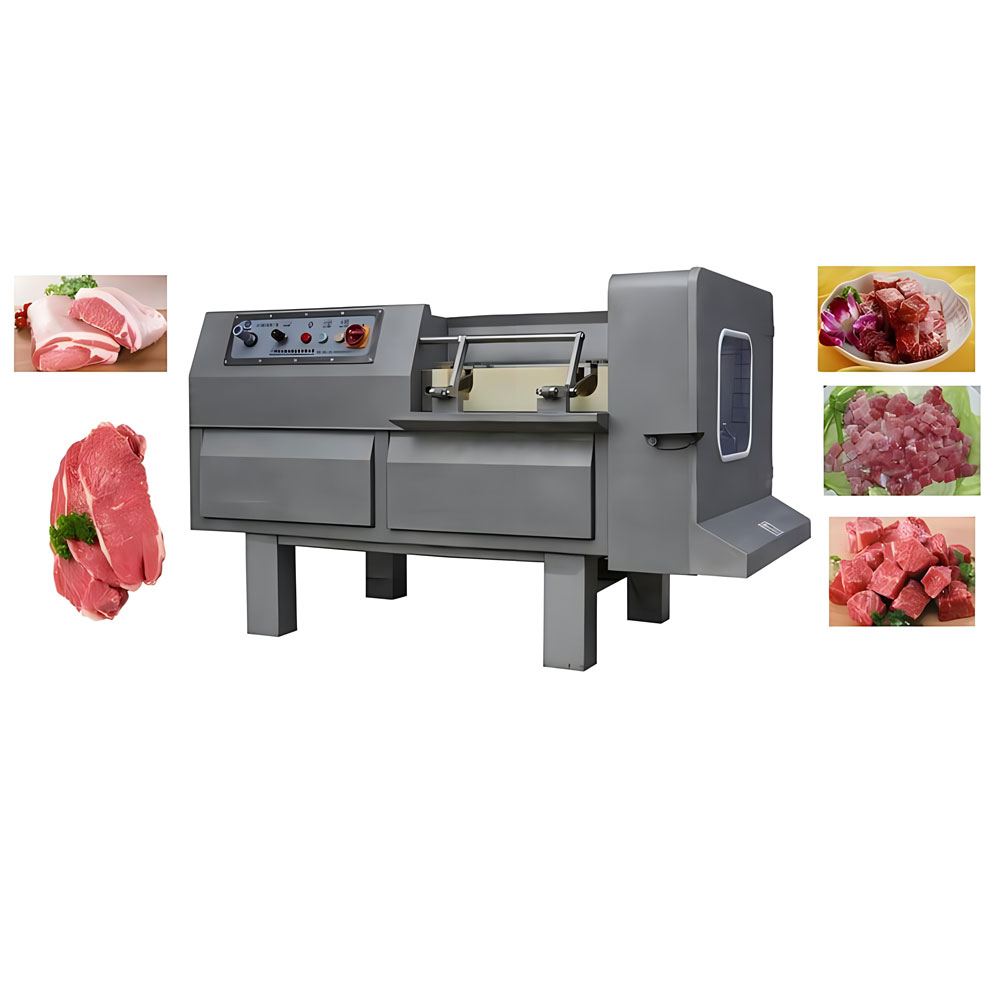 Automatic Fresh Meat Dicing Machine
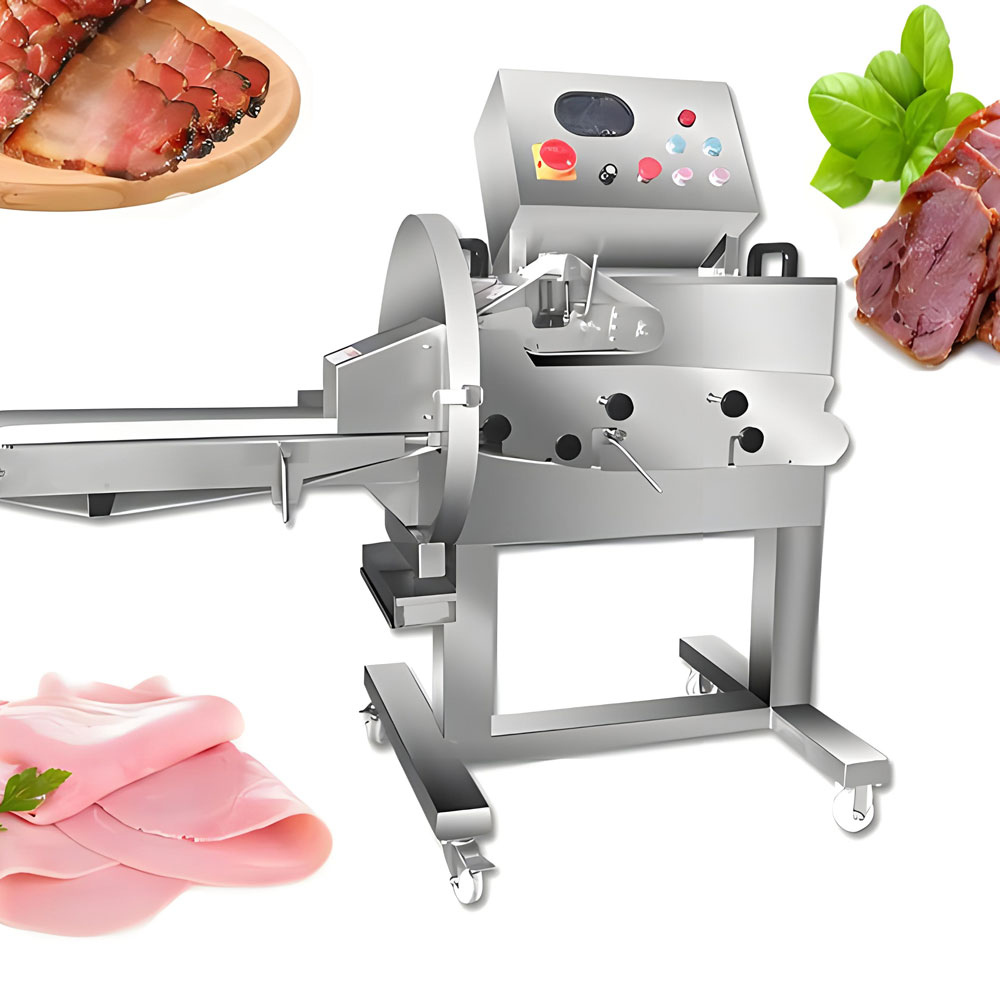 Automatic Cooked Meat Slicing Machine
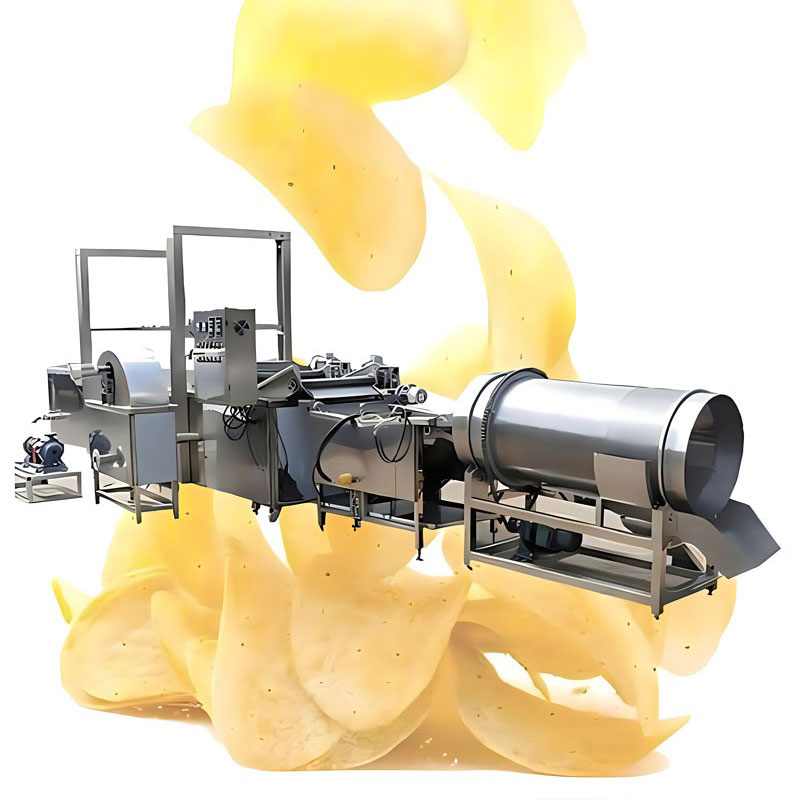 Fully Automatic Potato Chips Line
 Meat Processing Line Equipment
Ready to Get Started?