
Commercial Kitchen Food-Grade Polymer Selection: PP, POM, PTFE, PEEK and PPSU by Application
Food-grade polymers in commercial kitchen equipment are not a generic "plastic" — they are a material engineered for a specific temperature, a specific wear, a specific chemical, and a specific food contact. PP (polypropylene) handles impact and food contact for cutting boards; POM (acetal) handles wear and dimension for guides; PTFE (Teflon) handles non-stick and chemical for seals; PEEK handles high temperature and wear for specialty parts; PPSU handles high heat and impact for steam applications. A polymer that is right for a cutting board will fail in a high-temp seal; a polymer that is right for a seal may not be food-contact compliant. This article compares the five polymers, maps each to the kitchen application where it fits, and references FDA 21 CFR 178 compliance.
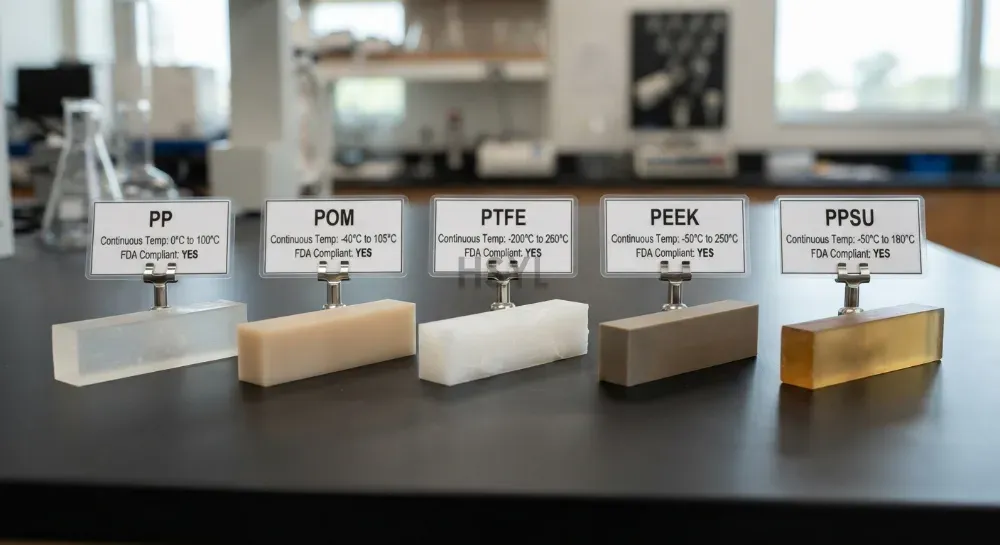
The scope covers food-grade polymer selection for commercial kitchen contact parts. It covers polymer types, temperature, wear, chemical resistance, and FDA compliance. It does not cover stainless grade selection (covered in CK-01), gasket elastomers (covered in CK-P0-10), or heat source. A compliant commercial kitchen equipment solution specifies polymer by application, not a single polymer for the whole kitchen.
Five Polymers and Their Properties
The five polymers differ in temperature range, impact, wear, chemical resistance, and food-contact compliance. The differences drive which polymer goes where.
| Polymer | Temp range (°C) | Impact | Wear | Chemical | Food contact (FDA) | Relative cost |
|---|---|---|---|---|---|---|
| PP (polypropylene) | 0 to +100 | Excellent | Low | Good (acid, base) | Yes — 21 CFR 178.1520 | Low |
| POM (acetal, Delrin) | -40 to +120 | Good | Excellent | Good (mild) | Yes — 21 CFR 178.3720 | Medium |
| PTFE (Teflon) | -200 to +260 | Low | Low (creeps) | Excellent (all) | Yes — 21 CFR 177.1550 | Medium-high |
| PEEK | -40 to +250 | Good | Excellent | Excellent | Yes — specific grades | High |
| PPSU (Radel) | -100 to +180 | Excellent | Good | Excellent | Yes — specific grades | High |
Temperature is the key number — a PEEK part at 240°C cannot use PP (limit 100°C); a steam part at 170°C cannot use POM (limit 120°C). FDA compliance is non-negotiable for any polymer that touches food. FDA 21 CFR 178 (indirect food additives: polymers) lists the approved polymers and their extraction limits; 21 CFR 177 covers specific resin grades.
Application-by-Polymer Map
The table below maps kitchen applications to the appropriate polymer, based on the temperature, the wear, the chemical exposure, and the food contact.
| Application | Conditions | Recommended polymer | Rationale |
|---|---|---|---|
| Cutting board | Food contact, knife impact, mild chemical | PP or HDPE | PP handles impact; HDPE also common; both FDA compliant |
| Guide / wear strip | Sliding contact, wear, intermittent food | POM | POM handles wear and dimension; FDA compliant |
| Non-stick seal / gasket | Food contact, non-stick, chemical | PTFE | PTFE handles temp and chemical; non-stick; creeps under load |
| High-temp specialty | Food contact, high temp, wear | PEEK | PEEK handles 250°C + wear; specialty only; cost |
| Steam tray / insert | Steam at 130–170°C, impact, food | PPSU | PPSU handles steam + impact; FDA compliant |
| Handle / knob | Hand contact, intermittent food, mild chemical | POM or PP | POM for wear; PP for impact; both FDA |
| Scraper / blade | Food contact, edge wear, mild chemical | POM or PTFE | POM for edge; PTFE for non-stick |
Material note: The application-by-polymer map is a starting point, not a universal spec. Local regulation, specific food chemistry, and cleaning concentration may shift the boundary. A polymer in a steam kitchen may need PPSU where a dry kitchen uses POM. Document the polymer per application in the equipment specification.
FDA Compliance and Documentation
FDA 21 CFR 178 lists approved indirect food additives for polymers; 21 CFR 177 lists specific resin grades. A polymer that touches food must comply with the applicable section. The compliance must be documented — a polymer without a compliance certificate is not food-grade, regardless of the resin name.
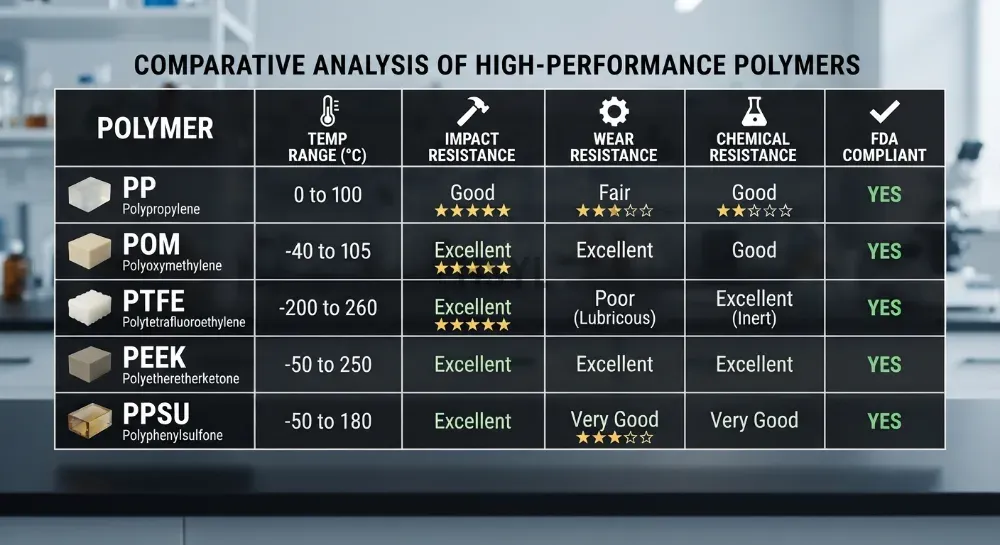
| Polymer | FDA section | Food types | Temp limit |
|---|---|---|---|
| PP | 21 CFR 178.1520 | All food types | Up to 100°C (sustained) |
| POM | 21 CFR 178.3720 | All food types (specific grades) | Up to 120°C |
| PTFE | 21 CFR 177.1550 | All food types | Up to 260°C (sustained) |
| PEEK | Specific grades only | Food contact grades | Up to 250°C |
| PPSU | Specific grades only | Food contact grades | Up to 180°C |
The double-tank vegetable washing machine may use PP for the basket (impact, water, food contact) and POM for the slide guides (wear, dimension). The polymer specification must list the resin grade, the FDA section, and the food types — a generic "plastic" specification is not defensible.
Scope, Sources and Limitations
Scope. This article covers food-grade polymer selection for commercial kitchen contact parts. It covers polymer types, temperature, wear, chemical resistance, and FDA compliance. It does not cover stainless grade selection, gasket elastomers, or heat source.
Limitations. All polymer properties and FDA references are drawn from publicly available material engineering and food-safety material. Actual polymer selection depends on local regulation, specific food chemistry, cleaning protocol, and equipment design. HSYL does not publish project-specific polymer specifications without verified evidence.
Source basis. Polymer properties are consistent with ASTM material specs, FDA 21 CFR 178 (polymers), FDA 21 CFR 177 (specific resins), and EU 1935/2004 (food-contact materials).
Food-Grade Polymer Resources
Three resources complement this polymer content. The kitchen solutions page carries the full scope. The vegetable washing machine page carries a polymer-basket and guide example. The gasket and seal selection article (CK-P0-10) carries the elastomer (rubber) specification, which is distinct from rigid polymer.
- Commercial kitchen equipment solution — the full kitchen scope where polymer-by-application specification applies.
- Double-tank vegetable washing machine — an equipment with polymer basket and slide guides.
- Commercial kitchen gasket and seal selection (CK-P0-10) — the elastomer (rubber) specification, distinct from rigid polymer.
Next Step: Map Your Kitchen Polymers
Send HSYL your equipment list, polymer contact parts, temperature range, food types, and cleaning chemical. HSYL will return a pre-filled application-by-polymer map with FDA references for your parts and a polymer specification template for your equipment.
Frequently Asked Questions
Which polymer is best for a commercial kitchen cutting board?
What is the difference between PTFE and PEEK for kitchen applications?
Is POM food-contact compliant for commercial kitchen guides?
What polymer is used for steam trays in commercial kitchens?
Can HSYL specify the polymer for every contact part in my kitchen equipment?
Must-Read Blogs For Chain Restaurants Owner

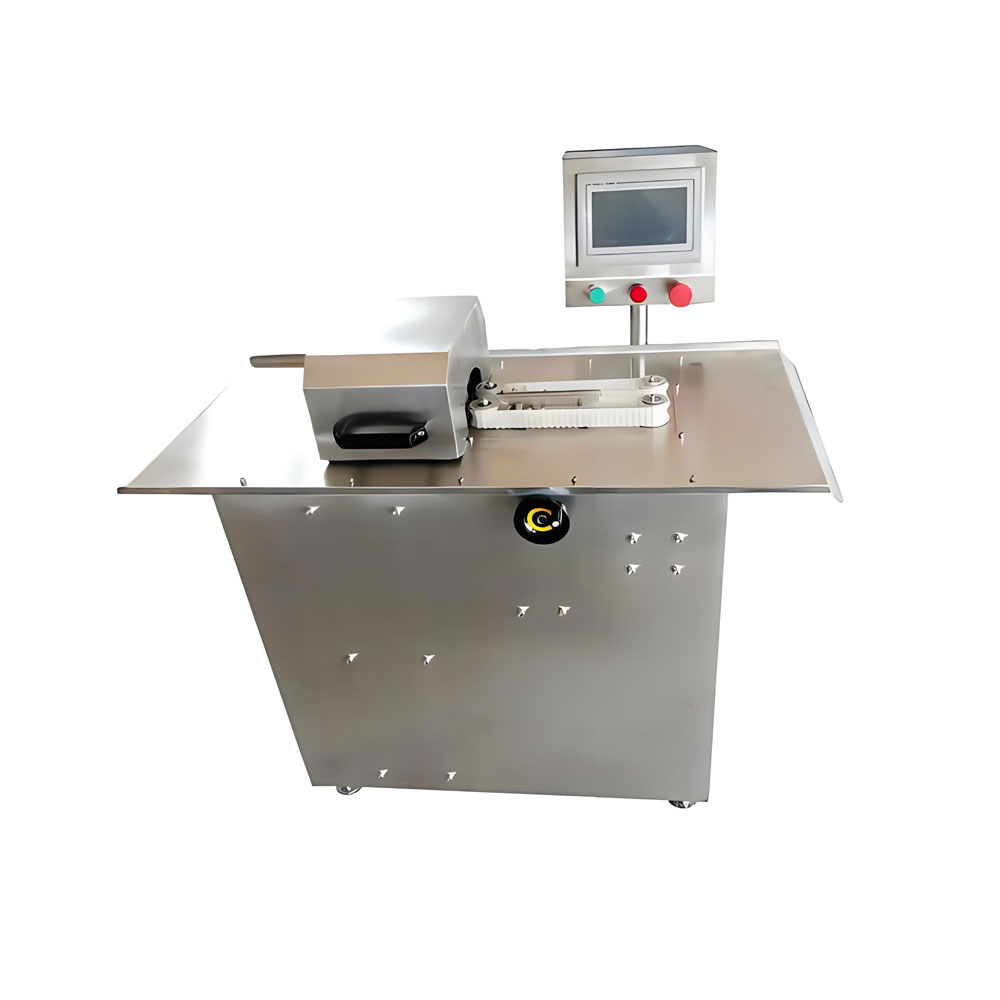
 Cutting And Stringing Integrated Machine
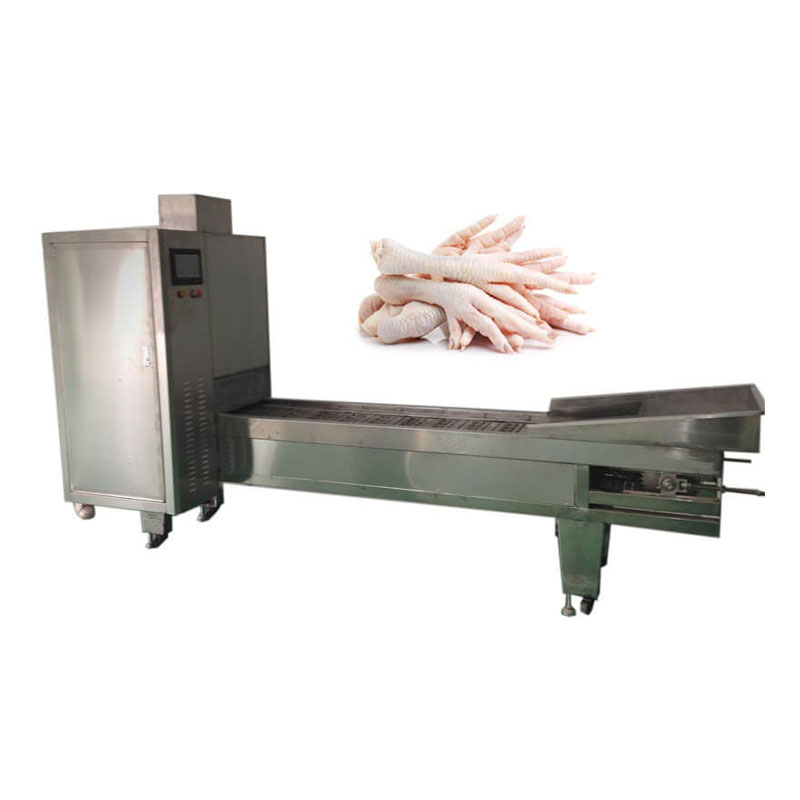 Chicken Feet Cutting Machine
 YL-W-01 Commercial Water Purification Equipment
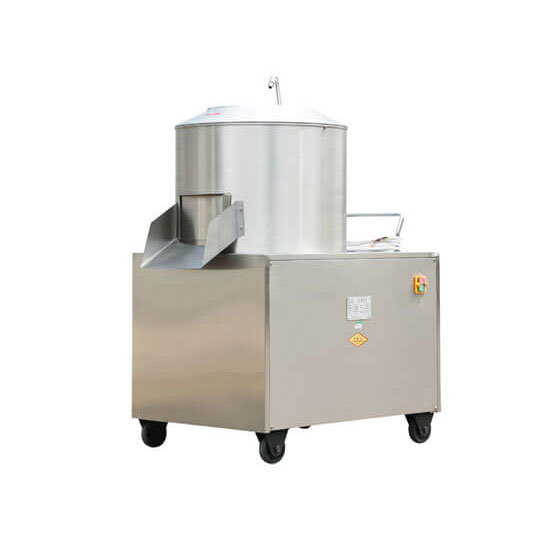 Potato Washing&Peeling Machine
Ready to Get Started?