
Commercial Kitchen Stainless Steel Bending, Folding and Forming: K Factor, Springback and Bend Radius
Bending and folding in commercial kitchen equipment is not just turning a flat sheet into a 90° angle — it is a controlled deformation where the bend radius, the K factor, and the springback determine whether the corner is sound or defective. A bend radius too small cracks the outer fiber; a K factor wrong distorts the flat blank; springback uncorrected leaves the angle open. The bend must match the application: a table edge needs a different radius than a sink corner; a hood panel needs a different method than a deep-draw sink bowl. This article provides a bend-by-application map, explains K factor and springback, and lists the corner forming defects to avoid.
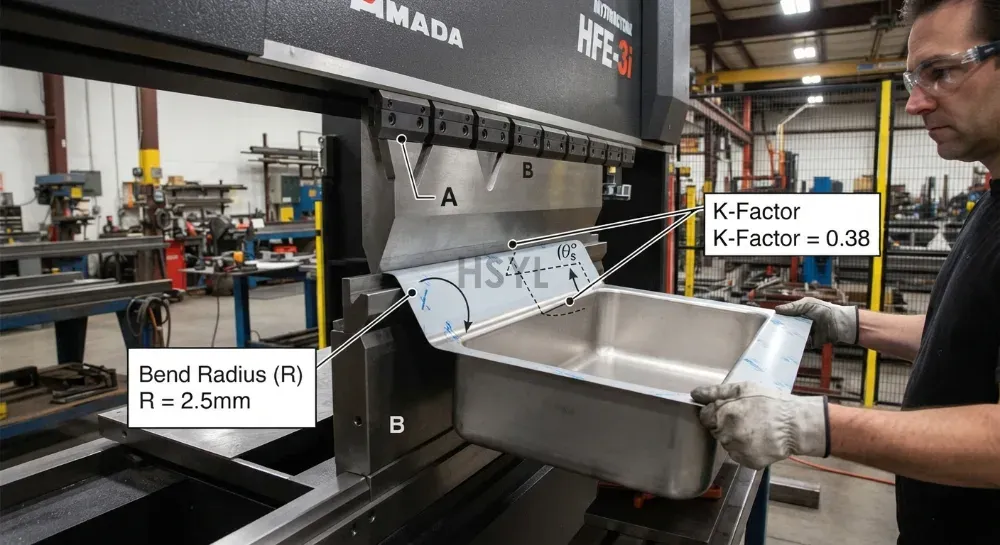
The scope covers bending and folding for commercial kitchen stainless equipment. It covers bend types, K factor, springback, and corner forming. It does not cover stainless grade selection (covered in CK-01), welding and passivation, or sheet metal gauge (covered in CK-06). A compliant commercial kitchen equipment solution specifies bend radius and method by application, not a single radius for the whole kitchen.
Bend Types and Their Properties
Three bend types are common in kitchen equipment: air bend (press brake, partial contact), bottom bend (press brake, full contact), and coining (press brake, full penetration). Each has a different radius control and tonnage.
| Bend type | Method | Radius control | Tonnage | Typical application |
|---|---|---|---|---|
| Air bend | Punch presses sheet into V-die without bottoming | Floats with material and tonnage; radius depends on V-die opening | Low | Table edges, panel bends — flexible, low tonnage |
| Bottom bend | Punch bottoms into V-die, full contact | More precise than air bend; radius near V-die shoulder | Medium | Sink corners, hood bends — better angle control |
| Coining | Punch penetrates beyond V-die bottom, full penetration | High precision; radius set by punch nose | High | High-precision corners, decorative edges |
Air bend is the most common in kitchen fabrication because it is flexible and low-tonnage. Bottom bend is used when angle precision matters. Coining is reserved for high-precision or decorative work because of its high tonnage and tool wear.
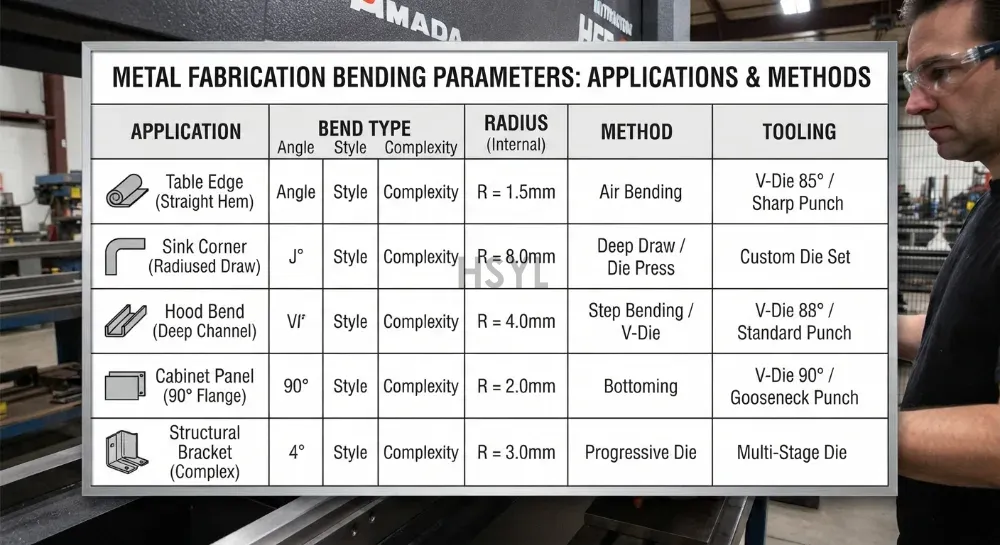
Bend-by-Application Map
The table below maps kitchen applications to the appropriate bend type, radius, and tooling, based on the sheet thickness and the corner requirement.
| Application | Typical gauge | Bend type | Min bend radius | Tooling note |
|---|---|---|---|---|
| Table edge (90° fold) | 16–14 ga (1.2–1.9 mm) | Air bend | 1.0–1.5 × thickness | V-die opening 8× thickness; radius floats |
| Sink corner (90° bend) | 16 ga (1.2 mm) | Bottom bend | 1.0 × thickness (inside) | Bottom bend for angle precision; radius for hygiene |
| Hood panel (90° bend) | 18–16 ga (1.0–1.2 mm) | Air bend | 1.0 × thickness | Large panel; air bend for low tonnage |
| Sink bowl (deep draw) | 16 ga (1.2 mm) | Deep draw (not bend) | Corner radius ≥ 3 mm | Press forming, not press brake; lubrication critical |
| Backsplash (90° fold) | 20 ga (0.9 mm) | Air bend | 0.8 × thickness | Thin sheet; small V-die |
Manufacturing note: The minimum bend radius for stainless is typically 1.0 × thickness for austenitic grades (304, 316L), but it depends on the grade, thickness, and edge condition. A sheared edge (with burr) cracks at a smaller radius than a ground edge. Bend across the grain where possible, not along it, to reduce cracking risk.
K Factor and Springback
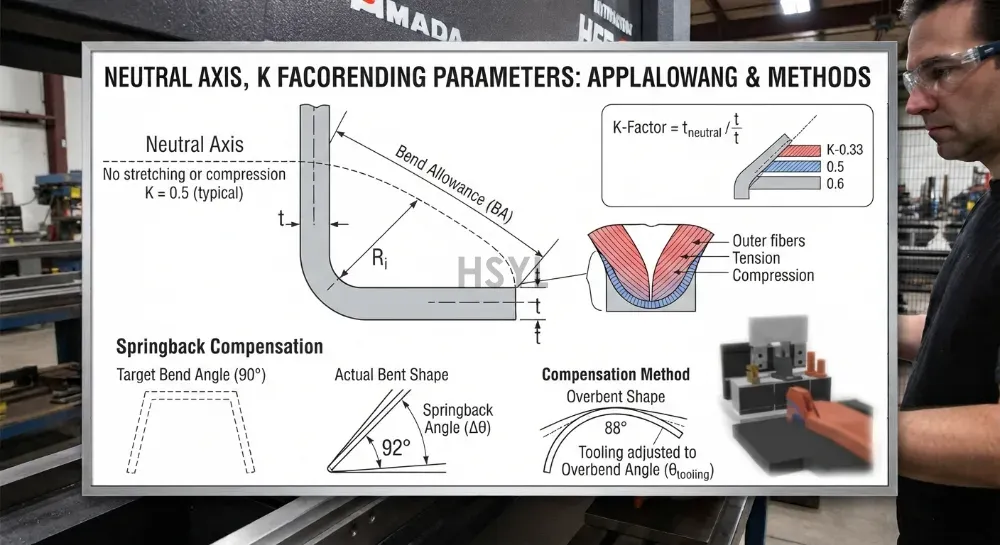
The K factor is the ratio of the neutral axis position to the sheet thickness — it determines the bend allowance (how much the sheet stretches during bending). For stainless, the K factor is typically 0.35–0.42 depending on the radius-to-thickness ratio. A smaller radius gives a smaller K factor (more thinning). The K factor is used to calculate the flat blank size before bending.
Springback is the elastic recovery of the sheet after bending — the bend angle opens by a few degrees once the punch retracts. Stainless has more springback than mild steel (typically 2–5° for 304, more for 316L). Springback is compensated by over-bending — bending a few degrees past the target angle, or by using bottom bend/coining which reduces springback by full contact.
The double-tank vegetable washing machine has bent tank corners that must seal against water — the bend radius and angle precision determine whether the gasket seals or leaks. The K factor is used to calculate the flat blank for the tank body; springback is compensated to achieve the 90° angle that the gasket requires.
Corner Forming Defects and Inspection
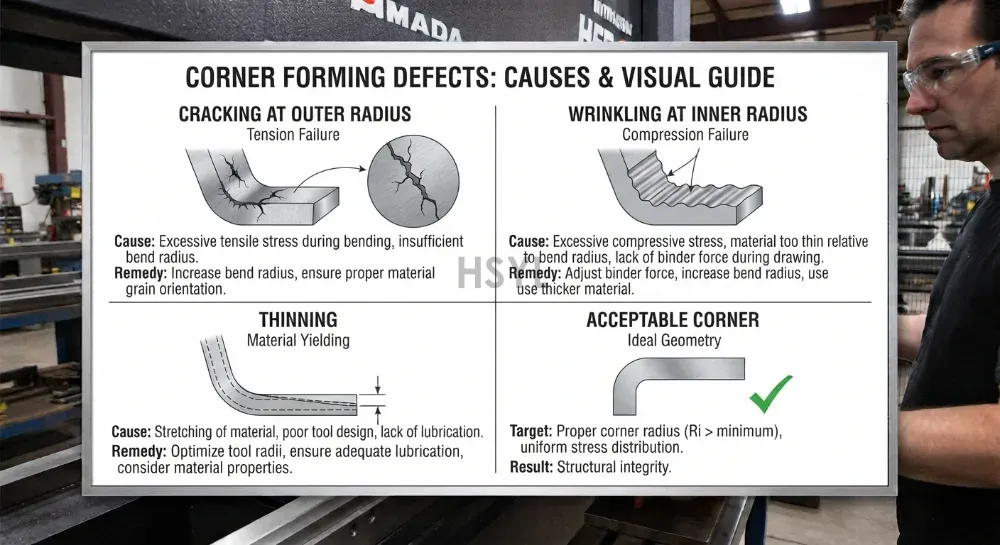
Four corner forming defects are common in kitchen stainless bending. Each has a cause and a correction.
| Defect | Cause | Correction |
|---|---|---|
| Cracking at outer radius | Bend radius too small; edge not ground; bent along grain | Increase radius; grind edge; bend across grain |
| Wrinkling at inner radius | Too much material in compression; blank too large | Reduce blank size; use larger radius; use hold-down |
| Thinning at outer radius | K factor too small; radius too tight; over-bent | Increase radius; use bottom bend; control tonnage |
| Springback (open angle) | Elastic recovery; insufficient over-bend | Over-bend by 2–5°; use bottom bend or coining |
Scope, Sources and Limitations
Scope. This article covers bending and folding for commercial kitchen stainless equipment. It covers bend types, K factor, springback, and corner forming. It does not cover stainless grade selection, welding and passivation, or sheet metal gauge.
Limitations. All bend, K factor, and springback values are drawn from publicly available manufacturing and metallurgical material. Actual bend parameters depend on grade, thickness, edge condition, and tooling. HSYL does not publish project-specific bend procedures without verified evidence.
Source basis. Bend and forming principles are consistent with ASM forming reference, ASTM A480/A480M (stainless sheet), and press-brake manufacturer data.
Bending and Forming Resources
Three resources complement this bending content. The kitchen solutions page carries the full scope. The vegetable washing machine page carries a bent-tank-corner example. The sheet metal gauge article (CK-06) carries the thickness framework that precedes bend specification.
- Commercial kitchen equipment solution — the full kitchen scope where bend-by-application specification applies.
- Double-tank vegetable washing machine — an equipment with bent tank corners that seal against water.
- Commercial kitchen sheet metal gauge (CK-06) — the thickness framework that precedes bend specification.
Next Step: Map Your Kitchen Bends
Send HSYL your equipment list, bend locations, sheet thickness, grade, and edge condition. HSYL will return a pre-filled bend-by-application map with radius and method for your parts and a bend specification template with K factor and springback compensation for your fabrication.
Frequently Asked Questions
What is the minimum bend radius for stainless steel in commercial kitchen equipment?
What is the K factor and why does it matter for kitchen stainless bending?
How is springback compensated in stainless kitchen equipment bending?
What is the difference between air bend, bottom bend, and coining for kitchen stainless?
Can HSYL specify the bend radius and method for every part in my kitchen equipment?
Must-Read Blogs For Chain Restaurants Owner

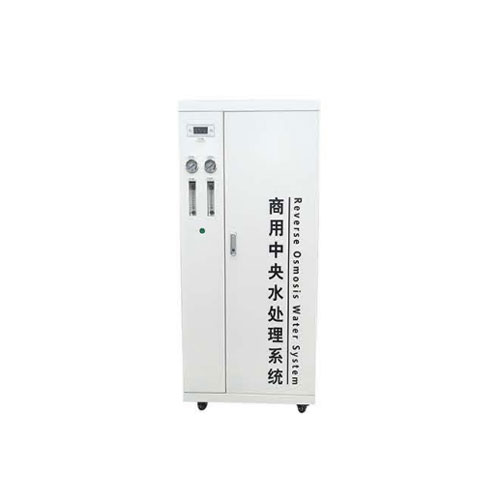 YL-W-06 Commercial Water Purification Equipment
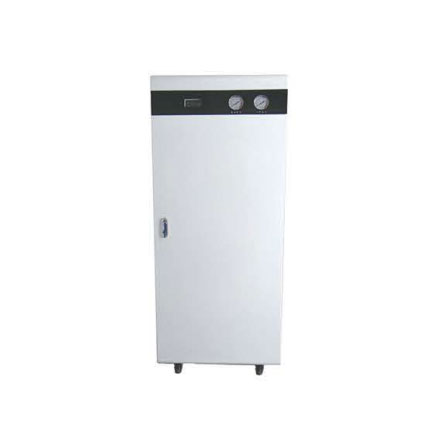 YL-W-05 Commercial Water Purification Equipment
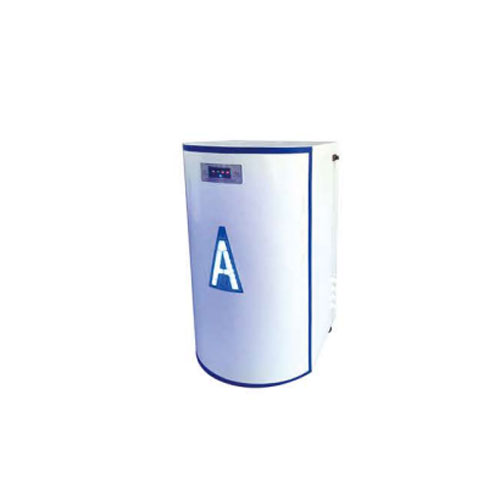 YL-W-04 Commercial Water Purification Equipment
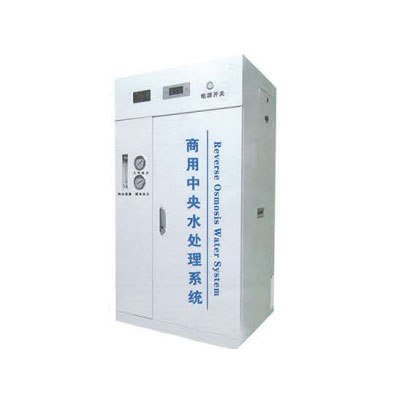 YL-W-03 Commercial Water Purification Equipment
Ready to Get Started?