
Histamine Control in Tuna and Sardine Receiving: A Time-Temperature Decision Tree
Histamine is the food-safety hazard that defines the receiving step for tuna and sardine canneries. It forms in the flesh of certain fish when bacteria convert free histidine to histamine, it forms faster as temperature rises, and once formed it cannot be removed — not by precooking, not by retort sterilization, not by freezing. This means the only practical control is time-temperature management from catch to retort, and the receiving dock is where the cumulative time-temperature history must be judged. This article provides a time-temperature decision tree that converts a lot's history into an accept, hold, or reject decision, and explains the hazard logic behind each branch.
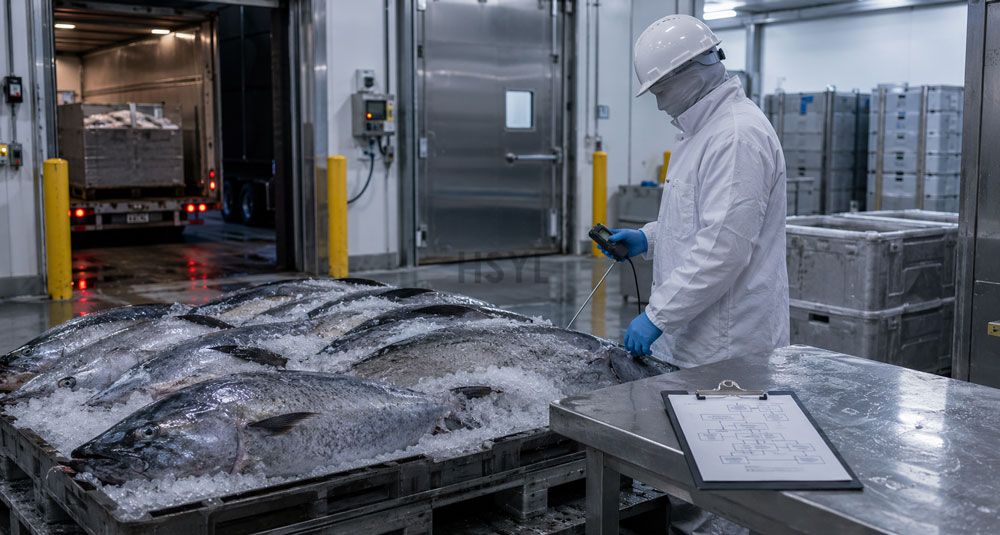
The scope covers histamine control for histamine-forming species — primarily tuna and sardine — at receiving, with emphasis on the time-temperature dimension. It covers the decision-tree framework, the formation thresholds, the catch-to-retort chain, and species differences. It does not cover the full receiving program (covered separately, including sensory evaluation, documentation, and lot isolation), scheduled thermal-process design, mass balance, or capacity. The decision tree in this article is a framework to be adapted to the cannery's HACCP plan, not a substitute for process-authority or QA judgment.
Why Time-Temperature Is the Only Histamine Control
Three properties of histamine make time-temperature the only practical control, and understanding these properties is the foundation of any defensible decision tree.
Histamine forms enzymatically. Bacteria naturally present on fish — primarily Morganella morganii, Hafnia alvei, and Klebsiella pneumoniae, among others — produce histidine decarboxylase, an enzyme that converts free histidine in the fish muscle into histamine. The rate of this conversion is temperature-dependent: it is slow near freezing and accelerates sharply as the temperature rises into the abuse range.
Histamine is heat-stable. Normal canning thermal processes do not destroy histamine. Precooking temperatures, retort sterilization temperatures, and cooking times used in fish canning are all insufficient to degrade histamine meaningfully. A lot with hazardous histamine at receiving will have hazardous histamine in the finished can.
Histamine formation is irreversible. Once formed, histamine does not degrade during frozen storage, thawing, or any subsequent processing step. Re-chilling a warmed lot stops further formation but does not remove what has already formed. This is why a lot that has experienced time-temperature abuse cannot be "rescued" by returning it to cold storage.
The regulatory consequence is that the FDA Fish and Fishery Products Hazards and Controls Guidance, 21 CFR Part 123 (Seafood HACCP), and FDA Compliance Policy Guide Sec. 540.525 (revised 2024) all treat histamine as a hazard reasonably likely to occur for histamine-forming species, and the control is time-temperature monitoring supported by sensory evaluation and chemical testing. Codex CXC 52-2003 provides the international counterpart. EU requirements differ in sampling plan detail and must be checked for the target export market.
Compliance note: Regulatory action levels, sampling plans, and guidance documents are revised periodically. The references in this article are accurate as of the last technical review date (2026-07-12). Before applying any threshold to your receiving program, verify the current version of the FDA Hazards Guide, 21 CFR Part 123, CPG Sec. 540.525, and Codex CXC 52-2003, and confirm the specific requirements of your export market.
The Histamine Formation Window
The decision tree depends on understanding which temperature bands allow histamine to form and how fast. The table below summarizes the formation-rate reference by temperature band, drawn from publicly available FDA and food-science material. The rates are qualitative references — actual formation depends on bacterial load, species, and fish condition — but the bands define the hazard logic of the decision tree.
| Temperature band | Histamine formation rate | Hazard implication | Decision-tree role |
|---|---|---|---|
| At or below 4 °C (well-iced or refrigerated) | Slow; bacterial growth and enzyme activity minimized | Low formation risk if held consistently | Baseline acceptable condition; time-at-temperature still matters |
| 4–10 °C (marginal cold chain) | Moderate; formation accelerates as temperature rises | Time-dependent risk; cumulative exposure matters | Trigger for time-since-harvest check and sensory escalation |
| 10–21 °C (temperature abuse) | Rapid; mesophilic bacteria actively producing histamine | High risk; hazardous levels can form in hours | Reject unless total time in band is very short and verified |
| Above 21 °C (severe abuse) | Very rapid; histamine can reach hazardous levels quickly | Presumptive hazard | Reject; do not rely on sensory or sampling to rescue |
Two principles follow from the bands. First, the hazard is not the temperature alone — it is the cumulative time the fish spends at each temperature. A lot that briefly touches 8 °C during unloading and returns to ice is very different from a lot held at 8 °C for six hours. Second, the hazard is not linear: time at 15 °C is far more dangerous than the same time at 5 °C, because formation accelerates non-linearly with temperature. The decision tree must consider both temperature and time, not temperature alone.
The Time-Temperature Decision Tree
The decision tree below converts a lot's time-temperature history into a disposition decision. It is a framework, not a substitute for the cannery's HACCP plan. Each branch should be adapted to the species, supplier history, and export market documented in the plan.
| Step | Decision node | Inputs | Outcome |
|---|---|---|---|
| 1 | Transport environment temperature at arrival | Probe or IR in fish mass; ice present and distributed? | At or below threshold → step 2. Above threshold → step 3. |
| 2 | Core temperature of sample fish | Calibrated probe in thickest part of multiple fish | At or below threshold → step 4. Above threshold → step 3. |
| 3 | Time-since-harvest and abuse duration | Cold-chain log; harvest time; duration above threshold | Short, verified, marginal → conditional hold + sensory + sampling. Long or unverified → reject. |
| 4 | Cumulative time at marginal temperature (4–10 °C) | Cold-chain log; total time in marginal band since harvest | Within HACCP limit → step 5. Exceeds limit → conditional hold + sampling. |
| 5 | Sensory evaluation | Trained evaluator; six dimensions per FDA Hazards Guide | All normal → step 6. Any reject signal → reject. Borderline → conditional hold + sampling. |
| 6 | Histamine sampling (where required by HACCP) | Sampling plan per FDA/Codex/EU; validated method | Below action level → accept. At or above action level → reject. |
| 7 | Documentation completeness | Lot ID, supplier, harvest date, cold-chain log, species confirmation | Complete → accept (if steps 1–6 pass). Incomplete or falsified → reject or conditional hold. |
The tree has three terminal outcomes. Accept means the lot is released to production — all gates passed, documentation complete. Conditional hold means the lot is physically isolated pending further evidence (sampling, supplier verification, QA authority review); it is not released until the hold is resolved by a documented decision. Reject means the lot is refused and removed from the food supply; it is not reconditioned, reprocessed, or "thermal-processed to safety" — because thermal processing cannot remove formed histamine.
Hazard note: The decision tree is designed to err toward hold and reject when evidence is incomplete. A lot with a broken cold-chain log, an unknown harvest time, or an unverified transport temperature cannot be judged safe by sampling alone — histamine distribution within a lot is uneven, and a passing sample does not guarantee the lot is free of hazardous histamine. The hazard logic is: when in doubt, hold; when the hold cannot be resolved with evidence, reject.
Species Differences: Tuna vs Sardine
Not all histamine-forming fish carry the same risk, and the decision tree should be calibrated to the species. Tuna and sardine are both histamine-forming species, but they differ in anatomy, histidine content, typical supply chain, and the way they are processed — and these differences affect where the decision tree's thresholds sit.
| Factor | Tuna (reference) | Sardine (reference) |
|---|---|---|
| Histamine risk classification | Scombroid fish; high histidine in muscle; classic histamine hazard species | Non-scombroid but histamine-forming; lower but still significant risk |
| Typical supply chain | Often frozen at sea or shortly after; long transport common | Often fresh or short-frozen; shorter transport typical |
| Fish size | Large; slow chilling if cold chain fails | Small; faster chilling, but also faster warming if cold chain fails |
| Receiving temperature control | Core temperature measurement essential; large fish chill slowly | Core temperature measurement essential; small fish show abuse quickly |
| Regulatory scrutiny | High; tuna is the most frequently cited histamine species in FDA and EU enforcement | Moderate; sardine is covered but with different sampling thresholds |
The practical implication is that a single decision-tree template should be species-calibrated. A tuna line — such as the canned tuna processing production line — typically handles large fish with long frozen supply chains, so the decision tree's time-since-harvest logic must account for frozen storage and thawing history. A sardine line — such as the sardine canned food production line — typically handles smaller fish with shorter supply chains, so the decision tree's time-at-marginal-temperature logic is more sensitive to short abuse events during unloading and holding.
Critical Time-Temperature Points from Catch to Retort
The receiving decision tree is only one link in a longer time-temperature chain. Histamine can form at any point from catch to retort, and the receiving decision depends on the cumulative history, not just the temperature at the receiving dock. The chain below identifies the critical control point at each link.
| Chain link | Time-temperature control | Typical control point | Weakest-link risk |
|---|---|---|---|
| Catch and on-vessel handling | Rapid chilling after catch; onboard ice or refrigeration | Vessel log; time-to-ice after catch | Delay between catch and chilling is the single biggest histamine driver |
| Unloading and transport | Maintain cold chain; monitor temperature in transit | Transport temperature log; ice condition at arrival | Transport without ice or refrigeration is a common abuse event |
| Receiving hold | Hold at or below threshold; minimize dwell time | Receiving temperature; hold-area time | Prolonged hold at marginal temperature accumulates risk |
| Pre-processing (thawing, butchering) | Control thawing temperature and time; minimize time at abuse temperature | Thawing method and time; pre-processing room temperature | Thawing is a high-risk step; warm thawing extends abuse time |
| Precooking | Precooking itself does not form histamine; but pre-precook hold time matters | Time from thawing to precooker entry | Long queue before precooker allows continued histamine formation |
| Retort | Retort sterilizes bacteria but does not destroy formed histamine | Not a histamine control point | Misunderstanding retort as a histamine control is a critical error |
The chain is only as strong as its weakest link. A lot that arrives at receiving with a verified cold-chain history but then sits in a warm pre-processing queue for hours before precooking can develop hazardous histamine after passing the receiving decision tree. The decision tree must therefore be part of a continuous time-temperature control program, not a single-point inspection. The seafood processing equipment solutions scope covers the cold-chain and pre-processing layout that supports this continuous control, including receiving hold area, thawing system, and pre-processing room temperature management.
When the Decision Tree Says Reject
A reject decision is not a suggestion — it is a food-safety action, and the logic behind it must be understood by everyone on the receiving team. Three reject scenarios have distinct hazard logic.
Reject for temperature abuse. A lot that has spent significant time in the 10–21 °C band, or any time above 21 °C, is a presumptive histamine hazard. Sampling cannot rescue it, because histamine distribution is uneven and a passing sample does not prove the lot is safe. The hazard logic is: the time-temperature history is itself the evidence, and no chemical test can override it.
Reject for sensory decomposition. A lot with clear sensory reject signals — putrid odor, discolored gills, soft flesh — is rejectable for decomposition regardless of histamine result. Sensory decomposition indicates bacterial activity, and bacterial activity may have produced histamine even if not yet at hazardous levels. The hazard logic is: decomposition is the visible signal of the same process that produces histamine.
Reject for documentation failure. A lot with missing, incomplete, or falsified cold-chain documentation cannot be judged safe, because the time-temperature history cannot be verified. Sampling cannot rescue it, for the same uneven-distribution reason. The hazard logic is: unverified history is equivalent to unknown history, and unknown history must be treated as high-risk.
In all three cases, the lot must be physically isolated, labeled as rejected, and removed from the food supply. It is not reconditioned by freezing, by thermal processing, by re-sorting, or by any other treatment — because none of these treatments remove formed histamine. The only defensible action on a rejected histamine lot is destruction or, where permitted, diversion to a non-food use that does not involve human consumption.
Documentation and Verification
The decision tree is only as defensible as the documentation behind it. For every lot, the receiving record must capture the decision path taken — not just the outcome, but the inputs and logic that led to the outcome. The minimum documentation for an audit-defensible histamine control program includes:
- Lot identification and traceability. Lot ID, supplier, species (scientific and common), harvest date, catch area or vessel, receiving date and time.
- Time-temperature history. Transport temperature at arrival, core temperature of sample fish, ice condition, cold-chain log from supplier, any gaps or deviations in the cold chain.
- Decision-tree path. Which step each gate reached, which outcome was selected, and the inputs that drove the outcome.
- Sensory evaluation record. Sample size, dimensions checked, scores, reject signals if any, evaluator name and training reference.
- Histamine sampling record (where applicable). Sample size, subsample IDs, analytical method, lab reference, results, action level applied.
- Disposition and authority. Final decision (accept / hold / reject), basis for decision, QA authority signature, date and time, hold status and release if applicable.
Record retention is a regulatory requirement. Under 21 CFR Part 123.9, FDA Seafood HACCP records must be retained for at least one year for refrigerated products and two years for frozen products — verify the current regulation for your product. EU requirements may differ. The retention policy must be documented in the HACCP plan and verified in internal audits.
Downloadable Decision Tree and Record Template
The decision tree and record template referenced in this article provide a structured two-document set. The decision tree is a one-page flowchart of the seven-step framework, with species-specific trigger points to be filled in from the cannery's HACCP plan. The record template captures lot identification, time-temperature history, decision-tree path, sensory and sampling results, and disposition authority in a single form. Together they form the minimum documentation to defend a histamine control decision in an FDA, Codex, or EU audit.
To request the templates: Share your fish species (tuna, sardine, or both), export market (US, EU, or other), current HACCP plan structure for histamine control, and whether the program is greenfield or an audit of an existing program. HSYL will return a pre-filled decision tree and record template set with the regulatory references for your market and a blank field column for your site data.
Scope, Sources and Limitations
Scope. This article covers histamine control for histamine-forming species — primarily tuna and sardine — at receiving, with focus on the time-temperature dimension and the decision-tree framework. It does not cover the full receiving program (sensory, documentation, and lot isolation are covered separately), scheduled thermal-process design, mass balance, or capacity.
Limitations. All temperature thresholds, formation-rate references, and decision-tree logic are drawn from publicly available regulatory and food-science material. Actual histamine formation depends on bacterial load, species, fish condition, and cumulative time-temperature history. HSYL does not provide legal or regulatory compliance advice, does not establish critical-factor limits, and does not publish project-specific rejection rates without verified evidence. A defensible histamine control program for your plant must be reviewed by your QA authority and process authority against the current version of every applicable regulation.
Source basis. Regulatory references include the FDA Fish and Fishery Products Hazards and Controls Guidance, 21 CFR Part 123 (Seafood HACCP), FDA Compliance Policy Guide Sec. 540.525 (scombrotoxin/histamine, 2024 revision), Codex CXC 52-2003 (Code of Practice for Fish and Fishery Products), and EU regulations including Reg. (EC) 2073/93 and Reg. (EC) 853/2004 as amended. Histamine formation and heat-stability principles are consistent with publicly available food-science literature. Specific source versions and review dates are recorded in the internal Evidence Brief and are available on request. Equipment-capability statements refer to HSYL equipment specifications and do not imply a compliance conclusion.
Reviewer and date. QA & Food Safety Lead, HSYL. Last technical review: 2026-07-12. This article should be re-reviewed when any cited regulation is updated, when Codex or EU histamine sampling attachments are revised, or when new food-science material on histamine formation becomes available.
Histamine Control and Time-Temperature Resources
Three resources complement this histamine control content when building or auditing a tuna or sardine cannery. The first is the tuna line page, which carries the species-specific equipment and process scope. The second is the sardine line page, which carries the sardine-specific process where the decision-tree thresholds differ. The third is the seafood processing solutions page, which frames the cold-chain and pre-processing layout that the time-temperature chain depends on.
- Fully automatic canned tuna processing production line — the tuna-specific line with receiving, thawing, and pre-processing scope that the histamine decision tree feeds into.
- Sardine canned food production line — the sardine-specific line where the decision-tree thresholds are calibrated to a smaller fish and a shorter supply chain.
- Seafood processing equipment solutions — the broader seafood processing scope, including cold-chain and pre-processing layout that supports continuous time-temperature control from catch to retort.
Next Step: Build a Defensible Histamine Decision Tree
If you are building a new histamine control program for tuna or sardine receiving, or auditing an existing one against FDA, Codex, or EU requirements, the fastest next step is to adapt the decision tree in this article to your HACCP plan. Send HSYL your fish species (tuna, sardine, or both), export market, current HACCP plan structure for histamine control, and whether the program is greenfield or an audit. HSYL will return a pre-filled decision tree and record template with the regulatory references for your market, plus a cold-chain and pre-processing layout review that covers the receiving hold area, thawing system, and pre-processing time-temperature control that the decision tree depends on.
Frequently Asked Questions
Why is time-temperature the only practical control for histamine in fish canning?
Can retort sterilization eliminate histamine already in the fish?
What temperature does histamine form at?
How does the histamine risk differ between tuna and sardine?
Can I sample my way out of a time-temperature abuse event?
What should I do if the cold-chain documentation is missing or incomplete?
Must-Read Blogs For Chain Restaurants Owner

 Fish Speed Cleaning Machine
 Salmon Processing Line
 Fish Deboner Machine
 Fish Cutting Machine
Ready to Get Started?