
Tuna Precooking: How Core Temperature, Steam Uniformity and Cooling Affect Yield and Texture
Precooking is the step where a Tuna Canning Line loses the most controllable yield and sets the texture of every loin that reaches the can. It is also the step most often treated as a black box — a setpoint entered once and never revisited, even as raw material, fish size, and fat content change. This article explains what precooking physically does to tuna muscle, how the three primary variables — core temperature, steam uniformity, and cooling method — drive yield and texture, and how to diagnose a precooking yield problem without guessing which variable to change. A loss matrix and a diagnostic checklist are provided for use on an operating line.
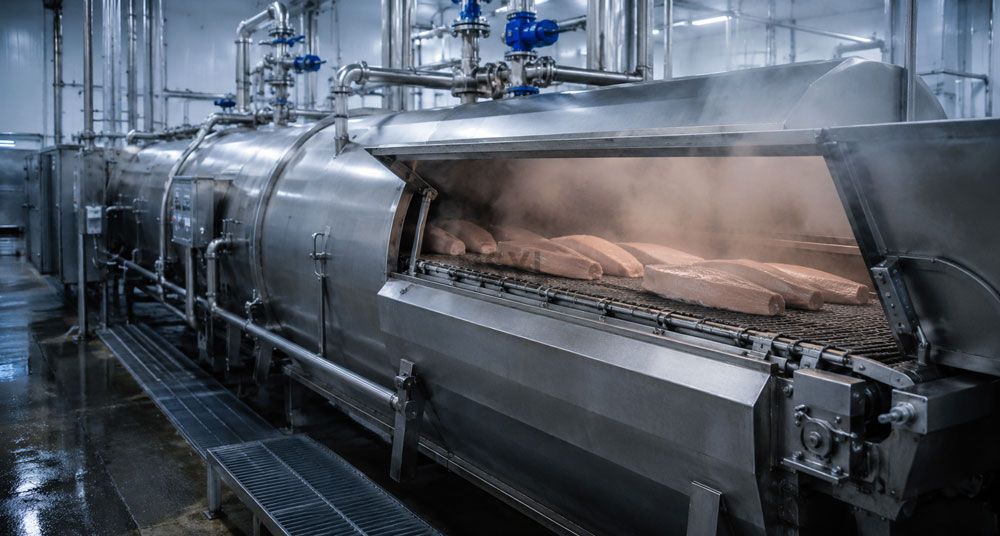
The scope covers precooking of dressed tuna from entry into the precooker through cooling and handoff to loin cleaning. It covers the yield and texture mechanics of steam precooking and the three variables that control them. It does not cover the mass balance of the full line (covered separately), retort sterilization, scheduled-process design, or histamine control at receiving — precooking is a process step, not the sterilization step, and the scheduled sterilization process is set by a process authority, not by the precooker. A fully integrated canned tuna processing production line treats precooking, cooling, and loin cleaning as a single tuned system; this article is the engineering counterpart to that integration.
What Precooking Does to Tuna Muscle
Precooking is not cooking in the culinary sense. The objective is to denature the muscle proteins enough that the loin can be cleaned of blood meat, skin, and bone in the next step, without overcooking the flesh and driving out water. Three physical changes happen in sequence as tuna muscle is heated through the precooking range.
Protein denaturation. Myofibrillar proteins (primarily myosin and actin) begin to denature as the muscle temperature rises. Myosin denatures in the 50–60 °C range; actin denatures at a higher temperature. Denaturation shrinks the protein network and reduces its ability to hold water.
Water-holding capacity loss. As the protein network shrinks, water that was bound within the muscle structure is released. This is the primary mechanism of precooking weight loss — not evaporation from the surface, but drip from within the muscle as the water-holding capacity falls. The released water carries soluble protein and some fat, so the drip is not pure water but a loss of both water and nutritional solids.
Connective tissue and fat changes. Connective tissue (collagen) begins to shrink and gelatinize at higher temperatures, affecting texture. In fatty tuna species and seasons, subcutaneous and intermuscular fat softens and can exude, contributing to weight loss and to the surface appearance of the cooked loin.
The practical consequence is that precooking loss is not a defect — it is the unavoidable result of the protein denaturation that makes loin cleaning possible. The engineering question is not how to eliminate precooking loss but how to hold it at the minimum level that still produces a clean, well-textured loin. That is what core temperature, steam uniformity, and cooling method control.
Core Temperature: The Primary Process Variable
Core temperature — the temperature at the geometric center of the thickest part of the loin — is the single variable that most directly determines both yield and texture. It is also the variable most often set by tradition rather than by measurement. Two relationships define the engineering of core temperature.
Core temperature and yield. As core temperature rises through the precooking range, water-holding capacity falls and drip loss increases. The relationship is not linear: drip loss is modest in the early denaturation range and accelerates as the temperature climbs past the point where the loin is cleanable. A core temperature setpoint that is 5 °C higher than necessary can add several percentage points of precooking loss with no improvement in cleanability.
Core temperature and texture. Texture follows an inverted-U curve. Undercooked loin (core temperature too low) is soft, difficult to clean, and retains blood meat; overcooked loin (core temperature too high) is dry, crumbly, and loses integrity during cleaning and filling. The optimal core temperature band is the range that produces a cleanable loin with the desired firmness — and it is species-, size-, and fat-content-dependent, which is why a single inherited setpoint is rarely optimal across a season.
| Core temperature outcome | Loin appearance | Cleaning behavior | Yield signal | Texture signal |
|---|---|---|---|---|
| Undercooked (below optimal band) | Translucent, reddish, soft | Blood meat hard to separate; skin and bone adherence high | Low precooking loss but high cleaning loss; net yield often lower | Soft, mushy; loses shape in can |
| Optimal band | Opaque, pink-grey, firm but resilient | Blood meat separates cleanly; skin and bone release | Precooking loss in reference range; cleaning loss minimized; net yield maximized | Firm, holds shape, acceptable can texture |
| Overcooked (above optimal band) | Opaque, grey, dry, cracked surface | Cleaning easy but loin crumbles; trimmings high | Precooking loss above reference; cleaning loss shifted to trimmings | Dry, crumbly; poor can texture |
The optimal band is not a universal number — it is a target set by the process engineer for a specific species, size profile, and product format, validated by measuring yield and texture across a setpoint sweep. A defensible core-temperature setpoint is one that was established by measurement on the line's own raw material, not one copied from another plant or another species.
Engineering note: Measuring core temperature during precooking requires a calibrated probe inserted into the thickest loin in the batch, with the measurement recorded against the precooker setpoint. A setpoint that is not verified against measured core temperature is a guess, not a process control. The gap between setpoint and measured core temperature is itself a diagnostic signal — a large gap indicates steam uniformity or heat-transfer problems.
Steam Uniformity: Why Distribution Drives Yield
Core temperature is the target, but steam uniformity is what determines whether every loin in the precooker reaches the target. A precooker set to a single setpoint can produce loins at very different core temperatures if the steam distribution is uneven — and those loins will have different yield and texture outcomes, even though they went through the "same" process.
Steam uniformity problems create two failure modes that often appear together. Hot spots overcook the loins nearest the steam inlet or nearest a steam distribution flaw, driving excess drip loss and dry texture in those loins. Cold spots undercook the loins in poorly steamed zones, leaving them hard to clean and shifting loss downstream into the cleaning step. Because both happen in the same batch, the average core temperature can look acceptable while the yield and texture variance between loins is wide.
Four equipment-design factors govern steam uniformity, and all four are equipment-capability questions, not process-setpoint questions:
- Steam inlet design and location. Steam entering at a single point or from one side creates a gradient across the precooker. Distributed inlets or perforated distribution pipes spread steam more evenly.
- Bleeder vents. Bleeders remove non-condensable gases (primarily air) that otherwise accumulate and insulate loins from steam contact. Blocked or undersized bleeders create cold spots.
- Condensate drainage. Steam condenses on cold loins and on the precooker structure. If condensate is not drained, it pools, cools, and creates localized cold zones. Drainage design and slope are equipment-capability questions.
- Precooker geometry and loading. Loins packed too tightly or unevenly block steam flow and create their own cold spots. The precooker must be loaded to its design pattern, not to an improvised maximum.
Steam uniformity is measured by a multi-point temperature study: calibrated probes placed at multiple positions across the precooker, run through a cycle, and compared. The spread between the hottest and coldest probe is the uniformity metric. A spread of more than a few degrees Celsius within a batch indicates a distribution problem that no setpoint change can fix. A canned fish production line audit should include a steam uniformity test as a standard part of precooking evaluation, not as a special investigation.
Cooling: The Hidden Second Cook
The precooking step does not end when the loin leaves the steam chamber. It ends when the loin reaches a temperature where protein denaturation stops and drip loss ceases. Between those two points — exit from the precooker and arrival at cooling temperature — the loin is still cooking, still losing water, and still changing texture. Cooling is therefore not a passive handling step; it is the second half of the precooking process, and the cooling method determines how much additional yield is lost and how the texture sets.
Three cooling methods are common, each with different yield, texture, and hygiene implications:
| Cooling method | Yield effect | Texture effect | Hygiene consideration |
|---|---|---|---|
| Air cooling (still or forced) | Slowest cooling; longest continued cook; highest post-cook drip loss | Texture continues to firm; risk of overcook in small loins | Lowest cross-contamination risk if air is filtered; surface drying can affect appearance |
| Spray cooling (water spray) | Faster cooling; reduced post-cook loss; some surface leaching | Texture sets sooner; more consistent across loin sizes | Cooling-water potability and microbiology must be controlled; spray nozzles require cleaning |
| Immersion cooling (brine or chilled water) | Fastest cooling; lowest post-cook loss; some salt uptake if brine | Texture sets rapidly; risk of surface softening if immersion too long | Cooling-water or brine microbiology critical; immersion tank requires CIP |
The choice of cooling method is an engineering decision that trades off cooling speed (and therefore post-cook yield) against equipment complexity and hygiene control. Spray and immersion cooling are faster and reduce post-cook loss, but they introduce cooling-water microbiology as a new control point — and for a cannery, post-process contamination risk is a food-safety concern that must be managed in the HACCP plan. Air cooling is simpler and lower-risk microbiologically, but it allows more post-cook loss and more texture variance.
Two operational rules govern cooling regardless of method. First, cooling must begin immediately at precooker exit — any delay extends the continued-cook period and adds loss. Second, the cooling endpoint must be defined (a target loin surface or core temperature at which the loin is released to cleaning), measured, and recorded. A cooling step with no defined endpoint is an uncontrolled process, and its yield contribution cannot be diagnosed or improved.
The Precooking Loss Matrix
The loss matrix below maps each precooking variable to the loss mechanism it drives, whether the loss is controllable, the reference loss range, and the diagnostic signal that the variable is out of control. The ranges are planning references drawn from publicly available industry and food-science material for tuna canning; they are not guarantees, and actual values depend on species, size profile, fat content, and equipment set.
| Variable | Loss mechanism | Controllable? | Reference loss range | Diagnostic signal |
|---|---|---|---|---|
| Core temperature setpoint | Water-holding capacity loss from protein denaturation | Yes — process engineering decision | Each 5 °C above optimal band can add 1–3% loss | Precooking loss above reference with normal steam uniformity |
| Steam uniformity | Hot-spot overcook + cold-spot downstream cleaning loss | Yes — equipment design and maintenance | Uniformity spread above a few °C adds variance, not average loss | Wide loin-to-loin core temperature spread in same batch |
| Cooling method and speed | Continued cook during slow cooling | Yes — equipment and process decision | Air cooling can add 1–2% post-cook loss vs immersion | Loin surface temperature still high at cleaning handoff |
| Cook time (batch) | Cumulative heat exposure beyond cleanability | Yes — process engineering decision | Overlong batch time adds loss without improving cleanability | Core temperature reached well before batch time ends |
| Loading pattern | Steam blockage and localized cold spots | Yes — operational discipline | Improper loading adds variance; loss shifts to cleaning | Cold spots correlated with high-density loading zones |
| Fish size variance | Small loins overcook while large loins undercook in same batch | Partly — upstream sorting | Wide size range in one batch increases total loss | Core temperature spread correlated with loin weight variance |
The matrix separates the variables a process engineer can change on an existing line (core temperature setpoint, cook time, loading pattern) from those that require equipment intervention (steam distribution, cooling system). A yield improvement project that changes setpoints without measuring steam uniformity or cooling speed will produce inconsistent results, because the underlying equipment problem is still there.
How Precooking Interacts with Upstream and Downstream
Precooking is not an isolated step. Its yield and texture outcomes depend on what arrives from upstream and determine what is possible downstream.
Upstream: thawing and sorting. Frozen tuna that is thawed unevenly enters the precooker with temperature variance already built in, and the precooker amplifies that variance. Fish size variance within a batch is the other upstream driver: small loins reach core temperature faster and overcook while large loins are still undercooking. Pre-cook sorting by size class is one of the highest-leverage yield improvements available, because it reduces the variance the precooker has to handle.
Downstream: loin cleaning. Precooking determines what the loin cleaning step can recover. Undercooked loins hold blood meat and skin, forcing aggressive cleaning that throws away usable muscle. Overcooked loins crumble during cleaning, shifting loss from "precooking" to "cleaning trimmings" — the total loss is the same or worse, but it appears in a different node of the mass balance. A precooking yield problem is often first visible as a cleaning yield problem. The loin cleaning and cutting equipment — typically an automatic fish filleting or cutting system integrated with the precooker output — must be matched to the precooking outcome; a fish filleting and cutting machine sized for firm, well-cooked loin will underperform on soft, undercooked loin and will waste crumbly, overcooked loin.
The practical implication is that a precooking yield audit cannot look at the precooker alone. It must measure yield across the precooking-cleaning-handoff segment as a whole, because losses move between the two steps depending on the precooking outcome.
Equipment Choices That Shift Precooking Yield
Each precooking variable maps to equipment decisions that set the ceiling for how well that variable can be controlled. The mapping below is a framework for evaluating equipment against a yield and texture target, not a product recommendation.
- Batch still retort used as precooker vs continuous atmospheric precooker. Batch retorts have poor steam uniformity and no inherent cooling integration; they are flexible but yield-inefficient. Continuous precookers provide better uniformity, faster throughput, and integrated cooling handoff, at higher capital cost.
- Steam distribution design. Distributed inlets, properly sized bleeders, and condensate drainage are equipment specifications that directly determine the uniformity ceiling. A precooker with a single steam inlet and no bleeders cannot produce uniform loins regardless of setpoint.
- Cooling system integration. Spray or immersion cooling integrated with the precooker exit reduces post-cook loss and standardizes the cooling endpoint. A separate, distant cooling station introduces handling delay and uncontrolled continued cook.
- Core temperature measurement. In-line or batch-sampled core temperature probes with recorded output are the difference between a controlled and an uncontrolled precooking process. Equipment without measurement capability cannot defend its yield number.
- Pre-cook sizing and sorting. Sizing and sorting equipment upstream of the precooker reduces size variance within each batch and is often the highest-ROI yield improvement, because it reduces the variance the precooker has to compensate for.
Diagnosing a Precooking Yield Problem
Precooking yield problems present as symptoms that can point to any of several root causes. The diagnostic checklist below maps the symptom to the likely variable and the measurement needed to confirm.
| Symptom | Likely variable | Confirming measurement | Corrective direction |
|---|---|---|---|
| Precooking loss above reference; uniform within batch | Core temperature setpoint too high | Measure core temperature vs setpoint; compare to optimal band | Lower setpoint in steps; measure yield and texture response |
| Precooking loss above reference; wide loin-to-loin variance | Steam uniformity or size variance | Multi-point temperature study; loin weight variance audit | Equipment distribution fix or upstream sorting |
| Cleaning loss above reference; precooking loss normal | Undercook (core temperature too low) or cold spots | Core temperature at low end of band; cold-spot identification | Raise setpoint or fix cold spots; re-measure cleaning yield |
| Texture crumbly; trimmings high | Overcook (core temperature too high) or slow cooling | Core temperature at high end; cooling endpoint temperature | Lower setpoint or accelerate cooling; measure texture response |
| Yield varies by shift or operator | Loading pattern or cooling discipline | Audit loading against design pattern; audit cooling endpoint consistency | Standardize loading and cooling SOP; re-train |
| Yield varies seasonally | Fat content or fish size profile change | Track fat content and size profile against yield by season | Adjust setpoint by season; tighten size sorting |
The discipline is to measure before changing. A precooking yield problem with three possible root causes cannot be solved by changing one variable and hoping — the change must be guided by the measurement that identifies which variable is actually out of control.
Downloadable Precooking Yield Diagnostic Checklist
The diagnostic checklist referenced in this article provides a structured one-page protocol for auditing a tuna precooking step. It covers core temperature audit (setpoint vs measured), steam uniformity test (multi-point probe study), cooling audit (method, endpoint, post-cook loss), and yield measurement (pre-cook and post-cook weight by batch). It is designed for use on an operating line and produces the evidence needed to decide whether a yield problem is a setpoint problem, an equipment problem, or a raw-material variance problem.
To request the checklist: Share your tuna species, typical fish size range, precooker type (batch or continuous), cooling method, current core temperature setpoint, and whether the audit is for an existing line or a new line specification. HSYL will return a pre-filled checklist with the reference ranges for your precooker type and a blank measurement column for your site data.
Scope, Sources and Limitations
Scope. This article covers precooking of dressed tuna, from entry into the precooker through cooling and handoff to loin cleaning. It covers the yield and texture mechanics of steam precooking and the three primary variables that control them. It does not cover the mass balance of the full line, retort sterilization, scheduled-process design, histamine control at receiving, or regulatory compliance — each is a separate engineering topic.
Limitations. All loss percentages and temperature relationships are planning references drawn from publicly available food-science and industry material for tuna canning. Actual values depend on species, size profile, fat content, season, equipment set, and operating discipline. HSYL does not publish project-specific precooking yield or texture figures without verified project evidence. A defensible precooking setpoint for your plant requires measurement on your line with your raw material, not adoption of these reference ranges as targets.
Source basis. The precooking mechanism and food-science principles are consistent with publicly available food-science literature on fish muscle heat denaturation and with industry canning reference material. Equipment-capability statements refer to HSYL equipment specifications and do not imply a scheduled-process or compliance conclusion. Precooking is a process step; the scheduled sterilization process is set by a process authority and is outside the scope of this article.
Reviewer and date. Process Engineering & Food Science, HSYL. Last technical review: 2026-07-12. This article should be re-reviewed when the referenced food-science material is updated, or when HSYL publishes verified project precooking data that would replace the reference ranges with project-specific figures.
Tuna Precooking Engineering and Equipment Resources
Three resources complement this precooking engineering content when specifying or auditing a tuna canning line. The first is the tuna line page, which carries the full tuna-specific equipment set including the precooking and cooling sections. The second is the canned fish line page, which frames the species-level line that this precooking step belongs to. The third is the fish cutting and filleting equipment page, which carries the downstream loin-cleaning and cutting equipment that must be matched to the precooking outcome.
- Fully automatic canned tuna processing production line — the tuna-specific line with integrated precooking, cooling, and loin-cleaning equipment.
- Canned fish production line — the species-level line that the tuna precooking step fits into, with full upstream and downstream scope.
- Automatic fish filleting machine — the cutting and filleting equipment used in the loin-cleaning and portioning step downstream of precooking.
Next Step: Turn Precooking from a Setpoint into a Process
If you are specifying a new tuna precooking step or auditing why an existing one underperforms on yield or texture, the fastest next step is to run the diagnostic checklist on your own line. Send HSYL your tuna species, typical fish size range, precooker type (batch or continuous), cooling method, current core temperature setpoint, and whether the audit is for an existing line or a new specification. HSYL will return a pre-filled precooking yield diagnostic checklist with the reference ranges for your precooker type, a steam-uniformity test protocol, and an equipment-capability review that identifies whether your yield ceiling is set by the setpoint, the steam distribution, or the cooling system.
Frequently Asked Questions
What is the purpose of precooking tuna in a cannery?
What core temperature should tuna be precooked to?
How does steam uniformity affect precooking yield?
Does the cooling method after precooking matter for yield?
Can HSYL guarantee a specific precooking yield on a tuna line?
How do I diagnose a precooking yield problem?
Must-Read Blogs For Chain Restaurants Owner

 Salmon Processing Line
 Fish Scaler Machine
 Sausage Processing Line
 Fish Meal Production Line
Ready to Get Started?