
Raw Fish Receiving for a Cannery: Temperature, Sensory Checks, Histamine Risk and Lot Acceptance
Of every control point on a fish canning line, receiving is the one that cannot be corrected downstream. Histamine, the chemical hazard associated with scombroid and other histidine-rich fish, is heat-stable: once it forms through bacterial decarboxylation of histidine during time-temperature abuse, neither precooking nor retort sterilization will remove it. This single fact makes the receiving dock the critical control point for histamine — and makes the receiving inspection program the first line of defense for both food safety and regulatory compliance. This article sets out a lot-acceptance framework that integrates temperature, sensory, and histamine sampling into a single accept/hold/reject logic, with a downloadable receiving record and lot-isolation checklist.
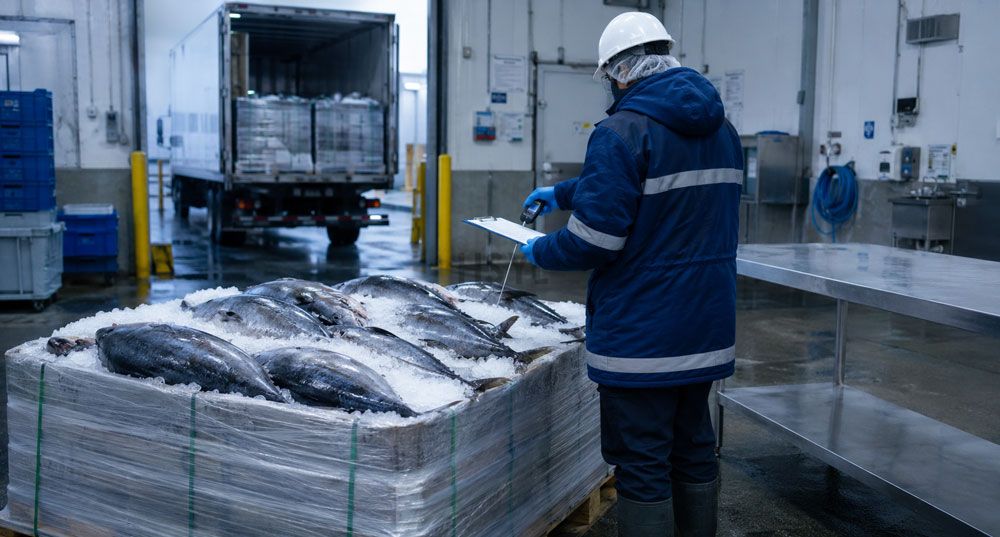
The scope covers raw fish receiving at a cannery, from truck arrival to the decision to release a lot into production or to isolate and reject it. It covers histamine-forming species (tuna, mackerel, sardine, bonito, and related fish) and the FDA, Codex, and EU regulatory structure that governs them. It does not cover the canned fish production line downstream of receiving, scheduled thermal-process design, or the mass balance and capacity layers covered in companion articles. A compliant canned fish production line starts with a compliant receiving program; this article is the receiving counterpart to the downstream engineering content.
Why Receiving Is the Critical Control Point for Histamine
Histamine forms when bacteria naturally present on fish gills, skin, and gut convert free histidine in the muscle into histamine through enzymatic decarboxylation. The rate of this conversion is temperature-dependent: it is slow near freezing and accelerates sharply as fish temperature rises into the abuse range. The bacteria most responsible — including Morganella morganii, Hafnia alvei, and Klebsiella pneumoniae — are mesophilic and produce histamine rapidly at temperatures above about 4 °C, with the fastest formation in the 10–30 °C range.
Three properties of histamine make receiving the critical control point:
- Histamine is heat-stable. Normal canning thermal processes — precooking, retort sterilization — do not destroy histamine. A lot with unsafe histamine at receiving will have unsafe histamine in the finished can.
- Histamine formation is irreversible. Once formed, histamine does not degrade during frozen storage, thawing, or processing. Rejection at receiving is the only effective control.
- Histamine is not always detectable by sensory inspection alone. Fish can have hazardous histamine levels without strong decomposition odor, particularly in the early stages of abuse. Sensory rejection catches gross decomposition; histamine sampling catches the hazardous-but-sensory-normal lot.
The regulatory consequence follows directly. Under the FDA Fish and Fishery Products Hazards and Controls Guidance and 21 CFR Part 123 (the FDA Seafood HACCP regulation), histamine is a hazard that must be controlled at receiving for histamine-forming species, and the control is a combination of time-temperature monitoring and sensory evaluation supported by chemical testing. The FDA Compliance Policy Guide Sec. 540.525 (revised 2024) sets the enforcement framework for histamine and decomposition in histamine-forming fish. Codex CXC 52-2003 (Code of Practice for Fish and Fishery Products) provides the international counterpart guidance. EU requirements differ in sampling plan detail and action levels and must be checked for the target export market.
Compliance note: Regulatory action levels, sampling plans, and guidance documents are revised periodically. The references in this article are accurate as of the last technical review date (2026-07-12). Before applying any threshold to your receiving program, verify the current version of the FDA Hazards Guide, 21 CFR Part 123, CPG Sec. 540.525, and Codex CXC 52-2003, and confirm the specific requirements of your export market.
Temperature at Receiving: What to Measure and How
Temperature at receiving is the primary indicator of time-temperature abuse. The objective is not to measure a single point but to reconstruct the temperature history of the lot well enough to judge whether histamine could have formed. Three measurement points matter, and each answers a different question.
| Measurement point | What it tells you | How to measure | Reference threshold (verify current version) |
|---|---|---|---|
| Transport environment (ice or refrigerated air) | Whether the cold chain was maintained in transit | Probe or IR thermometer in the fish mass, not the air | Typically 4 °C or lower for refrigerated; ice must be present and distributed |
| Surface temperature | Whether the outer fish warmed during unloading | IR or surface probe on several fish in the lot | Close to transport environment; sharp surface warming signals handling abuse |
| Core temperature | Whether the fish interior stayed cold | Calibrated probe thermometer inserted into the thickest part of the flesh | Typically 4 °C or lower; any fish above the threshold triggers sensory and histamine escalation |
The measurements are only as defensible as the calibration behind them. Probe thermometers must be calibrated against a reference (ice slurry and boiling water, or a certified reference) at the start of each receiving shift and after any shock or drop, with the calibration recorded. A thermometer that has not been calibrated cannot produce a defensible temperature reading, and a temperature reading that is not recorded with lot ID, time, sampler, and instrument ID cannot be used to defend a lot-acceptance decision in an audit.
The temperature measurement is a gate, not a target. A lot at or below the threshold is not automatically accepted — it still must pass sensory and (where required) histamine sampling. A lot above the threshold is not automatically rejected — it is escalated to sensory and histamine evaluation, and the decision is made on the combined evidence.
Sensory Checks: The First Signal of Decomposition
Sensory evaluation is the fastest and most sensitive method for detecting decomposition in raw fish, and it is the method most explicitly required by FDA and Codex guidance. A trained sensory evaluator can detect decomposition earlier than most chemical methods, because the volatile compounds that signal spoilage are perceptible to the human nose before histamine reaches hazardous levels.
The FDA Hazards Guide structures sensory evaluation around six dimensions, each scored against a species-specific reference standard. The table below summarizes the dimensions and the rejection signals; the detailed scoring criteria are in the FDA guidance and should be adopted verbatim into your receiving procedure.
| Dimension | Normal (accept) | Reject signal |
|---|---|---|
| Eyes | Clear, bright, full, sometimes bulging | Cloudy, sunken, discolored, collapsed |
| Gills | Bright red or pink, no slime, no off-odor | Brown, grey, or green discoloration; milky or putrid slime; sour or putrid odor |
| Skin | Bright, characteristic color, slime clear | Dull, faded, bleached; slime cloudy or yellow |
| Flesh | Firm, elastic, springs back when pressed | Soft, loses fingerprint when pressed, flabby |
| Belly | Firm, no burst | Soft, burst, sunken |
| Odor | Evaluated on gills and belly cavity; normal = fresh sea-like; reject = sour, putrid, cheesy, ammoniacal, or any off-odor characteristic of decomposition | |
Three operational rules govern sensory evaluation and determine whether it is audit-defensible. First, the evaluator must be trained and the training documented; an untrained evaluator's sensory rejection is not defensible. Second, sensory evaluation must be performed on a representative sample of the lot, not on the top fish only — typically a defined number of fish per pallet or per lot, drawn from multiple locations. Third, any sensory rejection must be recorded with the specific dimension and the specific reject signal, not as a generic "decomposed" judgment.
Sensory rejection is a hard reject for decomposition. It is not, by itself, a histamine measurement — a fish can be sensory-acceptable and still have hazardous histamine, and a fish can be sensory-rejectable for reasons unrelated to histamine. The two controls work together: sensory catches gross decomposition that may or may not involve histamine; histamine sampling catches the hazardous lot that looks normal.
Histamine Sampling: When, How Much, and Who Decides
Histamine sampling is the chemical control that backs up sensory evaluation for histamine-forming species. It is not a substitute for temperature and sensory control — sampling cannot test every fish, and histamine distribution within a lot is uneven, so a passing sample does not guarantee the lot is free of histamine. The purpose of sampling is to catch lots with histamine levels that sensory evaluation missed.
Three regulatory frameworks define histamine sampling for histamine-forming fish, and they differ in detail that matters for export. The table below summarizes the structure of each; the specific sample size, analytical method, and action level must be verified against the current version of each source before use.
| Framework | Scope | Sampling structure | Action level (verify current) |
|---|---|---|---|
| FDA Hazards Guide + 21 CFR 123 + CPG 540.525 | U.S. domestic and imported fish | Defined sample size per lot; subsamples from multiple fish; chemical analysis by validated method | Defect action level 50 ppm histamine (per CPG 540.525, 2024 revision — verify current) |
| Codex CXC 52-2003 + Codex sampling plans | International trade reference | Codex sampling plan structure with n, c, m, M values by product type | Per Codex standard for the specific product — verify current version |
| EU regulations (Reg. (EC) 2073/93 and successors, Reg. (EC) 853/2004) | EU market access | EU-specific sampling plan with different n and c values for certain products; species-specific limits | Per EU regulation for the specific product and species — verify current version |
Three operational decisions belong to the cannery QA function, not to the equipment supplier. First, the sampling frequency above the regulatory minimum — a cannery with a new supplier or a seasonally variable raw material may sample more intensively than the minimum. Second, the analytical method and laboratory — in-house rapid test, accredited external lab, or both, with the choice documented in the HACCP plan. Third, the lot-disposition rule when a sample exceeds the action level — hold, retest, reject, or destroy, in accordance with the applicable regulation and the cannery's own HACCP plan.
Compliance note: Histamine sampling plans and action levels differ across FDA, Codex, and EU frameworks, and the frameworks are revised periodically. A receiving program that meets one framework may not meet another. Before applying any sampling plan to your receiving program, verify the current version of each source and confirm the requirements of every export market you ship to.
Lot Acceptance and Rejection: A Decision Table
The four control inputs — temperature, sensory, histamine sampling, and documentation — combine into a single lot-disposition decision. The table below is a decision framework, not a substitute for the cannery's HACCP plan. Each cell should be adapted to the specific species, supplier history, and export market documented in the plan.
| Control input | Accept signal | Conditional hold signal | Reject signal |
|---|---|---|---|
| Temperature | Core and environment at or below threshold; ice present and distributed | Marginal temperature; isolated fish above threshold; documentation gap on cold chain | Core temperature above threshold on multiple fish; no ice; documented cold-chain break |
| Sensory | All sampled fish normal on all six dimensions | Borderline dimension on one or two fish; re-evaluation requested | Clear reject signal on any dimension; multiple fish affected |
| Histamine sampling | All subsamples below action level | One subsample approaching action level; retest initiated | Any subsample at or above action level |
| Documentation | Complete: lot ID, supplier, harvest date, vessel or farm, cold-chain log, species confirmation | Minor gap correctable before release | Missing or falsified documentation; species mismatch; traceability broken |
The disposition rule is that any reject signal triggers hold at minimum, and any reject signal on histamine or documentation triggers reject. A conditional hold is not a soft accept — it means the lot is physically isolated and not released into production until the hold condition is resolved by a documented QA decision. The decision and the person who made it must be recorded on the lot record.
Lot Isolation and Traceability During Holding
A lot on hold is not a lot in storage — it is a lot in legal limbo, and its physical and documentary isolation is what makes the hold enforceable. An audit-defensible isolation procedure has four components.
- Physical area. A clearly marked hold area, physically separated from accepted raw material and from finished goods, with access limited to authorized QA staff. The area must be large enough to hold the largest expected lot plus a margin, and it must be capable of maintaining temperature.
- Status labeling. Each pallet or container in hold carries a status label — Hold, Under Test, Rejected, or Released — with lot ID, date, and the QA staff member who set the status. A lot without a status label is treated as hold by default.
- Chain of custody. Every movement of the lot — into hold, out for sampling, back into hold, release to production, or removal for destruction — is recorded on the lot record with date, time, person, and action. A lot with a broken chain of custody cannot be released.
- Release authority. Only a named QA authority can release a lot from hold, and the release must be based on documented evidence (temperature, sensory, histamine, documentation all resolved). The release signature and date are the final entry on the lot record.
The isolation procedure is the part of the receiving program most often found non-compliant in audits — not because the procedure is wrong, but because the physical area is inadequate, the labels are missing or inconsistent, or the release authority is unclear. A receiving program audit should include a walk-through of the hold area and a review of three randomly selected lot records from hold to release.
Receiving Records: What Must Be Captured
The receiving record is the legal document that proves the lot was inspected and accepted. If it was not recorded, it did not happen — and in an audit, the absence of a record is treated as the absence of the control. The mandatory fields below are the minimum for an audit-defensible receiving record; a cannery's HACCP plan may require additional fields.
| Field group | Required fields |
|---|---|
| Lot identification | Lot ID (internal), supplier lot ID, species (scientific and common), harvest date, receiving date and time |
| Supplier and origin | Supplier name, vessel or farm ID, catch area or farm location, cold-chain carrier |
| Temperature | Instrument ID, calibration record, environment temperature, surface temperature, core temperature, sampler, time of measurement |
| Sensory | Sample size, dimensions checked, scores, reject signals if any, evaluator name and training reference |
| Histamine sampling | Sample size, subsample IDs, analytical method, lab reference, results, action level applied, sampler and analyst |
| Documentation review | Documents received, gaps identified, species confirmation, traceability verification |
| Disposition | Decision (accept / hold / reject), basis for decision, QA authority signature, date and time, hold status and release if applicable |
Record retention is a regulatory requirement, not a cannery preference. FDA Seafood HACCP records must be retained for at least one year for refrigerated products and two years for frozen products (per 21 CFR 123.9), and EU requirements may differ. The cannery's record-retention policy must be documented in the HACCP plan and verified in internal audits.
Equipment and Layout That Support Receiving QA
The receiving program is a QA process, but it depends on equipment and layout that make the process executable and hygienic. Four equipment and layout decisions directly affect receiving QA.
- Temperature monitoring equipment. Calibrated probe thermometers (required for core temperature) and IR thermometers (useful for surface screening) are the minimum. The calibration frequency and method must be documented. Equipment that cannot be calibrated cannot produce a defensible reading.
- Sensory inspection station. A dedicated stainless steel table with good lighting, drainage, and easy cleaning, positioned so that the evaluator can work without blocking unloading. The station must be cleaned and sanitized between lots to prevent cross-contamination.
- Hold area design. The physical hold area must be part of the factory layout, not an improvised corner. It needs temperature control, clear marking, and limited access. The seafood processing equipment solutions scope includes receiving and pre-processing layout that should account for hold area from the start, not as a retrofit.
- Post-receiving washing. Fish accepted at receiving typically moves to a washing step before butchering, to remove surface slime, blood, and loose scales that would otherwise contaminate downstream equipment. A fish speed cleaning machine integrated into the receiving-to-butching transition standardizes this step and removes a source of line variability — but it does not replace the receiving inspection, and it does not reduce histamine already in the flesh.
Engineering note: Equipment capability at receiving — thermometer accuracy, cleaning machine throughput, hold area capacity — supports the QA program but does not define it. The receiving program is governed by the cannery's HACCP plan and the applicable regulation. Equipment suppliers specify what the equipment can do; the QA authority decides how it is used to meet the regulatory standard.
Downloadable Receiving Record and Isolation Checklist
The receiving record template and lot-isolation checklist referenced in this article provide a structured two-document set. The receiving record captures lot identification, supplier and origin, temperature, sensory, histamine sampling, documentation review, and disposition in a single form. The isolation checklist covers hold area assignment, status labeling, chain-of-custody entries, and release authority signature. Together they form the minimum documentation to defend a lot-acceptance decision in an FDA, Codex, or EU audit.
To request the templates: Share your fish species, export market (US, EU, or other), current HACCP plan structure, and whether the receiving program is greenfield or an audit of an existing program. HSYL will return a pre-filled template set with the regulatory references for your market and a blank field column for your site data.
Scope, Sources and Limitations
Scope. This article covers raw fish receiving at a cannery, from truck arrival to lot disposition, for histamine-forming species. It does not cover the canned fish production line downstream of receiving, scheduled thermal-process design, mass balance, or capacity sizing — each is a separate engineering topic covered in companion articles.
Limitations. All regulatory thresholds, sampling plans, and action levels are cited to public sources and are accurate as of the last technical review date. Regulatory frameworks are revised periodically, and a receiving program that meets one framework may not meet another. HSYL does not provide legal or regulatory compliance advice and does not publish project-specific rejection rates or detection accuracy without verified evidence. A defensible receiving program for your plant must be reviewed by your QA authority against the current version of every applicable regulation.
Source basis. Regulatory references include the FDA Fish and Fishery Products Hazards and Controls Guidance, 21 CFR Part 123 (Seafood HACCP), FDA Compliance Policy Guide Sec. 540.525 (scombrotoxin/histamine, 2024 revision), Codex CXC 52-2003 (Code of Practice for Fish and Fishery Products), and EU regulations including Reg. (EC) 2073/93 and Reg. (EC) 853/2004 as amended. Specific source versions and review dates are recorded in the internal Evidence Brief and are available on request. Equipment-capability statements refer to HSYL equipment specifications and do not imply a compliance conclusion.
Reviewer and date. QA & Food Safety Lead, HSYL. Last technical review: 2026-07-12. This article should be re-reviewed when any cited regulation is updated, when Codex or EU histamine sampling attachments are revised, or when HSYL publishes verified project data relevant to receiving QA.
Receiving Inspection and Food Safety Resources
Three resources complement this receiving program when building or auditing a fish cannery. The first is the canned fish commercial page, which anchors the species-specific line that this receiving program feeds. The second is the seafood processing solutions page, which frames the full receiving-to-processing layout. The third is the fish cleaning machine page, which carries the equipment detail for the post-receiving wash step.
- Canned fish production line — the species-level line that the receiving program supplies, with full downstream equipment scope.
- Seafood processing equipment solutions — the broader seafood processing scope, including receiving layout and pre-processing design that must accommodate the hold area.
- Fish speed cleaning machine — the post-receiving wash equipment that standardizes the transition from accepted raw fish to butchering.
Frequently Asked Questions
Why is receiving the critical control point for histamine in a fish cannery?
Does cooking or retorting destroy histamine in canned fish?
What temperature should raw fish be at receiving?
How many fish do I need to sample for histamine at receiving?
Can I accept a lot that fails sensory but passes histamine?
What records must I keep for raw fish receiving under FDA Seafood HACCP?
Must-Read Blogs For Chain Restaurants Owner

 Fish Meal Production Line
 Blackfish Canning Production Line
Ready to Get Started?