
Retort Heat Distribution vs Heat Penetration: What Each Study Proves
Two validation studies sit at the foundation of every retort-based canned fish process: heat distribution and heat penetration. They are often confused, sometimes treated as interchangeable, and occasionally substituted for each other in documentation — but they answer different questions, they are performed differently, and one cannot substitute for the other. A heat distribution study proves that the retort itself delivers uniform temperature. A heat penetration study proves that a specific product, in a specific container, under specific critical factors, reaches commercial sterility under the scheduled process. This article sets out what each study proves, how each is performed, when each is required, and why confusing them is a compliance and safety risk.
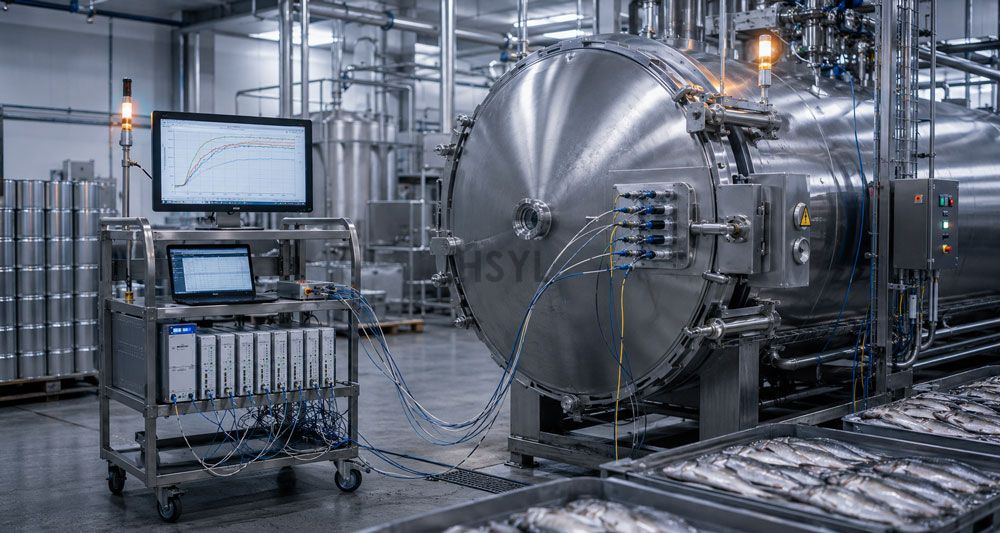
The scope covers the two validation studies as they apply to fish canning retorts — purpose, sensor placement, output, triggers, and relationship to the scheduled process. It covers the conceptual framework and the regulatory structure. It does not cover retort cycle design, scheduled-process establishment, mass balance, capacity, or receiving. A compliant turnkey canning line scope includes retort validation as a commissioning and ongoing obligation; this article is the validation-concept counterpart to the retort equipment and commissioning content.
Two Studies, Two Questions
The confusion between heat distribution and heat penetration usually starts at the level of the question each study answers. The two questions sound similar but are fundamentally different.
Heat distribution answers: "Does this retort deliver uniform temperature throughout the chamber?" The subject of the study is the retort itself — its steam distribution, its venting, its condensate drainage, its geometry. The study asks whether every position in the retort reaches the same temperature at the same time, or whether some positions (cold spots) lag behind. The answer is a property of the equipment, not of the product.
Heat penetration answers: "Does this product, in this container, under these critical factors, reach commercial sterility under this scheduled process?" The subject of the study is the product-container-process combination. The study asks how fast heat moves from the retort medium into the slowest-heating point of the product, and whether that heating rate, combined with the retort temperature and hold time, delivers the lethality required. The answer is a property of the product-process pairing, not of the retort alone.
Because the questions are different, the studies are different, and the evidence each produces is not interchangeable. A retort with excellent heat distribution can still fail to sterilize a product if the heat penetration characteristics of that product were not studied and the scheduled process was not set correctly. A product with a valid heat penetration study can still fail if the retort's heat distribution has drifted and a cold spot has developed. Both studies are required, and both must be current.
Concept note: A useful mnemonic is: distribution studies the oven; penetration studies the food. The oven must be uniform (distribution); the food must cook through (penetration). A uniform oven does not guarantee cooked food, and cooked food does not prove the oven is uniform. Both must be established independently.
Heat Distribution Study: Proving the Retort Itself
A heat distribution study is performed on the retort, typically empty or with a dummy load that represents the thermal mass of a production load without the product. Its purpose is to map the temperature distribution inside the retort chamber during a cycle and to identify any cold spots that would cause under-processing in production.
The study uses multiple calibrated temperature sensors distributed throughout the retort chamber — typically 9 to 12 or more sensors, placed at multiple depths (top, middle, bottom), multiple lateral positions (center, sides, corners), and near known potential cold spots (near the door, near drains, near vent locations). The sensors are placed in the retort chamber, not inside the product. The retort is then run through a cycle, and the temperature at each sensor is recorded continuously from the start of come-up through the hold and into cooling.
The outputs of a heat distribution study are:
- Come-up time. The time from cycle start until all sensor positions reach the retort's setpoint temperature (within a defined tolerance). Long come-up time indicates venting or steam-supply problems.
- Temperature distribution. The spread between the hottest and coldest sensor positions during the hold phase. A wide spread indicates distribution problems — steam inlet design, bleeder blockage, condensate pooling, or loading pattern interference.
- Cold-spot identification. The location of the sensor or sensors that consistently lag or run coolest. This location becomes a reference for where heat penetration sensors should be placed in production (the worst-case position in the retort).
- Stability over time. Whether the distribution holds steady through the hold phase or drifts. Drift indicates a dynamic problem (e.g., condensate accumulation, steam-supply fluctuation).
The study is performed when a retort is installed, after any significant modification (repair, relocation, steam-system change), and periodically as part of revalidation. It is an equipment-capability study — it proves the retort can deliver uniform temperature, not that any specific product is safe. A retort sterilization equipment for fish canning installation is not complete until a heat distribution study has been performed and documented.
Heat Penetration Study: Proving the Process for a Specific Product
A heat penetration study is performed on a specific product in a specific container under specific critical factors. Its purpose is to determine the temperature history at the slowest-heating point in the product during the retort cycle, and from that history to establish or verify the scheduled process that achieves commercial sterility.
The study uses calibrated temperature sensors inserted into the product at the slowest-heating point — typically the geometric center for conduction-heating products (solid-pack fish), or a different location for convection-heating products (fish in brine or oil, where convection currents move heat). The sensors are placed inside the can, in the product, not in the retort chamber. The instrumented cans are placed at the cold spot identified by the heat distribution study (the worst-case position in the retort), and the retort is run through the scheduled process.
The outputs of a heat penetration study are:
- Temperature history at the slowest-heating point. A continuous recording of product temperature from cycle start through the hold and into cooling. This is the core data of the study.
- Heat penetration curve. A plot of product temperature versus retort time, showing how fast the product heats. The curve shape depends on product, container, packing medium, and critical factors.
- Lethality calculation (F-value). The cumulative microbial lethality delivered to the slowest-heating point, calculated from the temperature history using a defined z-value and reference temperature. The F-value is the measure of whether the process achieved sterility.
- Scheduled process parameters. The retort temperature, hold time, and critical-factor limits that the study validated. These become the scheduled process — the parameters that must be used in production for this product-container-process combination.
- Critical-factor limits. The values of fill weight, headspace, initial temperature, packing medium, and container size that the study was based on. These become the critical-factor limits that production must control.
The study is performed for every new product, every new container size or type, every significant formulation change, and periodically as part of revalidation. It is a process-authority responsibility — the study is performed by or under the supervision of a process authority, and the scheduled process it establishes is filed with the appropriate regulatory authority. A species-level canned fish thermal process requires a heat penetration study for each species, product format, and container size combination that the line produces.
Side-by-Side Comparison
The table below contrasts the two studies across the dimensions that matter for validation planning. The comparison is drawn from publicly available FDA, Codex, and IFTPS (Institute for Thermal Processing Specialists) guidance material; specific protocol details should be verified against the current version of each source.
| Dimension | Heat distribution study | Heat penetration study |
|---|---|---|
| Subject of study | The retort (equipment capability) | The product-container-process combination (process validity) |
| Question answered | Is temperature uniform throughout the chamber? | Does the product reach commercial sterility under the scheduled process? |
| Sensor location | In the retort chamber, distributed across positions (not in product) | Inside the can, at the slowest-heating point of the product |
| Sensor count | Multiple (typically 9–12+) distributed across chamber | Fewer (typically in multiple instrumented cans, at cold-spot position) |
| Load | Empty or dummy load representing thermal mass | Actual product in actual containers with critical factors controlled |
| Primary output | Come-up time, temperature spread, cold-spot location | Temperature history, F-value, scheduled process parameters |
| Who performs | Retort supplier, cannery engineering, or qualified third party | Process authority (or under process-authority supervision) |
| Establishes | Equipment capability and cold-spot reference for penetration studies | Scheduled process and critical-factor limits for a specific product |
| Regulatory reference | 21 CFR Part 113; FDA Hazards Guide; Codex CXC 23-1979; IFTPS guidelines | 21 CFR Part 113; FDA Hazards Guide; Codex CXC 23-1979; IFTPS guidelines |
Two reads from the table matter. First, the studies are complementary, not redundant — each proves something the other cannot. Second, the "who performs" distinction is important: a heat distribution study is often performed by the retort supplier or cannery engineering team, while a heat penetration study is performed by or under a process authority. Confusing the two roles is a common audit finding.
When Each Study Is Required
The two studies are triggered by different life-cycle events. The table below maps common events to the study or studies required. The triggers are drawn from regulatory and standards guidance; specific requirements should be verified against the current version of 21 CFR Part 113 and the FDA Hazards Guide.
| Life-cycle event | Distribution study | Penetration study | Notes |
|---|---|---|---|
| New retort installation | Required | Not directly (but needed before first production) | Distribution proves the retort works; penetration is needed for each product run on it |
| New product or formulation | Not required (if retort unchanged) | Required | Each product-container combination needs its own scheduled process |
| New container size or type | Not required (if retort unchanged) | Required | Container geometry changes heat penetration |
| Retort modification or repair | Required | Required if modification affects heat transfer | Steam system, venting, or geometry changes require revalidation |
| Process change (temperature, time, critical factor) | Not required (if retort unchanged) | Required | Any change to scheduled process parameters requires revalidation |
| Periodic revalidation | Required (frequency per regulation and HACCP plan) | Required (frequency per regulation and HACCP plan) | Both studies are part of ongoing validation, not one-time events |
| Cold-spot drift suspected | Required | Required if drift confirmed | Distribution drift can invalidate penetration studies that assumed the original cold spot |
The table highlights a common gap: cannery teams often treat validation as a one-time commissioning event, when in fact both studies have ongoing revalidation requirements. A retort that was validated at installation can develop distribution drift over years of operation, and a product that was validated at launch may need revalidation if critical-factor control drifts or if raw material changes affect heat penetration characteristics.
Common Confusion and Its Consequences
Three patterns of confusion between the two studies appear regularly in cannery audits, and each carries a specific compliance and safety risk.
Confusion 1: Treating a distribution study as proof of product safety. A cannery points to a heat distribution report as evidence that its canned fish is safe. The distribution report proves the retort is uniform; it does not prove that any specific product reaches sterility. The consequence is a false sense of safety — the retort works, but without a heat penetration study, there is no evidence that the scheduled process is valid for the product.
Confusion 2: Treating a penetration study as proof of retort capability. A cannery points to a heat penetration report as evidence that its retort is functioning correctly. The penetration report proves the product-process combination is valid at the cold spot identified in the distribution study; it does not prove that the cold spot has not moved or that the distribution has not drifted. The consequence is undetected equipment degradation — the product was safe when the distribution was last studied, but the distribution may have changed since.
Confusion 3: Substituting one study for the other in documentation. A cannery submits a distribution study where a penetration study is required (e.g., for a new product filing), or vice versa. The consequence is a regulatory finding — the submission is incomplete or invalid, and the cannery may be required to stop production of the affected product until the correct study is performed and filed.
| Confusion pattern | What it misses | Compliance and safety risk |
|---|---|---|
| Distribution as proof of product safety | Product-specific heat penetration and scheduled process | Product may not be sterile; scheduled process may be invalid |
| Penetration as proof of retort capability | Current heat distribution and cold-spot location | Retort drift undetected; cold spot may have moved |
| Substituting one study for the other | The other study entirely | Regulatory finding; production stoppage; product recall risk |
The corrective discipline is to maintain both studies as separate, current documents, each with its own protocol, its own data, and its own revalidation schedule. A validation file that contains only one type of study is incomplete, regardless of how thoroughly that one study was performed.
The Relationship to Critical Factors
The two studies connect to critical factors in different ways, and understanding the connection is part of understanding why the studies are not interchangeable.
A heat distribution study does not involve critical factors directly, because it studies the retort, not the product. But the cold spot it identifies becomes the reference location for heat penetration studies — the worst-case position in the retort where instrumented cans should be placed. If the distribution drifts and the cold spot moves, the penetration study's assumption about worst-case position is no longer valid, and the penetration study may need to be repeated at the new cold spot.
A heat penetration study is built on critical factors. The study is run with specific fill weight, headspace, packing medium, initial temperature, and container size — and the scheduled process it establishes is valid only when those critical factors are controlled in production. A critical-factor deviation in production invalidates the penetration study for the affected cans, regardless of whether the retort's distribution is perfect. This is why critical-factor control (covered separately) and heat penetration validation are inseparable: the penetration study assumes critical factors are in spec, and production must maintain that assumption for the scheduled process to remain valid.
Compliance note: This article describes the conceptual framework and regulatory structure for heat distribution and heat penetration studies. It does not provide study protocols, F-values, scheduled-process parameters, or cold-spot locations for any specific retort or product. Those are established by a process authority and qualified validation personnel for the specific retort, product, and container, and they must be documented in the cannery's validation file and HACCP plan. Always verify the current version of 21 CFR Part 113, the FDA Hazards Guide, Codex CXC 23-1979, and applicable IFTPS guidelines before performing or submitting a validation study.
Downloadable Validation Protocol Templates
The validation protocol templates referenced in this article provide a structured two-document set. The heat distribution protocol covers retort identification, sensor positions, come-up time measurement, temperature spread analysis, and cold-spot identification. The heat penetration protocol covers product and container identification, critical-factor documentation, sensor location in the product, retort position at the cold spot, temperature history recording, and F-value calculation. Together they form the framework for a validation file that distinguishes the two studies clearly.
To request the templates: Share your retort type (batch still, batch agitating, or continuous), product format (solid pack, brine, oil, sauce), container size range, and whether the validation is for a new installation, a new product, or a periodic revalidation. HSYL will return a pre-filled protocol template set with the framework for your retort type and a blank field column for your process-authority-specified parameters.
Scope, Sources and Limitations
Scope. This article covers heat distribution and heat penetration studies as they apply to fish canning retorts — purpose, sensor placement, output, triggers, and relationship to the scheduled process and critical factors. It does not cover retort cycle design, scheduled-process establishment, mass balance, capacity, or receiving — each is a separate topic.
Limitations. All study descriptions, triggers, and frameworks are drawn from publicly available regulatory and standards material. Actual study protocols, F-values, and scheduled-process parameters are established by a process authority and qualified validation personnel for the specific retort, product, and container. HSYL does not provide process-authority services, does not establish scheduled-process parameters, and does not publish project-specific validation data without verified evidence. A defensible validation program for your plant must be performed by qualified personnel and reviewed against the current version of every applicable regulation and standard.
Source basis. Regulatory and standards references include 21 CFR Part 113 (Thermally Processed Low-Acid Foods Packaged in Hermetically Sealed Containers), the FDA Fish and Fishery Products Hazards and Controls Guidance, Codex CXC 23-1979 (Code of Hygienic Practice for Low-Acid and Acidified Low-Acid Canned Foods), and IFTPS (Institute for Thermal Processing Specialists) guidelines on heat distribution and heat penetration studies. Specific source versions and review dates are recorded in the internal Evidence Brief and are available on request. Equipment-capability statements refer to HSYL equipment specifications and do not imply a scheduled-process or compliance conclusion.
Reviewer and date. Thermal-Process Specialist & QA, HSYL. Last technical review: 2026-07-12. This article should be re-reviewed when 21 CFR Part 113, the FDA Hazards Guide, Codex CXC 23-1979, or IFTPS guidelines are updated, or when HSYL publishes verified project data relevant to retort validation.
Retort Validation and Thermal Process Resources
Three resources complement this validation content when specifying or auditing a fish canning retort system. The first is the retort equipment page, which carries the sterilization equipment detail. The second is the canning line hub, which frames the full retort-inclusive line scope. The third is the canned fish line page, which anchors the species-level thermal process that the heat penetration study validates.
- Retort sterilization equipment for fish canning — the retort equipment whose capability a heat distribution study proves.
- Turnkey canning line scope — the full line scope including retort commissioning and validation obligations.
- Species-level canned fish thermal process — the species-level line for which heat penetration studies establish scheduled processes.
Next Step: Build a Defensible Retort Validation File
If you are commissioning a new retort, adding a new product or container, or auditing an existing validation file against current regulatory and standards requirements, the fastest next step is to confirm that both studies exist, are current, and are clearly distinguished. Send HSYL your retort type, product format, container size range, and whether the validation is for a new installation, a new product, or a periodic revalidation. HSYL will return a pre-filled validation protocol template set with the framework for your retort type, plus an equipment-capability review that confirms whether your retort's distribution is documented and whether your penetration studies are current for every product-container combination you run.
Frequently Asked Questions
What is the difference between heat distribution and heat penetration in a retort?
Can a heat distribution study prove my canned fish is safe?
Can a heat penetration study prove my retort is working correctly?
Who performs a heat penetration study?
When do I need to repeat a heat distribution study?
What happens if I submit the wrong study type for a regulatory filing?
Must-Read Blogs For Chain Restaurants Owner

 Peach Canned Food Production Line
 Honey Processing Equipment
 Automatic Bone Crushing Machine
 Fish Deboner Machine
Ready to Get Started?