
F₀, D-Value and z-Value in Canned Fish: Why 121.1°C Is Not a Complete Process
The most persistent misconception in canned fish thermal processing is that 121.1 °C (250 °F) is "the sterilizing temperature" — that reaching 121.1 °C for some fixed time makes a product safe. It does not. 121.1 °C is a reference temperature used in the F₀ calculation, not a complete process. A complete process is defined by the interaction of F₀, D-value, and z-value with the specific product, container, and formulation — and it is established by a process authority, not read off a chart. This article explains what each parameter means, how they relate, and why no universal scheduled process can be copied from one plant or product to another.
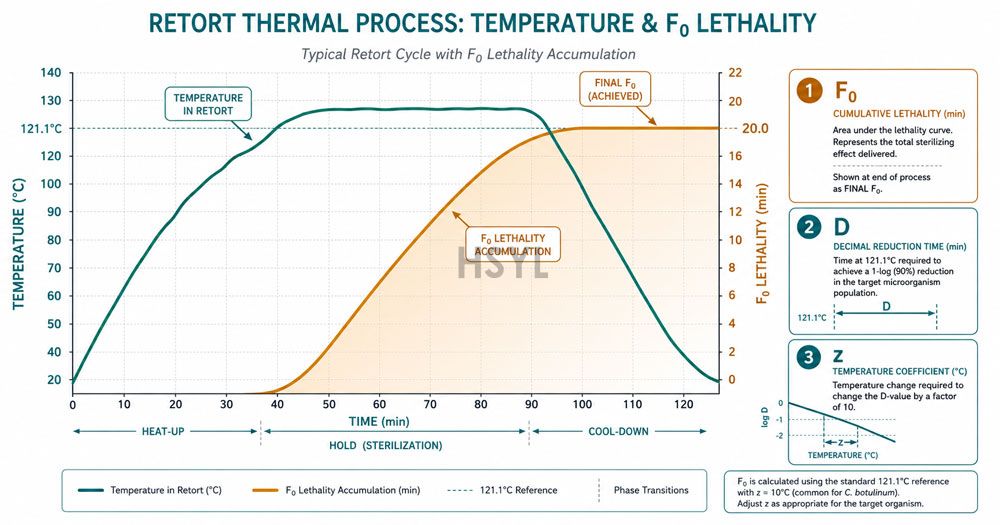
The scope covers the thermal-kinetics concepts behind canned fish sterilization: F₀, D-value, z-value, the role of 121.1 °C as a reference temperature, and the product, container, and formulation specificity that makes every scheduled process unique. It covers the science, not the establishment of any specific scheduled process. It does not cover retort validation studies (covered separately), mass balance, capacity, or receiving. A canned fish product and container format requires its own scheduled process established by a process authority; this article is the kinetics-concept counterpart to that establishment.
What 121.1°C Actually Is (and Is Not)
The temperature 121.1 °C (250 °F) occupies a central place in thermal processing literature, and that centrality is the source of the misconception. Three statements clarify what 121.1 °C is and is not.
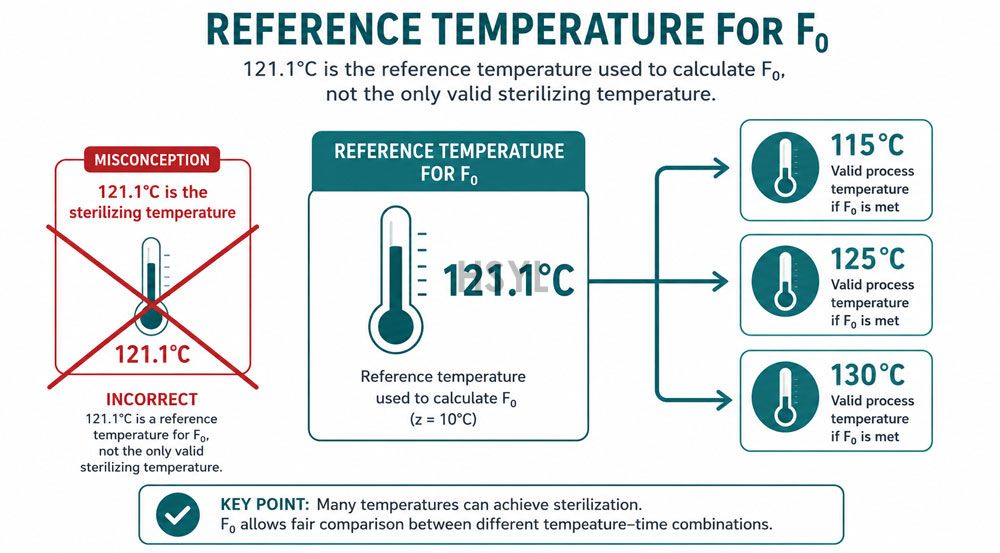
121.1 °C is the reference temperature for F₀. The F₀ value — the standard measure of accumulated lethality — is defined as the equivalent time at 121.1 °C, assuming a z-value of 10 °C. When a process authority reports "F₀ = 6 minutes," it means the process delivered the same microbial lethality as 6 minutes at 121.1 °C, regardless of what the actual retort temperature or hold time was. The 121.1 °C reference is what makes F₀ values comparable across different processes and different retorts.
121.1 °C is not "the sterilizing temperature." There is no single temperature at which canned fish becomes safe. A process can run at 115 °C, 121 °C, 130 °C, or other temperatures, and each can be valid if the accumulated lethality (F₀) meets the target established by the process authority for the specific product. Lower temperatures require longer times; higher temperatures require shorter times. The lethality is what matters, not the temperature label.
121.1 °C is not a complete process. Even if a retort is set to 121.1 °C, the product inside the can does not instantly reach 121.1 °C. Heat penetrates the can over time, and the product temperature traces a curve from its initial temperature up toward the retort temperature. The accumulated lethality depends on that entire curve — every minute at every temperature contributes — not on the retort setpoint. Two processes both "at 121.1 °C" can deliver very different F₀ values if the heat penetration characteristics differ.
Concept note: A useful framing is that 121.1 °C is to thermal processing what sea level is to altitude. Altitude is measured "above sea level" not because sea level is the only place with altitude, but because it is a common reference that makes measurements comparable. Similarly, lethality is expressed "at 121.1 °C" not because 121.1 °C is the only valid process temperature, but because it is a common reference that makes lethality comparable.
D-Value: The Time to Reduce by One Log
The D-value (decimal reduction time) is the time required at a specific temperature to reduce a specific microbial population by 90% (one logarithmic cycle, or "one log"). It is the most fundamental unit of thermal inactivation kinetics, and it is the building block on which F₀ is constructed.
Three properties of the D-value define how it is used and why it cannot be treated as a universal constant.
The D-value is temperature-specific. A D-value is always reported at a specific temperature — for example, D₁₂₁.₁ means the D-value at 121.1 °C. The D-value changes with temperature: higher temperatures have shorter D-values (less time to achieve the same kill), and lower temperatures have longer D-values. The rate of this change is described by the z-value, covered in the next section.
The D-value is microorganism-specific. Different microorganisms have different D-values at the same temperature. A heat-resistant sporeformer (such as Clostridium sporogenes, a common surrogate for Clostridium botulinum) has a longer D-value than a less heat-resistant organism. The D-value used in process design is the D-value of the target organism — the most heat-resistant organism of public health or spoilage concern for the product.
The D-value is medium (product) specific. The same microorganism in two different products can have different D-values, because the product composition (fat content, pH, water activity, salt, preservatives) affects heat resistance. A D-value determined in buffer is not directly applicable to canned fish in oil; the D-value must be determined in the actual product, or a conservative surrogate must be used with a documented safety margin.
Because of these three specificities, a D-value is never a single number that can be looked up in a generic table and applied to any product. It is a measured property of a specific microorganism in a specific medium at a specific temperature — and the process authority uses it, with the z-value, to design the scheduled process.
z-Value: How D Changes with Temperature
The z-value is the temperature change required to change the D-value by a factor of 10 (one log). It is the parameter that allows lethality calculations to be converted between temperatures, and it is what makes the F₀ calculation possible.
If a microorganism has a z-value of 10 °C, then increasing the temperature by 10 °C reduces the D-value by a factor of 10 (the kill is ten times faster). Decreasing the temperature by 10 °C increases the D-value by a factor of 10 (the kill is ten times slower). This relationship is what allows the Bigelow equation — the foundation of F₀ — to convert a varying product temperature history into an equivalent time at the reference temperature.
Two properties of the z-value matter for process design. First, the z-value is microorganism-specific, like the D-value. Different organisms respond differently to temperature changes. Second, the z-value used in the F₀ calculation is a chosen value — typically 10 °C for low-acid canned foods, targeting sporeformers — and this choice is documented in the process design. If a different z-value is used (for a different target organism or product), the resulting lethality value is not F₀ but a related value (sometimes called F or Fₜ), and the distinction matters in process filing.
The practical consequence is that F₀ is not a pure physical measurement — it is a lethality expressed relative to a specific reference temperature (121.1 °C) and a specific z-value (typically 10 °C). Two processes with the same temperature-time history can be reported with different lethality values if the z-value assumption differs. This is why F₀ values in process filings must always be accompanied by the z-value used in the calculation.
F₀: The Equivalent Lethality at 121.1°C
F₀ is the accumulated lethality of a thermal process, expressed as the equivalent time at 121.1 °C with a z-value of 10 °C. It is the parameter that converts a complex, varying temperature history into a single comparable number — and it is the parameter most often misunderstood because it sounds like a time.
F₀ is calculated by integrating the lethality rate over the entire process. The lethality rate at any instant depends on the product temperature at that instant, relative to the reference temperature, scaled by the z-value. The structure of the calculation (the Bigelow equation) is:
F₀ = ∫ 10^((T − 121.1) / z) dt, integrated over the process time, where T is the product temperature at the slowest-heating point, and z is typically 10 °C.
Three consequences of this equation are the source of most F₀ misunderstandings.
F₀ is accumulated, not instantaneous. Every moment the product is above the reference temperature contributes to F₀. The come-up phase, the hold phase, and the early cooling phase all contribute. A process with a short hold at high temperature can deliver the same F₀ as a process with a longer hold at a lower temperature, because lethality accumulates differently in each case.
F₀ is not the hold time. A retort set to 121.1 °C for 15 minutes does not necessarily deliver F₀ = 15. The product inside the can spends much of that time below 121.1 °C (during come-up) and the accumulated lethality depends on the actual product temperature curve, not the retort setpoint. The F₀ is typically less than the hold time, and the gap depends on heat penetration characteristics.
F₀ is product-specific. The same retort, the same setpoint, the same hold time, will deliver different F₀ values to two different products (e.g., solid-pack tuna vs tuna in brine), because the heat penetration curves differ. This is why an F₀ target cannot be copied from one product to another, even in the same retort.
Why 121.1°C Is Not a Complete Process
Bringing the three parameters together shows why "we run at 121.1 °C" is not a defensible statement about process safety. A complete process requires four elements that 121.1 °C alone does not provide.
| Element | What it provides | Why 121.1 °C alone does not provide it |
|---|---|---|
| Target organism and its D-value | The kill rate at the reference temperature | D-value is product- and organism-specific; 121.1 °C is just a temperature |
| z-value | The temperature sensitivity of the kill rate | z-value is organism-specific; 121.1 °C says nothing about z |
| F₀ target | The total lethality required for safety | F₀ target depends on D-value and the required log reduction; 121.1 °C does not define it |
| Heat penetration characteristics | The actual product temperature curve that delivers the F₀ | Heat penetration is product-container-specific; 121.1 °C is the retort reference, not the product curve |
The table shows that 121.1 °C is one reference point in a system of four interdependent elements. Remove any of the other three, and the temperature alone says nothing about whether the process is safe. A process that "runs at 121.1 °C" without a documented D-value, z-value, F₀ target, and heat penetration study is not a defined process — it is a retort setting, and a retort setting is not a safety guarantee.
Product, Container, and Formulation Specificity
The reason no universal scheduled process exists is that thermal kinetics depend on the product, the container, and the formulation. Change any of these, and the heat penetration curve changes, the F₀ delivered by the same retort settings changes, and the scheduled process must be re-established.
| Specificity dimension | Variables that change heat penetration | Effect on scheduled process |
|---|---|---|
| Product | Species (tuna, sardine, mackerel), format (loin, chunk, whole, minced), size, fat content | Different product → different heat penetration curve → different F₀ from same retort settings → new scheduled process required |
| Container | Can size (diameter, height), shape (round, rectangular), material (tinplate, aluminum), fill orientation | Different container → different heat transfer path → different heat penetration curve → new scheduled process required |
| Formulation | Packing medium (oil, brine, sauce, solid pack), medium viscosity, ingredients, initial temperature, fill weight, headspace | Different formulation → different heat transfer mechanism (conduction vs convection) → different heat penetration curve → new scheduled process required |
The implication for a fish cannery is direct: every product-container-formulation combination that the line produces requires its own scheduled process, established by a process authority based on a heat penetration study for that combination. A fish canning retort thermal process system can run many combinations, but each must have its own process filing, its own critical-factor limits, and its own F₀ target. The retort is the same; the processes are not.
What This Means for a Fish Cannery
The thermal-kinetics framework has practical consequences for how a cannery organizes its process safety work, and for what it can and cannot expect from its equipment supplier.
The process authority establishes the scheduled process. The D-value, z-value, F₀ target, and the heat penetration study that validates them are the responsibility of a process authority — a qualified specialist who designs and files the scheduled process. The cannery's QA team controls the critical factors in production to keep the scheduled process valid. The equipment supplier provides the retort and its capability data. None of these roles can substitute for another.
The equipment supplier provides capability, not schedule. A retort supplier specifies what the retort can deliver — temperature range, come-up time, temperature distribution, pressure capability, cooling capacity. The supplier does not — and cannot — provide a scheduled process for a specific product, because the scheduled process depends on the product, container, and formulation, which the supplier does not control. A cannery that expects its retort supplier to provide "the F₀" or "the process time" for its product has misunderstood the division of responsibility.
Critical-factor control is what keeps the scheduled process valid in production. Once the scheduled process is established for a specific product-container-formulation combination, production must control the critical factors (fill weight, headspace, initial temperature, packing medium, container size) to within the limits in the scheduled process. A critical-factor deviation can change the heat penetration curve and invalidate the F₀ for the affected cans — regardless of whether the retort ran at 121.1 °C.
| Misconception | Correct interpretation |
|---|---|
| "121.1 °C is the sterilizing temperature" | 121.1 °C is the reference temperature for F₀; valid processes can run at other temperatures if F₀ is met |
| "F₀ equals the hold time" | F₀ is accumulated lethality over the entire process, typically less than the hold time |
| "D-value is universal" | D-value is specific to microorganism, medium, and temperature |
| "We can copy another plant's scheduled process" | Scheduled processes are product-container-formulation-specific; copying invalidates the process |
| "The retort supplier provides the F₀" | The process authority establishes F₀; the supplier provides retort capability |
| "Running at 121.1 °C means the product is safe" | Safety depends on accumulated F₀, which depends on the product's heat penetration curve, not the retort setpoint |
Scope, Sources and Limitations
Scope. This article covers the thermal-kinetics concepts behind canned fish sterilization: F₀, D-value, z-value, the role of 121.1 °C as a reference temperature, and the product, container, and formulation specificity of scheduled processes. It does not cover retort validation studies, mass balance, capacity, receiving, or the establishment of any specific scheduled process.
Limitations. All parameter definitions and relationships are drawn from publicly available regulatory, standards, and food-science material. Actual D-values, z-values, F₀ targets, and scheduled processes are established by a process authority for the specific product, container, and formulation, and are documented in the cannery's process filing and HACCP plan. HSYL does not provide process-authority services, does not establish scheduled processes, and does not publish project-specific thermal-kinetics data without verified evidence. A defensible thermal process for your plant must be established by a qualified process authority and reviewed against the current version of every applicable regulation and standard.
Source basis. Regulatory and scientific references include 21 CFR Part 113 (Thermally Processed Low-Acid Foods Packaged in Hermetically Sealed Containers), the FDA Fish and Fishery Products Hazards and Controls Guidance, Codex CXC 23-1979 (Code of Hygienic Practice for Low-Acid and Acidified Low-Acid Canned Foods), IFTPS (Institute for Thermal Processing Specialists) guidelines, and established food-science literature on thermal inactivation kinetics. Specific source versions and review dates are recorded in the internal Evidence Brief and are available on request. Equipment-capability statements refer to HSYL equipment specifications and do not imply a scheduled-process or compliance conclusion.
Reviewer and date. Thermal-Process Specialist & Food Science, HSYL. Last technical review: 2026-07-12. This article should be re-reviewed when 21 CFR Part 113, the FDA Hazards Guide, Codex CXC 23-1979, or IFTPS guidelines are updated, or when new food-science material on thermal kinetics becomes available.
Thermal Process Kinetics and Lethality Resources
Two resources complement this thermal-kinetics content when organizing a fish cannery's process safety work. The first is the retort equipment page, which carries the sterilization equipment capability that the kinetics concepts apply to. The second is the canned fish line page, which anchors the species-level product and container formats that each require their own scheduled process.
- Fish canning retort thermal process system — the retort equipment whose capability (temperature, come-up, distribution) the process authority uses to design and validate a scheduled process.
- Canned fish product and container format — the species-level line whose product, container, and formulation combinations each require a scheduled process established by a process authority.
Next Step: Connect the Concepts to Your Process
If you are organizing a fish cannery's thermal-process documentation, training a new technical team on thermal kinetics, or preparing for an audit where F₀ and D-value understanding will be tested, the fastest next step is to map your current scheduled processes against the four-element framework in this article. Send HSYL your product format, container size range, packing media, and the process-authority documentation you currently hold. HSYL will return a thermal-process documentation review checklist with the four-element framework, a training-ready summary of F₀, D, and z for your team, and an equipment-capability review that confirms whether your retort's documented capability supports the scheduled processes your process authority has established.
Frequently Asked Questions
Is 121.1 °C the temperature that makes canned fish safe?
What is the difference between F₀ and hold time?
Why is the D-value not a universal number?
Can I use the same scheduled process for two different canned fish products?
Does HSYL provide the F₀ or scheduled process for my product?
What happens if I run my retort at 121.1 °C but my critical factors drift?
Must-Read Blogs For Chain Restaurants Owner

 Salmon Processing Line
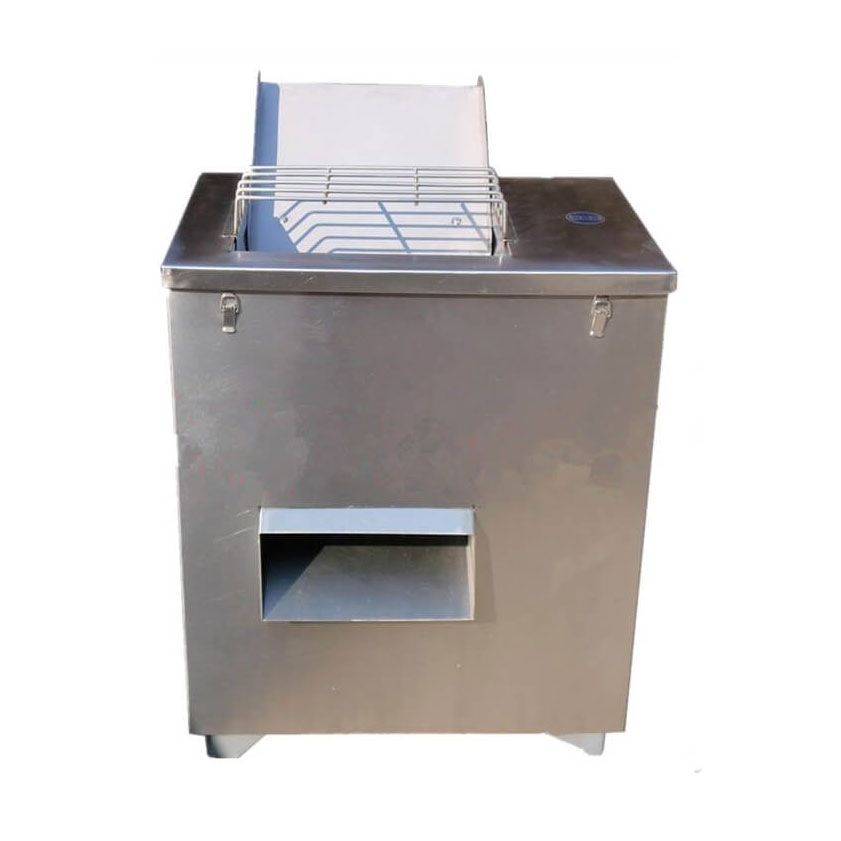 Fish Cutting Machine
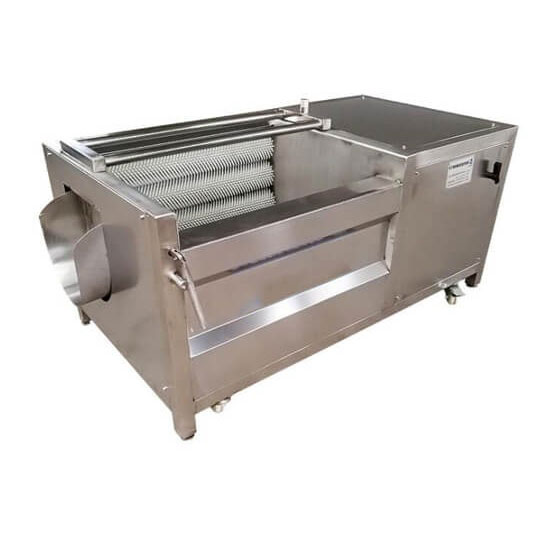 Fish Scaler Machine
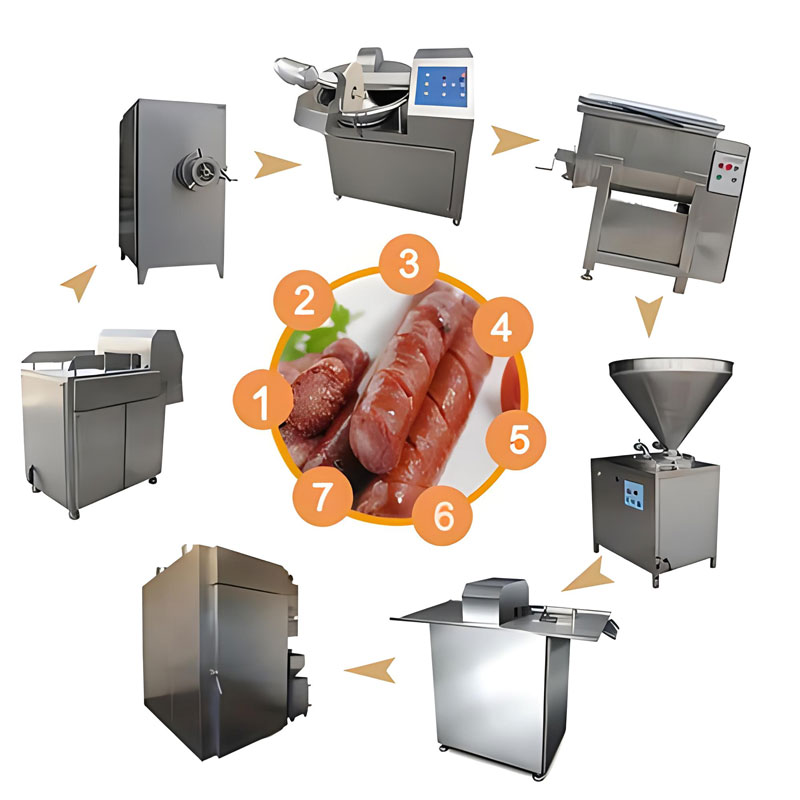 Sausage Processing Line
Ready to Get Started?