
Digital Retort Batch Records and Recipe Control: What Must Be Captured and Protected
A digital retort batch record is more than a paper record scanned into a file. It is a structured data capture with required fields, recipe version control, alarm management, audit trail, and backup — each of which must be designed to meet 21 CFR Part 113 record requirements and to survive an audit. A digital record that captures the right data but has no audit trail, or that has an audit trail but no backup, is not defensible. This article covers what a digital retort batch record must capture, how recipe version control works, and the alarm-audit-backup framework that protects the record.
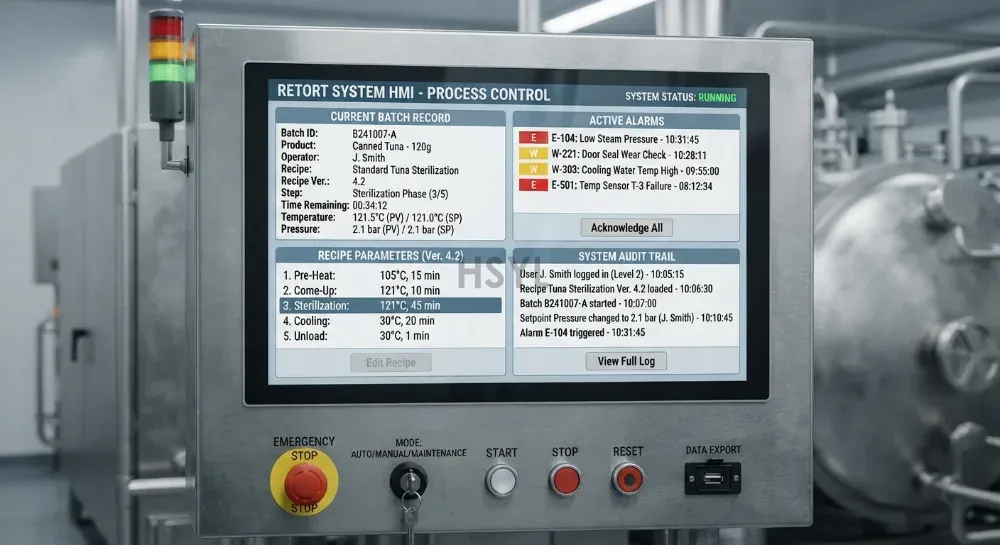
The scope covers digital retort batch records and recipe control for fish canning automation. It covers required fields, version control, alarm management, audit trail, and backup. It does not cover retort validation (covered separately), OEE measurement, or deviation handling. The retort equipment and the turnkey canning line scope carry the equipment and line context.
Required Batch Record Fields
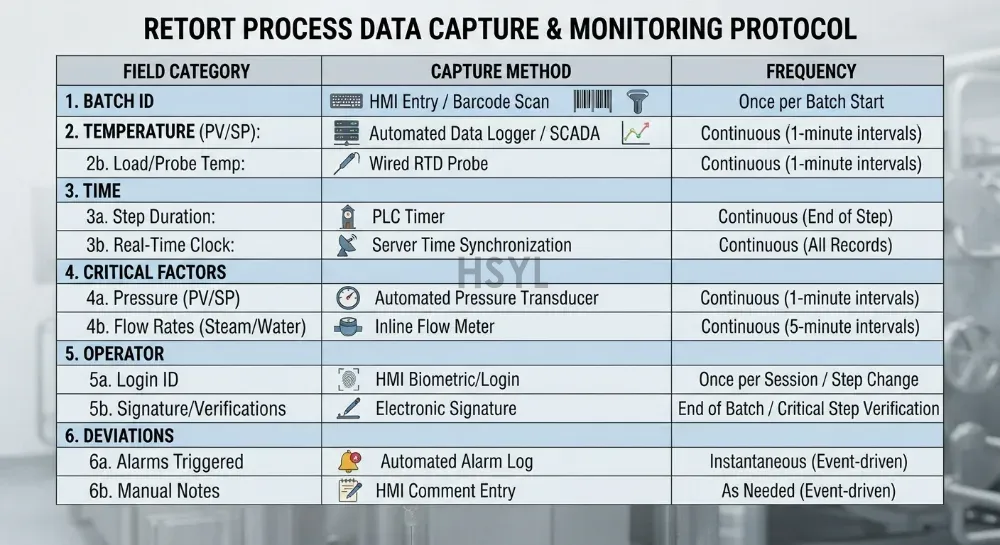
A defensible digital retort batch record captures, for every batch: batch ID, retort ID, product and container, scheduled process reference, operator ID, cycle start and end, retort temperature profile (continuous), product temperature at slowest-heating point (continuous), come-up time, hold time, cooling time, critical factors (fill weight, headspace, initial temperature, packing medium), any deviation and its handling, and QA release. The table below shows the structure.
| Field category | Specific fields | Capture method | Frequency |
|---|---|---|---|
| Batch identification | Batch ID, retort ID, product, container, scheduled process reference | Manual entry + recipe load | Per batch |
| Cycle data | Start, end, come-up, hold, cooling times | Automatic from PLC | Continuous |
| Temperature profile | Retort temperature, product temperature at slowest-heating point | Automatic from sensors | Continuous (e.g., every second) |
| Critical factors | Fill weight, headspace, initial temperature, packing medium, container size | From filler + manual verification | Per batch + per shift sample |
| Deviations | Deviation type, time, duration, handling reference | Automatic + manual | As they occur |
| Release | QA authority, decision, date, time | Manual signature | Per batch |
Automation note: Under 21 CFR Part 113, digital records must meet the same requirements as paper records — they must be accurate, legible, retrievable, and protected from alteration. A digital record that can be edited without an audit trail is not a defensible record. Verify the current version of 21 CFR 113 and FDA electronic records guidance (21 CFR Part 11 where applicable) for the specific requirements.
Recipe Version Control
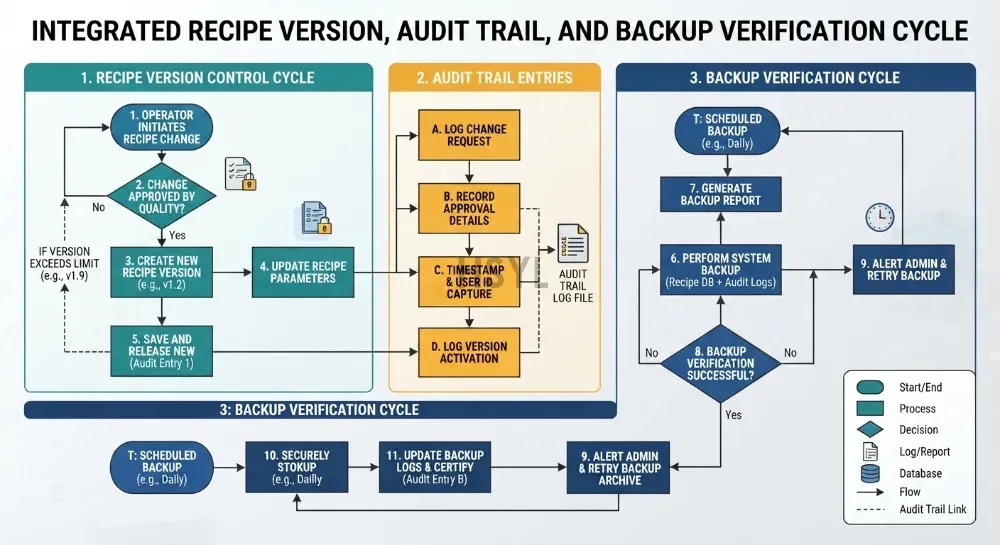
Recipe version control ensures the right scheduled process parameters are loaded for each batch, and that the loaded version is recorded and traceable. The version control framework has four components.
- Version numbering. Each recipe has a version number; the loaded version is recorded per batch.
- Pre-loaded verification. Recipes are verified against the process filing before being available for production load.
- Change control. Recipe changes require process-authority review and a new version number; old versions are archived, not overwritten.
- Audit trail. Recipe load events, version changes, and access events are recorded.
Alarm Management
Alarms are the automation's way of signaling that something needs attention. A defensible alarm management system classifies alarms by severity and defines the response for each. Critical alarms (temperature below setpoint, pressure deviation) stop the cycle and require QA release; warning alarms (sensor drift, minor parameter deviation) log an entry and alert the operator; informational alarms (cycle complete, door open) log without alerting. Every alarm must be recorded in the batch record with type, time, and response.
Audit Trail and Backup
The audit trail is the record of every access, entry, edit, and release event on the batch record. It is what makes a digital record defensible — without it, the record can be altered without detection. The audit trail must be automatic, time-stamped, and protected from alteration.
Backup is the protection against data loss. A defensible backup strategy has: regular automated backup (daily minimum), off-site or cloud storage, periodic restore testing (a backup that has never been restored is a backup of unknown status), and retention period defined by regulation (21 CFR 113 typically requires at least one year for refrigerated and two years for frozen/shelf-stable — verify current). The retort thermal process system with integrated automation should have the audit trail and backup framework designed in at commissioning, not retrofitted after an audit finding.
Scope, Sources and Limitations
Scope. This article covers digital retort batch records and recipe control for fish canning automation. It covers required fields, version control, alarm management, audit trail, and backup. It does not cover retort validation, OEE measurement, or deviation handling.
Limitations. All record field descriptions and automation frameworks are drawn from publicly available regulatory and automation material. Actual record format depends on equipment, automation system, and local regulation. HSYL does not publish project-specific automation specifications without verified evidence. A defensible digital record system for your plant must be reviewed by your QA and automation authority against the current version of every applicable regulation.
Source basis. Record and automation principles are consistent with 21 CFR Part 113 (batch record requirements), 21 CFR Part 11 (electronic records where applicable), FDA Hazards Guide, and IFTPS guidelines. Equipment-capability statements refer to HSYL equipment specifications.
Batch Records and Automation Resources
Two resources complement this automation content. The retort equipment page carries the sterilization system with automation. The canning line hub carries the full line scope.
- Retort thermal process system — the retort equipment whose batch records and recipe control the digital system captures and protects.
- Turnkey canning line scope — the full line scope where automation and record-keeping must be integrated at commissioning.
Next Step: Build Your Digital Record Framework
Send HSYL your retort automation system, current batch record fields, recipe management method, and audit/backup status. HSYL will return a pre-filled batch record field framework with the version-alarm-audit-backup checklist for your system and an automation-capability review of your retort's digital record and recipe control.
Frequently Asked Questions
What fields must a digital retort batch record capture?
What is recipe version control for retort automation?
What is the audit trail in a digital retort record?
How should retort batch records be backed up?
Can a digital retort record replace a paper record under 21 CFR 113?
Must-Read Blogs For Chain Restaurants Owner
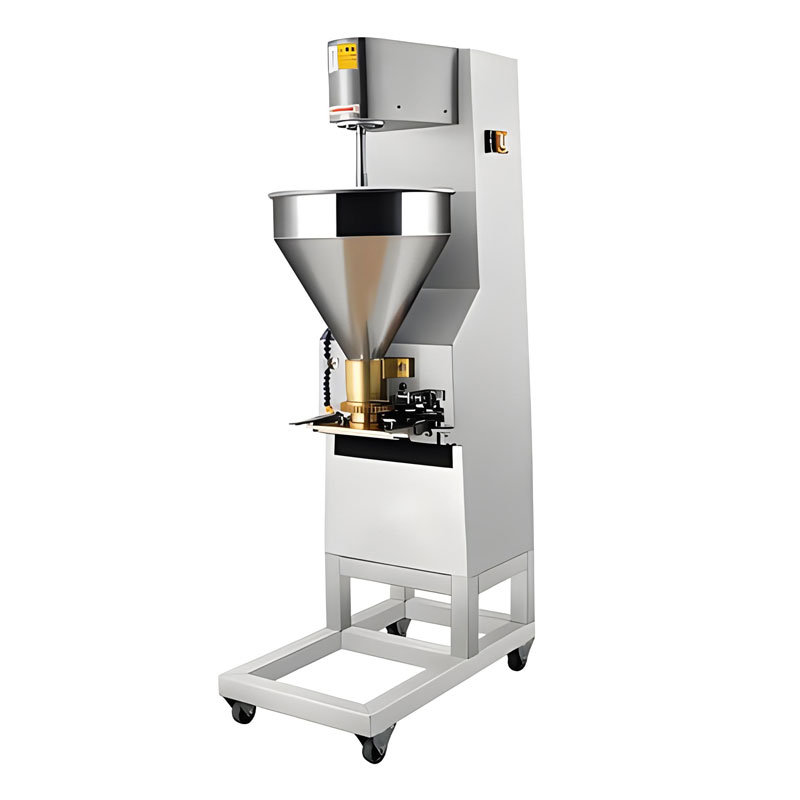

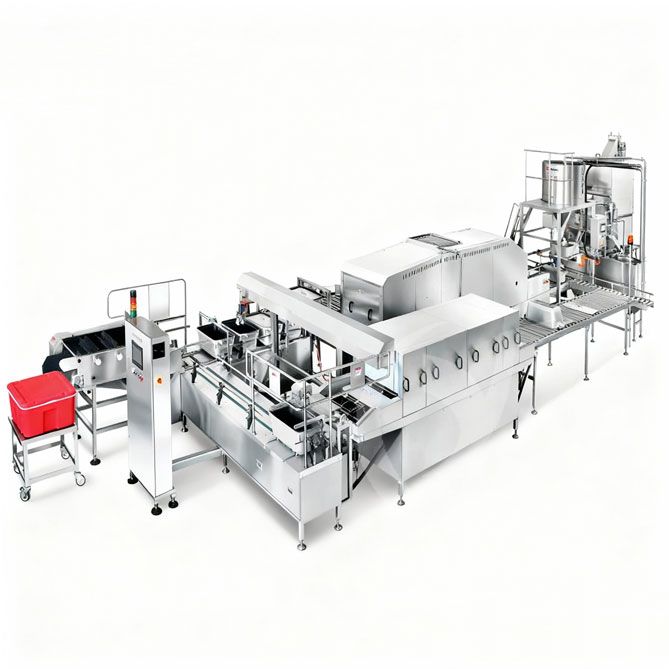
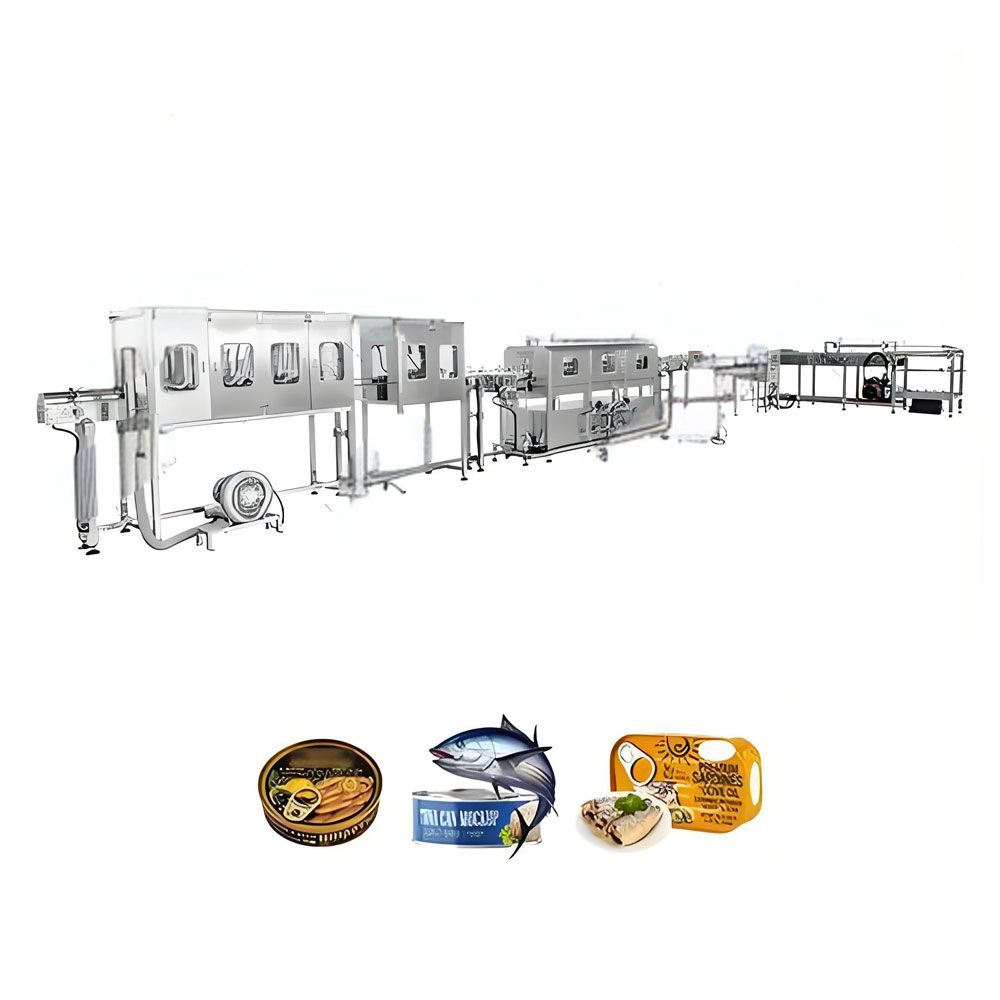 Blackfish Canning Production Line
Ready to Get Started?