
Commercial Kitchen Food-Contact Edge Finishing, Deburring and Rounding for Stainless Equipment
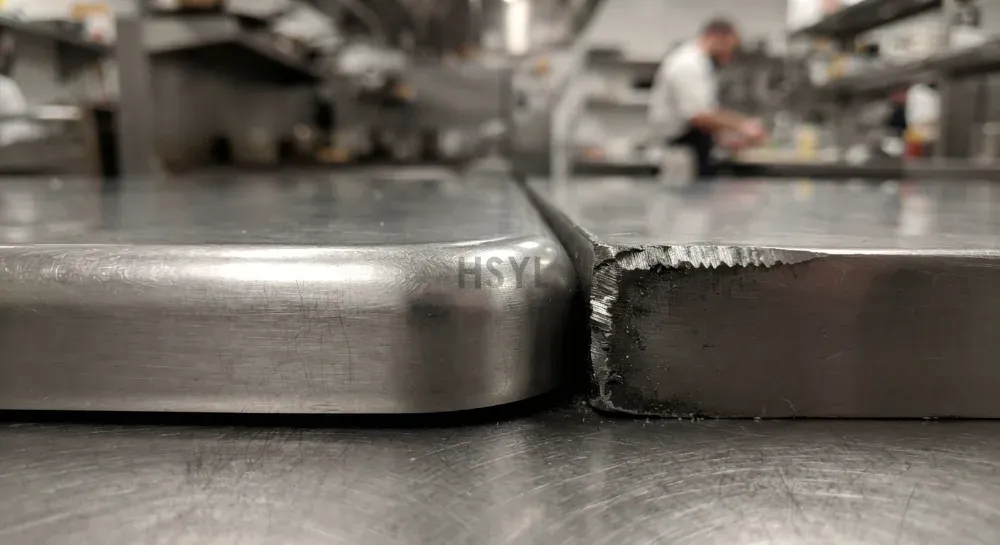
The edge of a commercial kitchen table, sink, or equipment panel is not just a profile — on a food-contact surface, it is a hygiene and safety feature. A sheared or laser-cut edge leaves a burr that can cut a hand, trap soil, and harbor bacteria. A food-contact edge must be deburred, rounded to a specified radius, and finished smooth enough to clean. The edge type — sheared, folded, or welded — determines the deburr process and the radius target. This article covers the edge types common in kitchen equipment, the deburr process that fits each, the food-contact edge requirements, and the inspection record that documents the work.
The scope covers edge finishing and deburring for commercial kitchen stainless equipment. It covers edge types, deburr process, food-contact requirements, and inspection records. It does not cover stainless grade selection (covered in CK-01), welding and passivation (covered in CK-03), or surface finish. A compliant commercial kitchen equipment solution specifies edge and deburr requirements per food-contact surface.
Edge Types and Deburr Process
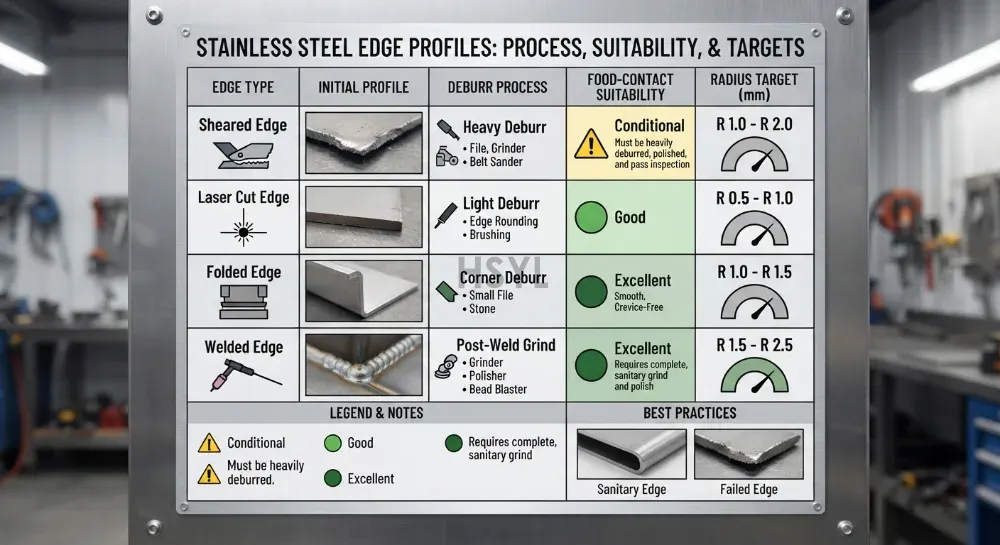
Three edge types are common in kitchen equipment: sheared (cut by shear), folded (bent 90° with a radius), and welded (joined with TIG or MIG). Each has a different burr profile and deburr requirement.
| Edge type | Where used | Typical burr | Deburr process | Food-contact suitability |
|---|---|---|---|---|
| Sheared | Cut-to-size sheet edges, hole edges | Sharp burr on one side, drag on the other | Grinding or filing to remove burr; then rounding | Yes — when deburred and rounded |
| Laser cut | Cut-to-size sheet, complex shapes | Minimal burr, slight oxide scale | Light grinding to remove oxide; rounding | Yes — when cleaned and rounded |
| Folded | Table edges, sink corners, hood bends | Minimal burr; outer radius stretch, inner radius compress | Light deburr if needed; radius already formed | Yes — preferred for food contact (no seam) |
| Welded | Seams on table tops, sink bowls | Weld spatter, undercut, heat tint | Grind weld flush, polish, passivate (see CK-03) | Yes — when ground, polished, passivated |
Folded edges are preferred for food contact because they have no seam — the metal is bent, not joined. Sheared and laser-cut edges require deburr and rounding. Welded edges require the full weld finishing sequence (grind, polish, passivate) covered in CK-03.
Food-Contact Edge Requirements
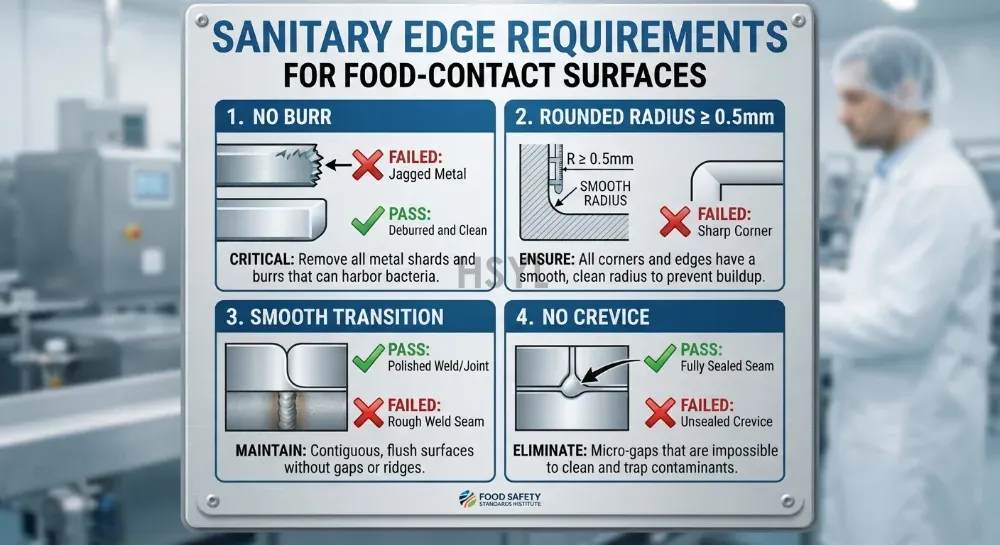
A food-contact edge must meet four requirements that a structural edge does not. The requirements are what make the edge safe, cleanable, and hygienic.
- No burr. Any raised material at the edge — from shearing, laser, or grinding — is a burr. Burrs cut hands, trap soil, and harbor bacteria. All burrs must be removed.
- Rounded radius. A food-contact edge must have a radius, not a sharp corner. The typical target is radius ≥ 0.5 mm for food-contact edges. A sharp corner is a stress riser and a soil trap.
- Smooth transition. The edge must transition smoothly to the surrounding surface — no step, no ridge, no groove. The transition must be cleanable.
- No crevice. Any gap at the edge — between the edge and a gasket, between the edge and a weld — is a crevice. Crevices cannot be cleaned and must be eliminated.
Manufacturing note: The four requirements are not optional. A deburred edge that is not rounded is still a sharp corner. A rounded edge that has a step transition is still a soil trap. All four must be met, and all four must be verified before the equipment enters food contact.
Deburr Process and Edge Radius
The deburr process depends on the edge type and the production volume. Manual grinding with a hand grinder is flexible for low volume and complex shapes. Belt grinding is faster for straight edges. Vibratory tumbling is used for small parts in batch. The edge radius is achieved by the grinding wheel profile or by a follow-up forming step.
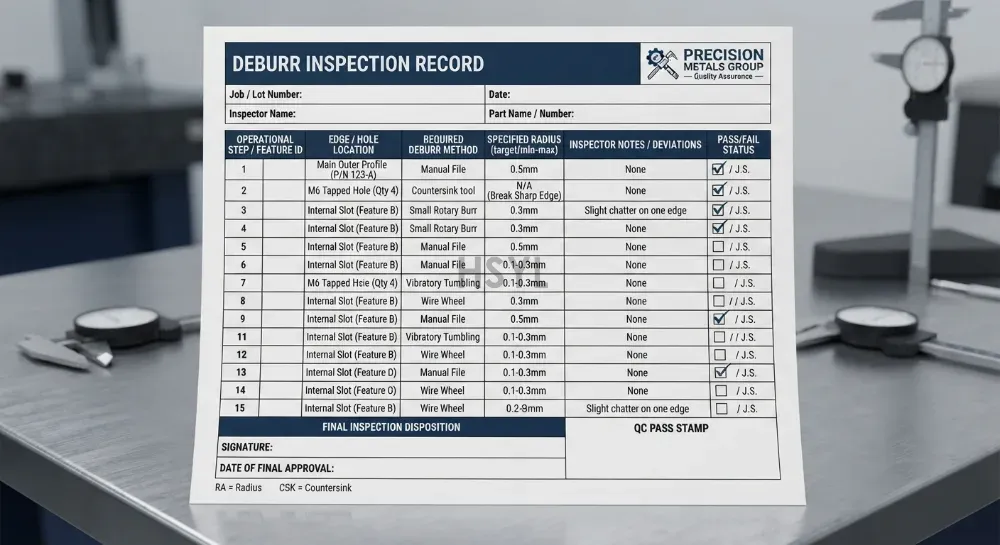
The deburr process is: inspect the edge for burr and sharpness; grind or file to remove burr; round the edge to target radius (≥ 0.5 mm for food contact); polish the edge to match the surrounding finish; inspect with visual and touch test. The process must be recorded. The single tank electric fryer has food-contact edges on the oil tank rim and the basket support — both require deburr, round, and inspection records.
Scope, Sources and Limitations
Scope. This article covers edge finishing and deburring for commercial kitchen stainless equipment. It covers edge types, deburr process, food-contact requirements, and inspection records. It does not cover stainless grade selection, welding and passivation, or surface finish.
Limitations. All edge, deburr, and radius descriptions are drawn from publicly available manufacturing and food-safety material. Actual edge procedure and radius depend on edge type, sheet thickness, and equipment design. HSYL does not publish project-specific edge procedures without verified evidence.
Source basis. Edge and deburr principles are consistent with EHEDG hygienic design guidelines, 3-A Sanitary Standards, and AWS welding standards.
Edge Finishing and Deburring Resources
Three resources complement this edge finishing content. The kitchen solutions page carries the full scope. The fryer page carries an oil-tank rim edge example. The welding and passivation article (CK-03) carries the welded edge finishing sequence.
- Commercial kitchen equipment solution — the full kitchen scope where edge and deburr requirements apply.
- Single tank single basket electric fryer — an equipment with food-contact edges on the oil tank rim.
- Hygienic welding and passivation (CK-03) — the welded edge finishing sequence.
Next Step: Audit Your Kitchen Edges
Send HSYL your equipment list, food-contact edge locations, current edge type (sheared, folded, welded), and radius target. HSYL will return a pre-filled edge requirement checklist with the edge-type-deburr-radius framework for your equipment and a deburr inspection record template for your fabrication.
Frequently Asked Questions
What makes an edge hygienic for food contact in commercial kitchen equipment?
What edge radius is required for food-contact stainless in commercial kitchen equipment?
What is the difference between a folded edge and a welded edge for food contact?
What deburr process is used for sheared and laser-cut edges in kitchen equipment?
Can HSYL specify the edge radius and deburr process for every food-contact edge in my kitchen?
Must-Read Blogs For Chain Restaurants Owner

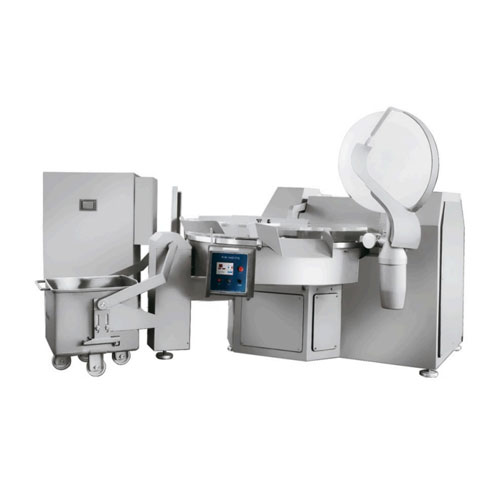
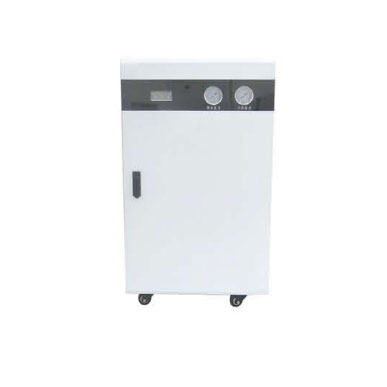 YL-W-01 Commercial Water Purification Equipment
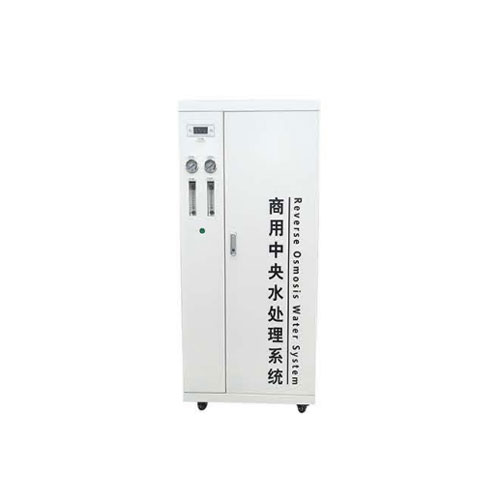 YL-W-06 Commercial Water Purification Equipment
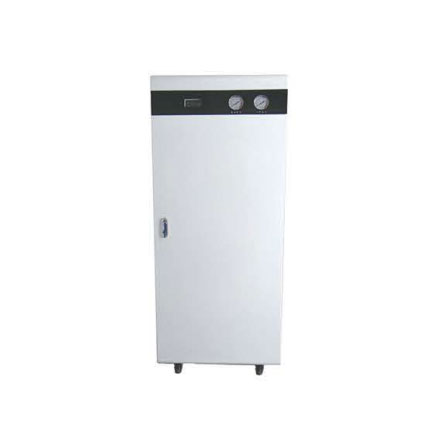 YL-W-05 Commercial Water Purification Equipment
 YL-W-04 Commercial Water Purification Equipment
Ready to Get Started?