
304 vs 316L Stainless Steel in a Fish Canning Line: A Zone-by-Zone Materials Map
A plant manager at a newly commissioned sardine cannery conducts a routine inspection and notices faint, reddish-brown stains forming along the corners of the brining flume and the dosing nozzle mounts. The equipment was supposed to be made of "food-grade stainless steel," yet after just twelve months of operation, localized pitting corrosion has begun to compromise the hygienic surface. This scenario is a common and costly result of a critical engineering shortcut: treating all stainless steel as identical. Fish processing environments represent a hostile setting for metals, combining continuous moisture, high concentrations of sodium chloride (NaCl) from seawater and brine, organic acids, high thermal stress during sterilization, and aggressive Clean-in-Place (CIP) cleaning chemicals. On modern industrial canned fish production lines, choosing between AISI 304 and AISI 316L stainless steel is not just a budget decision; it determines whether the line will survive for twenty years or corrode into a food-safety hazard in less than two.
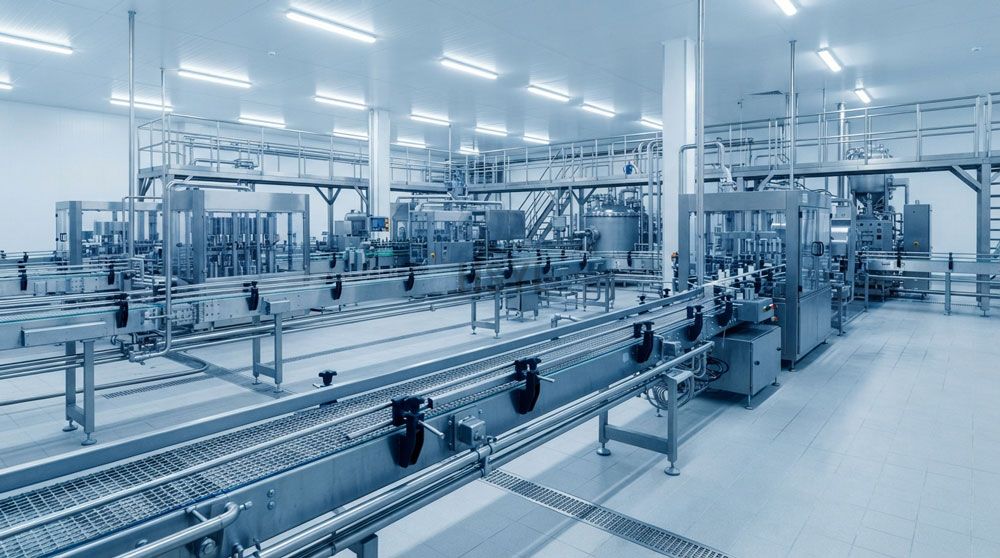
This article maps the metallurgical differences between 304 and 316L stainless steel. It details the chemistry of chloride attack, introduces the Pitting Resistance Equivalent Number (PREN), and provides a zone-by-zone materials map to guide equipment buyers and QA engineers through procurement and factory auditing.
Metallurgical Foundations: Alloy Chemistry Explained
To understand why one food-grade alloy resists rust better than another, one must examine their chemical compositions. Both AISI 304 and AISI 316L are austenitic stainless steels, characterized by their non-magnetic properties, high ductility, and excellent weldability. Their corrosion resistance is derived from a microscopic, self-healing chromium oxide (Cr₂O₃) passive layer that forms spontaneously on the metal surface in the presence of oxygen. However, their alloying elements differ in key ways:
- AISI 304 (Standard Food-Grade): Typically contains 18% Chromium (Cr) and 8% Nickel (Ni). It is the workhorse of the food industry, providing excellent mechanical properties and basic atmospheric and chemical resistance at a moderate cost. However, it lacks molybdenum.
- AISI 316L (High-Chloride Resistance): Contains 16% Chromium, 10% Nickel, and the addition of 2% to 3% Molybdenum (Mo). Crucially, the "L" stands for "Low Carbon" (carbon content ≤ 0.03%), compared to 304 which permits up to 0.08% carbon.
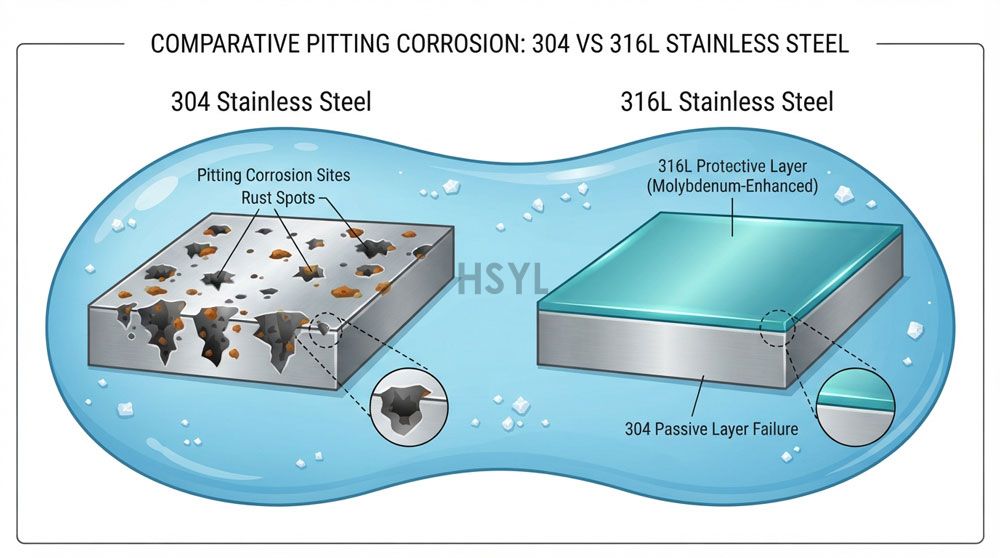
The addition of molybdenum is the primary differentiator. Molybdenum physically interacts with the chromium oxide passive layer, reinforcing its stability and accelerating its regeneration, particularly in acidic or high-chloride environments. The low carbon content of 316L is equally critical for food equipment. During welding, standard stainless steel undergoes "sensitization" in the heat-affected zone (between 425°C and 815°C). At these temperatures, carbon binds with chromium to form chromium carbides along the metal's grain boundaries. This depletes the surrounding steel of chromium, leaving the welded joints highly vulnerable to intergranular corrosion. By using 316L, the low carbon content prevents carbide precipitation, maintaining the passive layer across the welded seams without requiring post-weld solution annealing.
 x
x
Chloride Attack: Why Seafood Needs Molybdenum
In fish canning, the primary enemy of stainless steel is the chloride ion (Cl⁻) found in salt (NaCl), seawater, and tap water containing high chlorine residues. Chloride ions are small, highly mobile, and carry a strong negative charge. They physically penetrate the chromium oxide passive layer at microscopic weak points (such as weld scales, surface scratches, or crevice boundaries).
Once the passive layer is breached, chlorides establish a localized electrochemical cell. The exposed metal inside the tiny breach acts as an anode, while the surrounding passive surface acts as a cathode. Metal dissolves rapidly at the anode, drilling a microscopic hole into the steel—a destructive phenomenon known as **pitting corrosion**. If a product remains stagnant in a joint or seam, **crevice corrosion** occurs, which propagates even faster. Molybdenum inhibits this localized dissolution, stopping the pit from drilling deeper.
Materials engineers use the Pitting Resistance Equivalent Number (PREN) to quantify and compare an alloy's resistance to localized pitting. The standard formula is:
PREN = %Cr + 3.3 * %Mo + 16 * %N
Where: %Cr is Chromium percentage, %Mo is Molybdenum percentage, and %N is Nitrogen percentage.
Comparing the standard values for food-grade alloys:
PREN (304) = 18.0 + 3.3 * 0 + 16 * 0.05 = 18.8
PREN (316L) = 16.5 + 3.3 * 2.1 + 16 * 0.05 = 24.2
A PREN value above 23 is generally considered the threshold for resisting pitting in contact with brackish water or dilute brines. Standard 304, with a PREN of 18.8, is metallurgical under-qualified for continuous contact with fish brine or hot packing liquids containing salt.
Zone-by-Zone Materials Map
To balance equipment budgets against long-term operational lifespan, engineers should apply a risk-based materials map. The fish canning line can be divided into six distinct zones based on moisture, temperature, chloride levels, and chemical exposure.
Zone 1: Raw Fish Receiving and Dry Handling (Low Risk)
In areas where frozen or fresh whole fish are received, sorted, and graded in cold conditions with low salt exposure, AISI 304 is fully acceptable. Conveyor frames, grading tables, and sorting bins do not require 316L, provided they are washed with fresh potable water. However, if the plant utilizes raw seawater for initial fluming and washing, 316L must be specified for all flume structures and intake screens.
Zone 2: Cutting, Filleting, and Evisceration (Medium Risk)
During head cutting, evisceration, and skinning, the machinery is continuously exposed to moisture and fish oils. Because the chloride levels are low (potable water is used for spraying and transport flumes), AISI 304 is the standard material for machine frames, waste flumes, and conveyor supports. Note that cutting blades themselves are typically made of high-hardness martensitic stainless steel (such as 420 or 440 series) to maintain a sharp edge, but these blades must be passivated and regularly inspected since martensitic steel is more prone to rust than 304.
Zone 3: Pre-cooking and Cooling (Medium-High Risk)
Tuna precooking and sardine steam-cooking chambers are subjected to continuous steam, high humidity, and temperatures up to 105°C. The combination of thermal stress, moisture, and organic volatile acids released from the fish can cause stress-corrosion cracking in standard metals. While 304 can be used for external structural panels, the internal steam manifolds, cooking racks, and condensate recovery lines should be made of 316L to withstand the hot, acidic condensate.
Zone 4: Salting, Brining, and Dosing (Extreme Risk)
This is the most critical zone for material selection. Brine preparation tanks, dosing piping, and salt-mixing vessels are in continuous contact with sodium chloride solutions ranging from 2% to 25% concentration, often at elevated temperatures. Standard 304 will fail in this zone. All brine dosing pumps, pipelines, valve manifolds, and filler hopper assemblies must be made of AISI 316L. When designing canned food filling and sealing systems, specify 316L for all liquid contact nozzles and filler cylinders to prevent product contamination from corroded metal residues.
Zone 5: Retorting and Thermal Utilities (High Risk)
The retort chamber is exposed to high-pressure steam, compressed air, and rapid cooling water cycles. While the retort vessel shell is often made of heavy carbon steel with clad liners or thick 304 stainless steel, the baskets that hold the cans must be highly corrosion-resistant. Retort baskets are continuously loaded with wet cans, subjected to thermal expansion/contraction, and sprayed with chlorinated cooling water. Baskets made of 304 will degrade, rust, and stain the cans. Retort baskets and internal spray manifolds in modern rotary and still sterilization equipment for fish canning should be constructed of 316L to prevent rust-staining on the canned product.
Zone 6: Clean-in-Place (CIP) Piping (High Risk)
To maintain hygienic standards, food lines are cleaned daily using CIP loops containing hot caustic soda (NaOH, up to 2.0% at 85°C) and hot nitric or phosphoric acid solutions (up to 1.5% at 70°C). Standard 304 pipelines will degrade over time under the corrosive action of these cleaning chemicals at elevated temperatures. All CIP pipelines, return pumps, and chemical dosing tanks must be constructed from 316L to maintain structural integrity.
Welding, Passivation, and Surface Finish (Ra)
Specifying 316L is only the first step. The corrosion resistance of stainless steel is highly dependent on how the metal is welded, finished, and chemically passivated during manufacturing:
- Hygienic Welding: All product-contact welds must be executed using Tungsten Inert Gas (TIG) welding with an argon purging gas backing to prevent "sugar" (weld oxidation on the root side). Orbital welding should be used for all liquid piping.
- Pickling: After welding, the heat-affected zone must be treated with a pickling paste (a mixture of hydrofluoric and nitric acids) to dissolve the weld scale and deplete the chromium-depleted zone underneath.
- Passivation: Per ASTM A967/A967M-25, the finished stainless steel must be chemically treated with a nitric or citric acid bath. Passivation dissolves free iron and surface contaminants left by machining tools, accelerating the formation of the dense chromium oxide passive layer.
- Surface Roughness (Ra): Per EHEDG guidelines, all product-contact surfaces must be polished to a surface roughness of Ra ≤ 0.8 µm. A rough surface contains microscopic crevices that trap chlorides and bacteria, acting as incubation zones for corrosion and biological contamination.
Seafood Canning Line Materials Specification Matrix
The following table maps core canning machinery components to their recommended steel grades, contact media, and surface finishing standards. Equipment specs must be verified during FAT/SAT checks.
| Equipment Component | Contact Medium | Primary Corrosion Agent | Minimum Steel Grade | Hygienic Finish (Ra) | Weld/Passivation Standard |
|---|---|---|---|---|---|
| Fish Flume and Conveyor Frames | Potable water / fresh fish | Continuous moisture | AISI 304 | Ra ≤ 1.6 µm | ASTM A380 Cleaned |
| Fish Cutting Blades | Fish flesh and blood | Moisture, organic acids | Martensitic (420/440) | Ra ≤ 0.4 µm (ground) | ASTM A967 Citric Passivated |
| Brine Mixing Tank | 2% – 20% NaCl brine | High chloride concentration | AISI 316L | Ra ≤ 0.8 µm | ASTM A967 Nitric Passivated |
| Liquid Filling Nozzles | Hot oil, brine, tomato sauce | Chloride, heat, organic acids | AISI 316L | Ra ≤ 0.4 µm (electropolished) | ASME BPE Orbital Weld / Passivated |
| Pre-cooker Steam Trays | Steam, fish fat, condensates | High temperature, humidity | AISI 316L | Ra ≤ 0.8 µm | TIG Welded / Pickled |
| Retort Baskets | Steam, cooling water, steel cans | Chlorinated water, heat, contact rust | AISI 316L | Ra ≤ 1.6 µm | ASTM A380 Cleaned |
| CIP Distribution Piping | Nitric/Phosphoric acid, Caustic | Strong acids/alkalis at 85°C | AISI 316L | Ra ≤ 0.8 µm | ASME BPE Orbital Weld |
| Waste Discharge Chutes | Fish guts, heads, scales | Organic waste, washdown water | AISI 304 | Ra ≤ 1.6 µm | Standard TIG Welded |
Scope, Sources and Limitations
Scope. This article maps the metallurgical properties, corrosion mechanisms, and zoning rules for AISI 304 and AISI 316L stainless steel on a fish canning line. It does not cover concrete floor coatings, structural building materials, carbon steel boiler casings, or electrical cable conduit grades, which are covered in separate facility engineering guides.
Limitations. The material grades, PREN calculations, and finishes described are standard food industry engineering guidelines. Actual material selections may vary based on local water salinity, specific sanitizing chemicals (e.g., peracetic acid, chlorine dioxide), and operational temperatures. Seafood processors must coordinate with their chemical sanitation suppliers and equipment manufacturers to confirm chemical compatibility records before commissioning.
Source basis. Technical guidelines are aligned with ASTM A380/A380M-25, ASTM A967/A967M-25, EHEDG Guideline Catalogue (Materials of Construction), and standard food-safety engineering manuals from the European Hygienic Engineering & Design Group. Structural specifications conform to HSYL factory fabrication guidelines.
Reviewer and date. Last technical audit: 2026-07-14 by the HSYL Materials Engineering Team and QA Department. This guide must be reviewed when ASTM passivation standards or EHEDG food contact material catalogs are updated.
Canning Line Materials and Engineering Resources
To further support your factory's procurement planning and engineering audits, the following resources provide detailed machinery layouts, alloy specifications, and performance parameters:
- Industrial canned fish production lines — structural layouts, conveyor routing guides, and material zoning charts for greenfield projects.
- Canned food filling and sealing systems — mechanical specifications for dosing cylinders, valves, and pipelines constructed from certified electropolished 316L.
- Rotary and still sterilization equipment for fish canning — material data sheets for retort pressure chambers, doors, manifolds, and 316L sterilization baskets.
Next Step: Audit Your Plant's Materials Map
Prevent premature equipment failures and maintain strict food safety standards by auditing your canning line's materials specification sheet. Send HSYL your line layout, brine concentration levels, CIP temperature profiles, and current equipment material logs. HSYL will provide a pre-configured Materials Specification Checklist tailored to your factory zones, alongside a mechanical proposal for upgrading your filling hoppers, brining flumes, and retort baskets to certified 316L stainless steel with EHEDG-compliant finishes.
Frequently Asked Questions
Why does food-grade stainless steel still rust in a fish canning plant?
What is the difference between 304 and 316L stainless steel?
What is PREN and why does it matter for seafood processing?
Can I use 304 stainless steel for brine mixing and dosing systems?
What is passivation and why is it required for new equipment?
Why is the "L" in 316L important for food equipment welding?
Must-Read Blogs For Chain Restaurants Owner

 Meat Processing Line Equipment
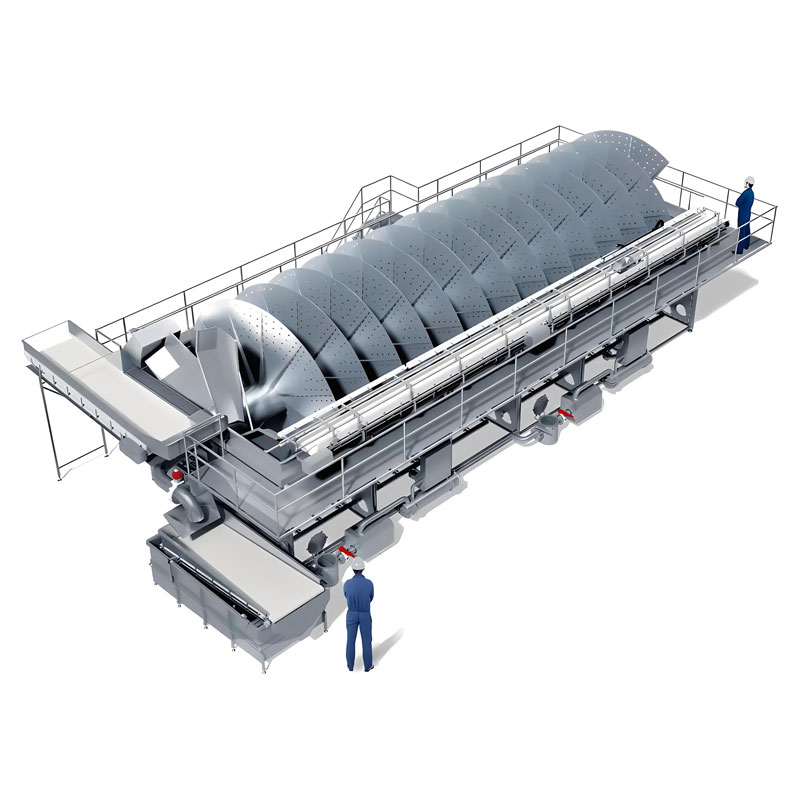 Salmon Processing Line
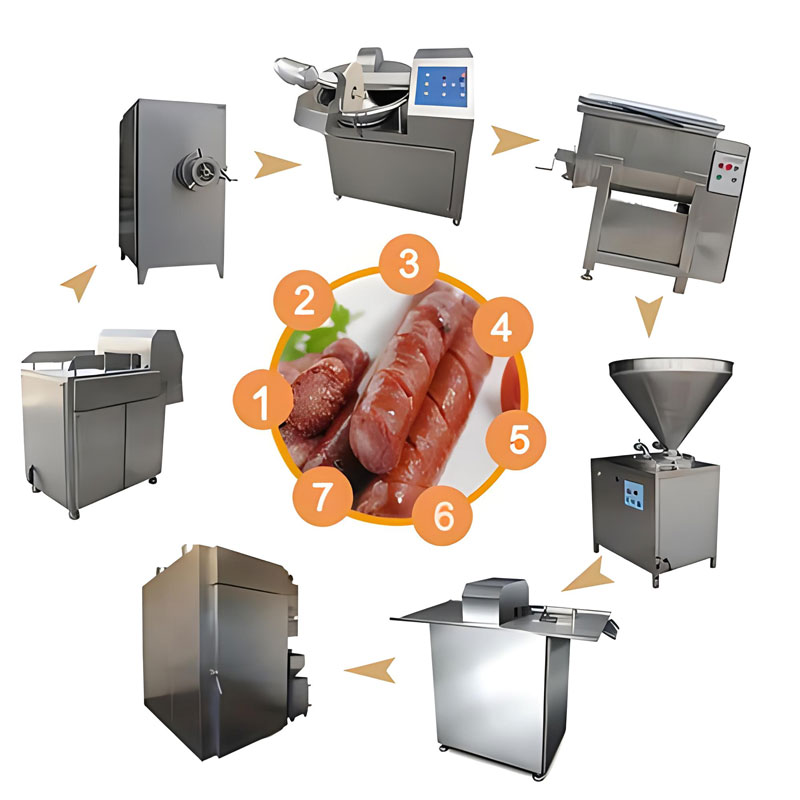 Sausage Processing Line
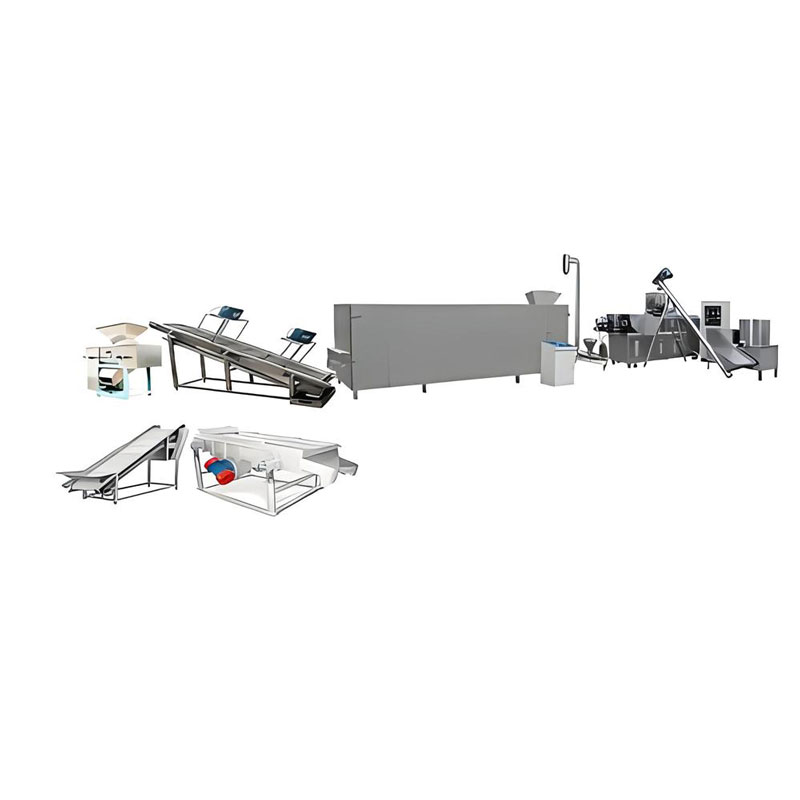 Fish Meal Production Line
Ready to Get Started?