
Retort Cooling Water Can Contamination: Sanitation and Overpressure
In low-acid canned food manufacturing, the transition from the sterilization hold phase to the cooling phase is the most critical window for product safety and structural integrity. After holding containers at the sterilizing temperature (typically 121.1°C or higher) for the required time, the product inside is commercially sterile. However, the process is not complete, and the product is not yet safe. As cooling water is sprayed into the chamber, a dramatic drop in temperature creates a physical vacuum inside the cans. If the retort pressure is not controlled, the cans will deform. More importantly, if the cooling water contains even trace amounts of bacteria, or if the cans are handled while wet, bacteria can be sucked directly into the container through temporary micro-gaps in the double seam. For industrial canned fish production lines, understanding this post-process contamination risk is essential to prevent flat sour spoilage and post-retort product recalls.
This article details the engineering and sanitation requirements of the retort cooling phase. It covers the mechanics of overpressure control to prevent can peaking and panelling, the regulatory quality standards for cooling water hygiene under 21 CFR Part 113.81, the biological mechanism of double-seam microleakage, and the sanitary controls required for post-retort can handling.
1. Overpressure Cooling: Balancing the Pressure Scales
When the retort cycle transitions from sterilization to cooling, steam is shut off and cold water is sprayed into the chamber. This creates an immediate thermodynamic challenge: the steam condenses instantly, causing the pressure inside the retort chamber to drop rapidly. However, the product inside the sealed cans remains near 121.1°C, and its internal pressure is still extremely high due to expansion, product moisture vapor pressure, and residual headspace air.
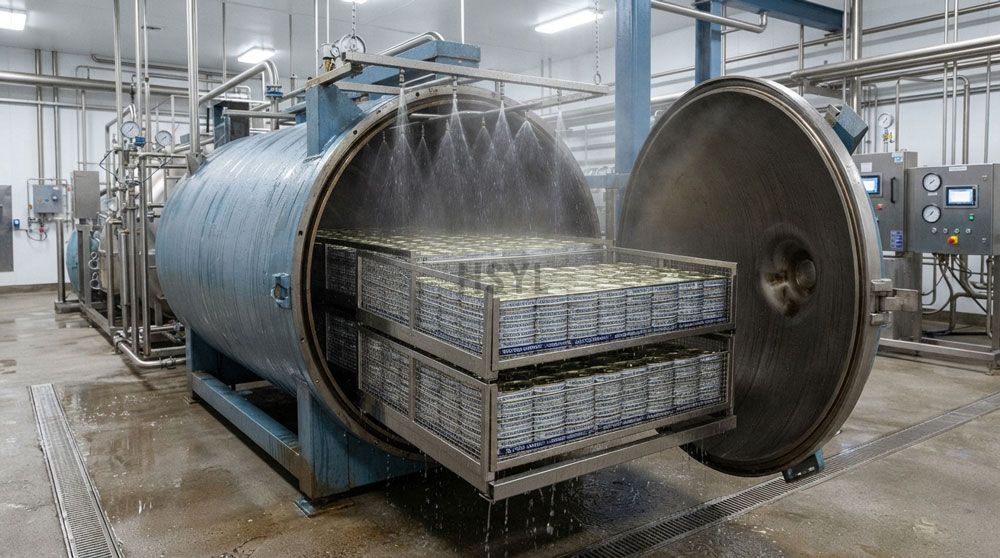
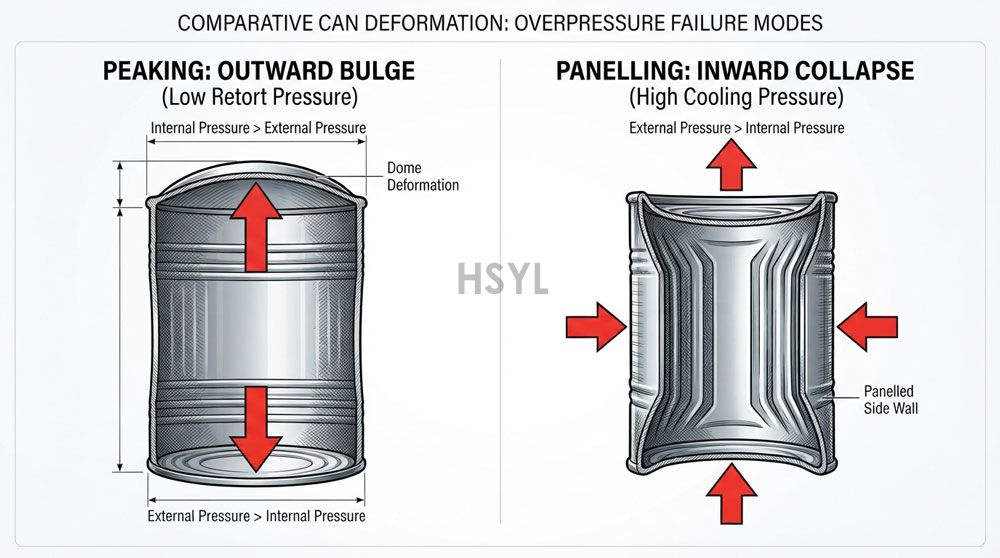
If the retort chamber pressure drops too quickly while the internal can pressure remains high, the pressure difference will cause the can ends to bulge outward permanently—a mechanical failure known as "peaking" or "buckling." Peaking distorts the can geometry and permanently compromises the double seam, rendering the container vulnerable to leakage. To prevent peaking, compressed air must be injected into the retort chamber before the steam is vented, maintaining an external pressure that offsets the internal can pressure. This process is known as overpressure cooling.
Conversely, the air overpressure must be controlled within a narrow window. If too much compressed air is injected and the retort chamber pressure is excessively high, the pressure difference will crush the sides of the cans inward—a mechanical failure known as "panelling." Panelling is common in thin-walled steel cans and aluminum containers. To maintain this balance, modern rotary and still sterilization equipment for fish canning uses modulated pressure control valves, PID loops, and automatic air compressors to follow a strict cooling pressure curve that steps down the pressure in synchronization with the product's internal cooling rate.
Physical Principle: The internal pressure of the can during cooling is determined by the fill weight, headspace volume, initial vacuum, and product temperature. The overpressure control system must be calibrated to match the worst-case container format (e.g., the largest container or the tightest fill weight) in the load.
2. Cooling Water Hygiene: Preventing Post-Process Ingress
Under US FDA 21 CFR Part 113.81 and Codex CXC 23-1979, all retort cooling water must be sanitarily clean. The water must be treated with an active sanitizer—most commonly chlorine or chlorine dioxide—to ensure that it is free from pathogenic and spoilage microorganisms. The reason for this strict requirement lies in the physical behavior of the container's double seam during cooling.
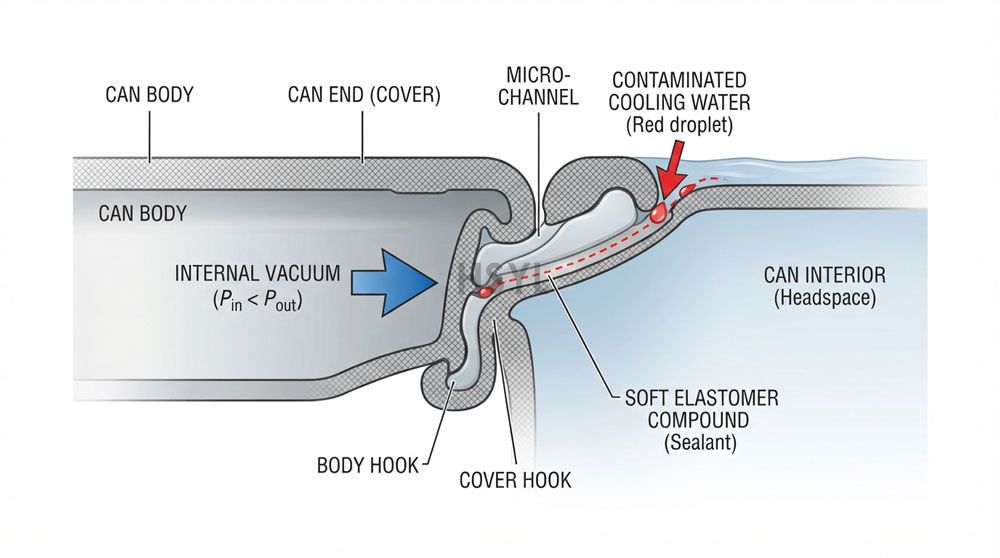
During the thermal hold phase, the elastomer double seam sealing compound (which is rolled between the can body hook and end hook) becomes hot and enters a soft, plasticized state. When the cooling water is sprayed, the can is subjected to rapid thermal contraction and an internal vacuum. For a brief moment, the sealing compound is still soft, and the double seam is under dynamic stress as the can end collapses inward to form the final vacuum. During this transitional window, micro-quantities of cooling water can pass through the double seam compound via capillary action. If the cooling water contains bacteria, these micro-droplets will inoculate the sterile fish product inside the can.
To prevent this, cooling water systems must maintain a strict sanitization protocol:
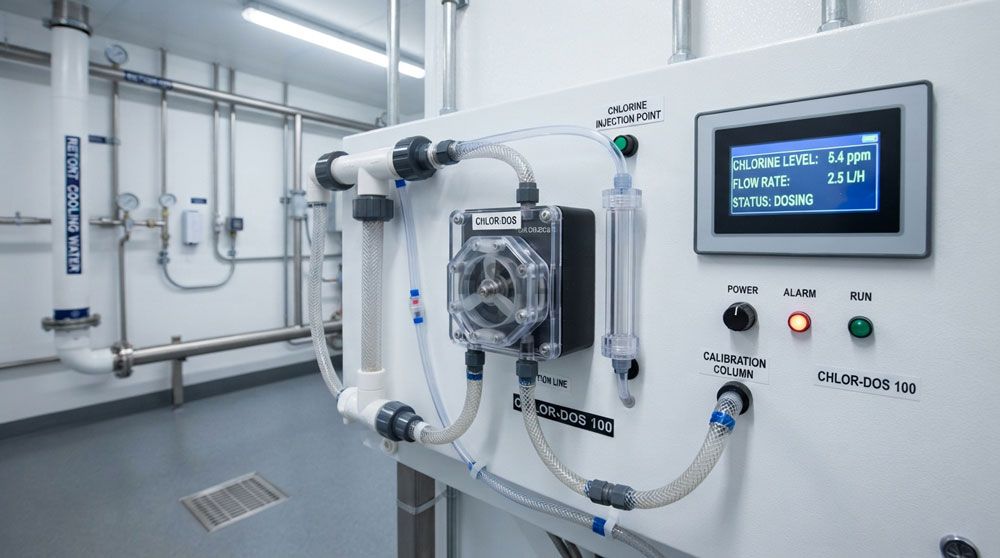
- Free Residual Chlorine: The water must contain a measurable free residual chlorine concentration of 0.5 to 2.0 parts per million (ppm) at the discharge point of the retort. Using total chlorine or checking the water at the inlet is insufficient; the sanitizer must be active within the retort chamber.
- pH Control: The pH of chlorinated cooling water must be maintained between 6.5 and 7.5. If pH is too high, the sanitizing efficacy of chlorine drops dramatically; if pH is too low, the water becomes corrosive, risking pitting corrosion and rust on the can body.
- Microbiological Limits: Regular microbiological monitoring of the cooling water must be performed, with target bacterial levels kept below 100 Colony Forming Units (CFU) per milliliter, and zero coliforms.
Recirculated Water: If cooling water is recycled and recirculated, it must pass through a filtration and cooling tower system, and be continuously dosed with sanitizer. Recirculated water has a high risk of organic load build-up, which rapidly deactivates chlorine.
3. The Double Seam Microleakage Mechanism
The entry of bacteria during the cooling phase is a temporary phenomenon. When the can is hot and the internal vacuum is developing, the double seam undergoes mechanical shifting. The microscopic pathways that allow water to enter exist only during this dynamic transition. As the can cools completely, the sealing compound solidifies, and the double seam settles into its final, rigid shape, locking the seam tight. This is known as the "breathing" or "resealing" effect of double seams.
Once the can has cooled and dried, the double seam compound forms a hermetic barrier. If the cooling water was chlorinated and sterile, the micro-droplets that entered the can during cooling are sterile, and no spoilage will occur. However, if the water was contaminated, the bacteria drawn inside will begin to multiply. Because fish products are low-acid (pH > 4.6), they provide an ideal growth medium for anaerobic and facultative anaerobic bacteria, including *Clostridium botulinum* and *Bacillus* species. This results in post-process spoilage, which can present as:
- Flat Sour Spoilage: Spoilage by thermophilic or mesophilic spore-formers (*Bacillus coagulans*) where the can remains flat (no gas production) but the product turns sour due to acid production. This is difficult to detect visually.
- Swells and Blows: Gas-producing spoilage where the can ends bulge outward (soft or hard swells) due to the action of gas-forming anaerobes.
- Toxin Production: The growth of pathogenic bacteria without gas production, presenting a severe public health hazard.
4. Can Handling and Post-Process Sanitation Controls
The risk of post-process contamination does not end when the cans are removed from the retort. The external surfaces of the cans, baskets, and conveyor lines are wet. As long as the cans remain wet, the microleakage pathways through the double seam may still be open, or the seam compound may not have fully cured.
If wet cans are handled manually or run over dirty conveyors, bacteria from the operators' hands or the conveyor surfaces will migrate through the film of water on the can and enter the double seam. To prevent this post-process contamination, fish canning plants must enforce strict sanitary controls in the post-retort area:
- Dry Can Handling: Cans should never be handled manually while wet. Operators must not touch wet cans.
- Conveyor and Runway Sanitation: All conveyors, runways, elevators, and decrating equipment must be regularly cleaned and sanitized. They must be kept free of grease, fish debris, and standing water.
- High-Velocity Can Drying: Immediately after decrating or exiting the retort, cans must pass through a high-velocity air knife or blower station. Drying the cans removes the film of water, eliminating the capillary pathway for bacterial migration. Cans must be completely dry before they enter the automatic labelling, wrapping, or cartoning machines.
Hygiene Zoning: The post-retort area must be physically separated from the raw fish preparation and filling areas to prevent cross-contamination by aerosols or personnel movement.
Retort Cooling and Sanitation Control Plan
A compliant food safety management system (HACCP) must incorporate a cooling control plan. The table below outlines the critical controls for the cooling phase. Actual limits must be verified and approved by the plant's Process Authority.
| Control Parameter | Critical Safety Limit | Monitoring Instrument | Monitoring Frequency | Documentation Log | Corrective Action |
|---|---|---|---|---|---|
| Air Overpressure | Target cooling curve ± 0.1 bar | Calibrated pressure transducer & manual gauge | Continuous electronic logging; once per batch manually | Retort Batch Record / PLC Log | Stop cycle, hold batch, check air valve operation, report to Process Authority |
| Cooling Water Free Chlorine | 0.5 – 2.0 ppm free residual | DPD chlorine colorimeter or test kit | Every retort batch at discharge (or hourly for continuous loops) | Retort Water Treatment Log | Adjust chlorine dosing pump, check pH, isolate and re-chlorinate recirculated water |
| Cooling Water pH | 6.5 – 7.5 pH | Digital pH meter | Every 4 hours (or continuous probe) | Water Treatment Log | Adjust chemical dosing, verify water supply source |
| Cooling Water Bioburden | < 100 CFU/mL; 0 coliforms | Standard plate count (petrifilm or agar plate) | Weekly minimum (or daily for recirculating systems) | Microbiological Test Report | Flush water system, clean cooling tower, increase chlorine dosage, check filtration media |
| Can Dryness | 100% dry (no visible water on seams) | Visual check at dryer exit | Every 30 minutes | Packaging Line QA Log | Adjust air knife angle, check blower pressure, slow down line speed, manual wipe-dry of held cans |
| Conveyor Sanitation | Clean (ATP swab < baseline limit) | ATP bioluminescence swab / sanitizing check | Every shift change and post-CIP | Sanitation Verification Sheet | Re-clean and re-sanitize conveyors, verify sanitizer concentration |
Scope, Sources and Limitations
Scope. This article covers the retort cooling phase for canned fish, specifically focusing on air overpressure control, cooling water hygiene, chlorine dosing, double-seam microleakage mechanisms, and post-process can handling sanitation. It does not cover retort heat distribution validation, boiler steam capacity, double-seam teardown measurements, or raw fish receiving, which are documented in separate technical guides.
Limitations. The pressure, pH, and chlorine values listed are typical industry reference standards and do not constitute a specific process recommendation. The critical limits, sanitizers, and cooling curves for any commercial fish canning operation must be established by a qualified Process Authority and validated for the specific container size, thickness, and retort model in use.
Source basis. Technical guidelines are sourced from US FDA 21 CFR Part 113 (Thermally Processed Low-Acid Foods Packaged in Hermetically Sealed Containers), the FDA Fish and Fishery Products Hazards and Controls Guidance, Codex Alimentarius CXC 23-1979 (Code of Hygienic Practice for Low-Acid Canned Foods), and the FAO/WHO Joint Report on Risk-Based Water Reuse in Fish Processing. Equipment specifications refer to HSYL engineering guidelines.
Reviewer and date. Technical review completed on 2026-07-14 by the HSYL Fish Canning Engineering Team and QA Department. This guide should be updated upon updates to 21 CFR Part 113 or Codex hygienic codes.
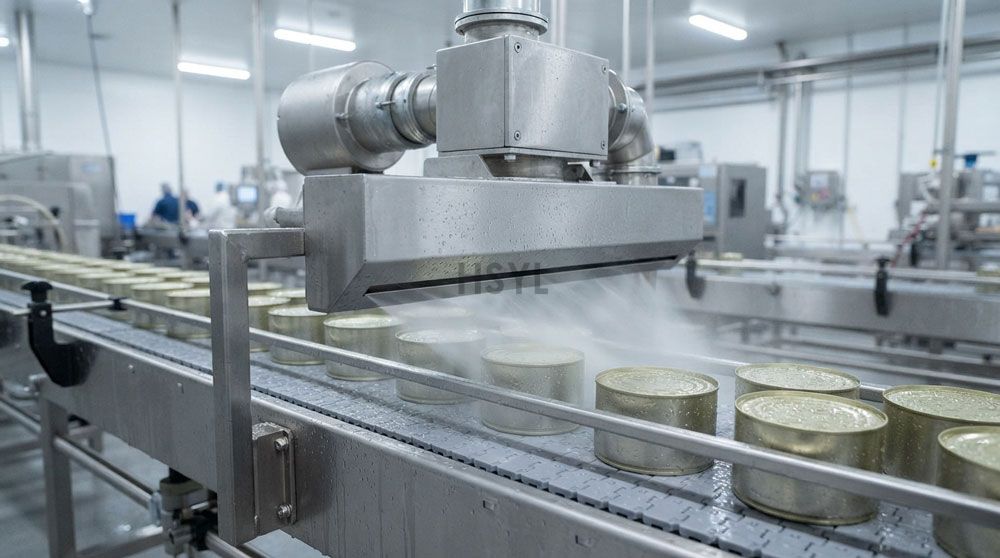
Retort Cooling and Post-Process Sanitation Resources
To support your factory's safety audits and equipment integration, the following resources provide deep-dive technical drawings, capacity data, and compliance records for related systems:
- Rotary and still sterilization equipment for fish canning — detailed specs on retort pressure control valves, air injection inlets, and water spraying nozzles.
- Industrial canned fish production lines — the layout design guidelines, showing post-retort zoning, automated basket decrating, and high-velocity can drying stations.
- Turnkey canning line scope — the overall engineering documentation, detailing commissioning protocols, water treatment baselines, and Process Authority handover checklists.
Frequently Asked Questions
Why do we need air overpressure during retort cooling?
What is the difference between can peaking and can panelling during cooling?
How does contaminated cooling water enter a sealed can?
What is the required free residual chlorine level for retort cooling water?
Why is it dangerous to handle wet cans after they exit the retort?
How often should cooling water microbiological quality be tested?
Must-Read Blogs For Chain Restaurants Owner

 Salmon Processing Line
 Fish Cutting Machine
 Fish Deboner Machine
 Fish Scaler Machine
Ready to Get Started?