
Commercial Kitchen Heat Source Comparison: Gas vs Induction vs Steam
The heat source in a commercial kitchen is not a single choice — it is a zone-by-zone decision that trades off thermal efficiency, response time, cost, ventilation, and product quality. Gas gives visible flame and wok-hei; induction gives high efficiency and fast response; steam gives gentle, even heat for steaming and boiling. A kitchen that uses one heat source everywhere is either over-paying for energy or under-delivering on cooking quality. This article compares the three heat sources on efficiency and cost, maps each to the kitchen zone where it fits, and provides a cost-efficiency model for the decision.
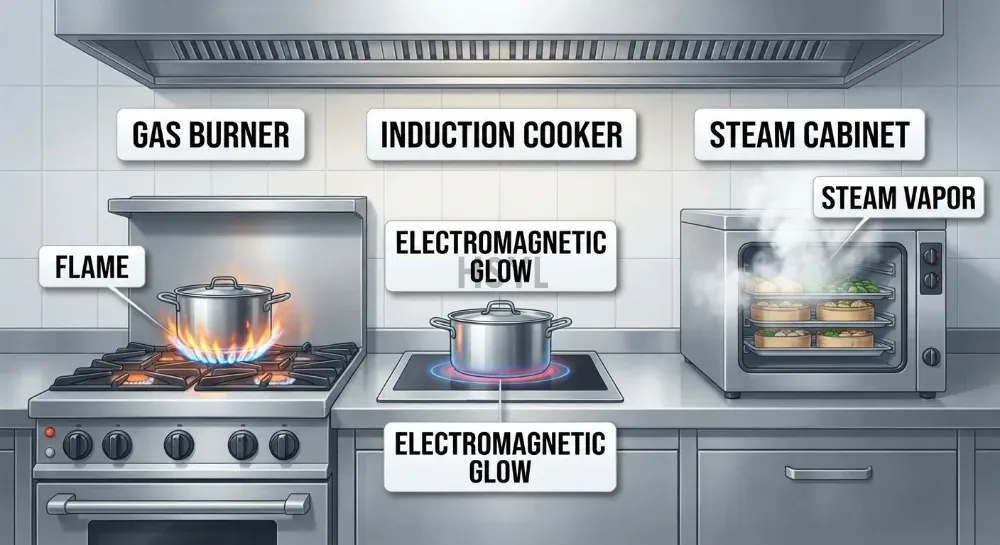
The scope covers heat source selection for commercial kitchen cooking lines, by zone. It covers gas, induction, and steam properties and zone assignment. It does not cover stainless grade selection (covered separately), layout, or CIP. A compliant commercial kitchen equipment solution specifies heat source by zone, not a single source for the whole kitchen.
Three Heat Sources and Their Properties
The three heat sources differ in how they deliver heat, how efficient they are, and what they cost to run.
| Property | Gas | Induction | Steam |
|---|---|---|---|
| Heat transfer | Flame to pan (radiation + convection) | Magnetic induction in pan | Steam condensation on product or pan |
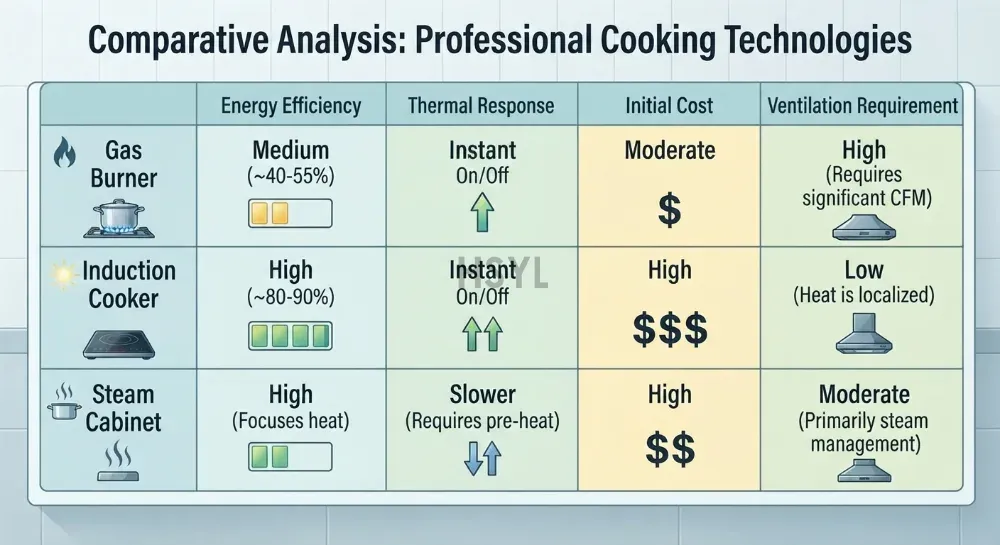
| Thermal efficiency | 40–55% (heat lost to surroundings) | 85–92% (heat generated in pan) | 70–85% (latent heat of condensation) |
| Response time | Fast (instant flame adjustment) | Very fast (instant electronic control) | Slower (steam generation lag) |
| Ventilation need | High (combustion products) | Low (no combustion) | Medium (steam release) |
| Energy cost | Variable (gas price) | Electricity (often higher per kWh) | Depends on boiler efficiency |
| Cooking quality | Wok-hei, flame-licked flavor | Consistent, controllable | Gentle, even, no hot spots |
Thermal efficiency is the key number. Induction's 85–92% means almost all the energy goes into the food; gas's 40–55% means half the energy heats the kitchen air. But efficiency is not the only factor — gas delivers a cooking quality (wok-hei) that induction cannot replicate, and steam delivers an evenness that neither gas nor induction can match for certain products.
Zone-by-Heat-Source Map
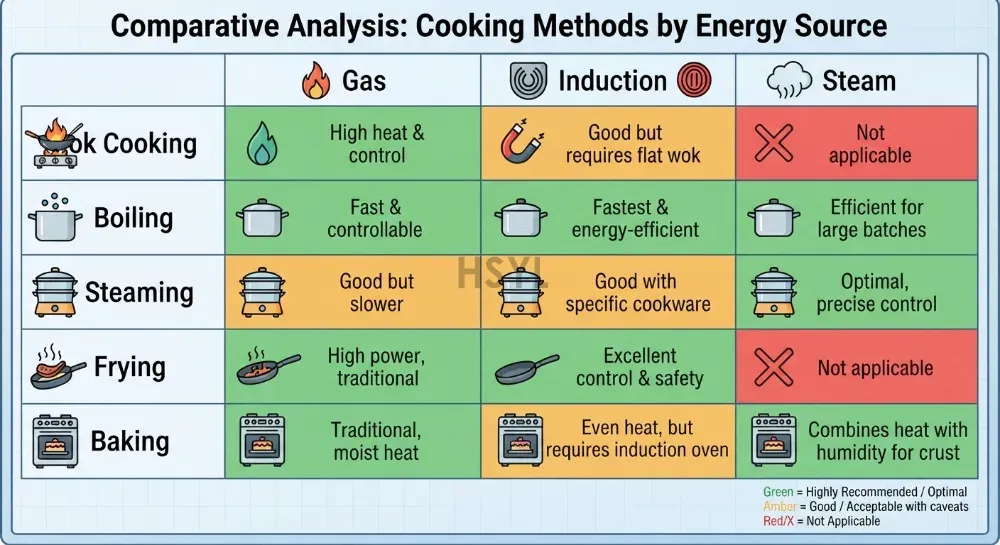
The table below maps kitchen cooking zones to the appropriate heat source, based on the cooking method and the heat source's strengths.
| Zone | Cooking method | Recommended heat source | Rationale |
|---|---|---|---|
| Wok station | Stir-fry, wok-hei | Gas (or high-power induction for compliance zones) | Gas flame delivers wok-hei; induction used where gas is restricted |
| Boiling and simmering | Soup, pasta, stock | Induction or steam | Induction for efficiency; steam for large-volume kettle |
| Steaming | Dim sum, seafood, vegetables | Steam | Steam is the defining heat source; even and gentle |
| Frying | Deep fry | Electric or gas (tank heating) | Direct electric element or gas burner under tank |
| Baking and roasting | Oven | Electric or gas (convection) | Depends on oven type; electric for precise control, gas for volume |
| Holding and warming | Bain-marie, holding cabinet | Steam or electric | Steam for gentle holding; electric for dry holding |
Energy note: The heat source decision is not always about efficiency. A wok station that requires gas for wok-hei cannot be replaced by induction without losing the cooking quality — the decision is gas-or-no-wok-hei, not gas-or-induction. Match the heat source to the cooking method first, then optimize efficiency within that constraint.
Cost-Efficiency Model
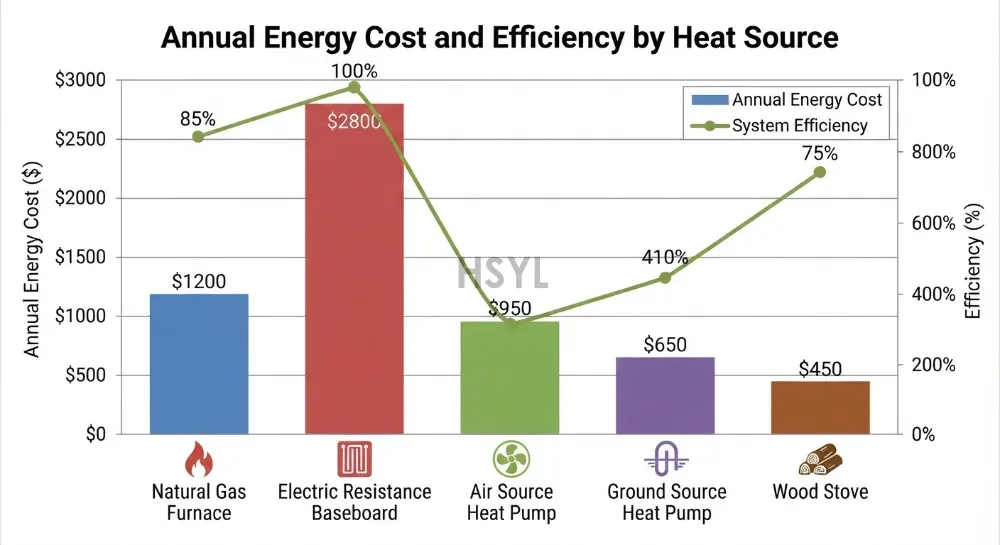
The cost-efficiency model compares the annual energy cost of each heat source, factoring in efficiency and energy price. A higher-efficiency source (induction) may have a higher per-kWh energy price but lower total cost because less energy is wasted. The model inputs are: annual cooking hours, average power demand, heat source efficiency, and energy price per kWh (electricity or gas).
The commercial electromagnetic cooker at 30 kW and 90% efficiency delivers 27 kW of effective cooking power; a gas burner at 30 kW and 50% efficiency delivers 15 kW of effective cooking power. To match the induction cooker's effective power, the gas burner needs to be rated at 54 kW — with corresponding gas consumption and ventilation cost. The double-door steaming cabinet uses steam, which is efficient for large-volume steaming where induction or gas would be impractical.
Scope, Sources and Limitations
Scope. This article covers heat source selection for commercial kitchen cooking lines, by zone. It covers gas, induction, and steam properties and zone assignment. It does not cover stainless grade selection, layout, or CIP.
Limitations. All efficiency ranges and cost models are drawn from publicly available energy and kitchen engineering material. Actual efficiency and cost depend on equipment model, energy price, usage pattern, and ventilation design. HSYL does not publish project-specific energy figures without verified evidence.
Source basis. Heat source properties are consistent with industry kitchen engineering material, energy-efficiency frameworks, and equipment manufacturer data.
Heat Source and Energy Resources
Three resources complement this heat source content. The kitchen solutions page carries the full scope. The electromagnetic cooker page carries an induction heat source example. The steaming cabinet page carries a steam heat source example.
- Commercial kitchen equipment solution — the full kitchen scope where zone-by-heat-source specification applies.
- Commercial electromagnetic cooker — an induction heat source equipment for high-efficiency cooking zones.
- Double-door steaming cabinet with viewing window — a steam heat source equipment for steaming zones.
Next Step: Map Your Kitchen by Heat Source
Send HSYL your kitchen zones, cooking methods, local energy prices (gas and electricity), and ventilation capacity. HSYL will return a pre-filled zone-by-heat-source map with gas/induction/steam assignment for your zones and a cost-efficiency model for your energy prices.
Frequently Asked Questions
Which heat source is most efficient for a commercial kitchen?
Can induction replace gas in a commercial kitchen wok station?
When is steam the right heat source for a commercial kitchen?
How do I compare the energy cost of gas vs induction?
Can HSYL specify the heat source for every zone in my kitchen?
Must-Read Blogs For Chain Restaurants Owner

 Cooking Drying Oven
 YL-W-06 Commercial Water Purification Equipment
 YL-W-05 Commercial Water Purification Equipment
 YL-W-04 Commercial Water Purification Equipment
Ready to Get Started?