
Hygienic Welding and Passivation in Commercial Kitchen Equipment
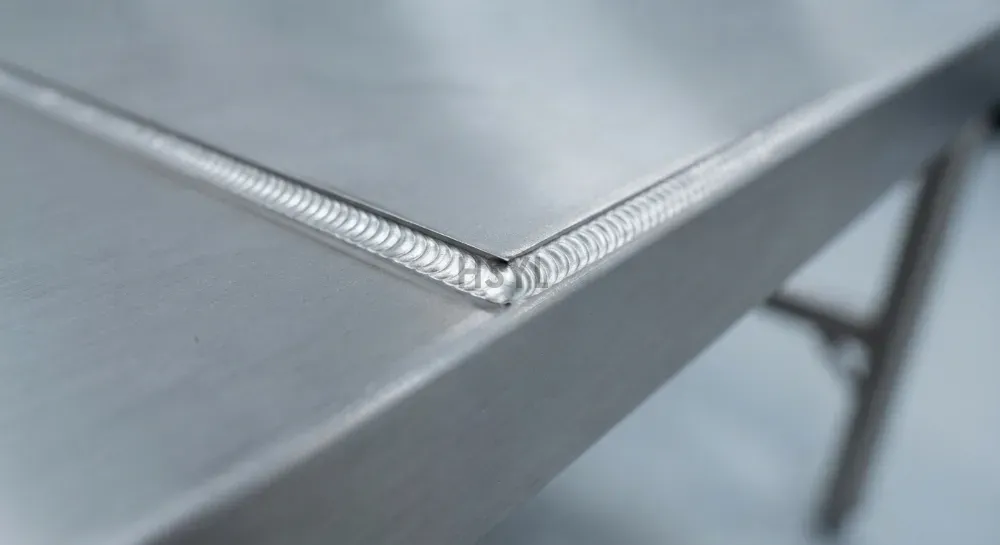
The weld on a commercial kitchen table, sink, or equipment frame is not just a structural joint — on a food-contact surface, it is a hygiene joint. A weld with porosity, undercut, or heat tint creates sites where bacteria can hide from cleaning and where corrosion can initiate. A food-contact weld must be smooth, fully penetrated, free of crevices, and passivated after welding to restore the chromium-oxide layer. This article covers the joint types common in kitchen equipment, the weld process that fits each, the food-contact weld requirements, and the passivation record that documents the work.
The scope covers hygienic welding and passivation for commercial kitchen stainless equipment. It covers joint types, weld process, food-contact requirements, and passivation. It does not cover stainless grade selection (covered separately), heat source, or layout. A compliant commercial kitchen equipment solution specifies weld and passivation requirements per food-contact surface.
Joint Types and Weld Process
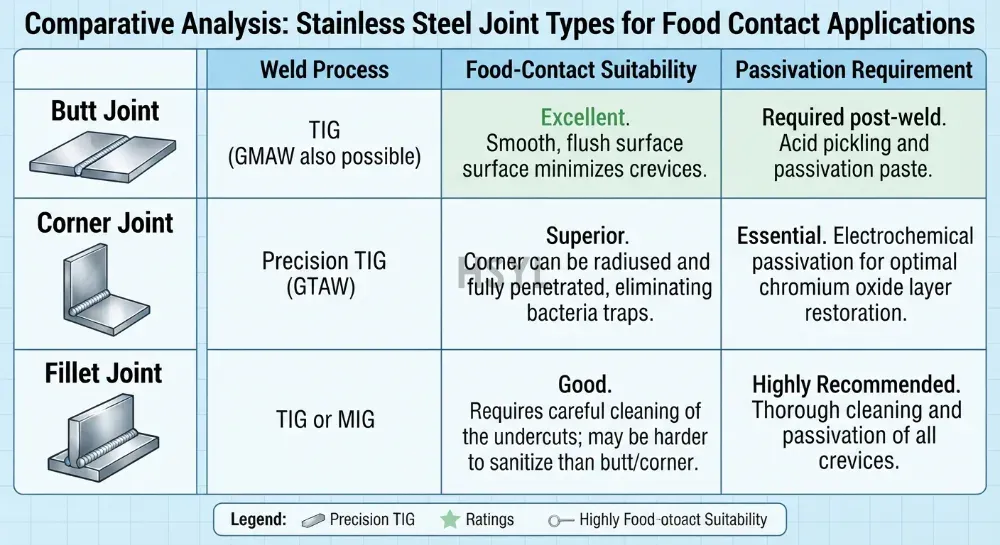
Three joint types are common in kitchen equipment: butt (two pieces edge-to-edge), corner (two pieces at 90°), and fillet (two pieces at 90°, one on top of the other). Each has a typical weld process.
| Joint type | Where used | Typical weld process | Food-contact suitability |
|---|---|---|---|
| Butt | Table top seams, sink bowl seams | TIG (GTAW) with full penetration | Yes — when fully penetrated and smooth |
| Corner | Table edges, sink corners, equipment frame | TIG (GTAW) with backing or MIG (GMAW) | Yes — when sealed and passivated |
| Fillet | Legs to frame, brackets, non-contact structural | MIG (GMAW) or TIG (GTAW) | Limited — not for direct food contact |
TIG (tungsten inert gas) is the preferred process for food-contact welds because it produces a clean, controllable bead with no spatter. MIG (metal inert gas) is faster and used for structural welds but produces spatter and a rougher bead that is harder to clean. Food-contact surfaces use TIG; non-contact structural can use MIG.
Food-Contact Weld Requirements
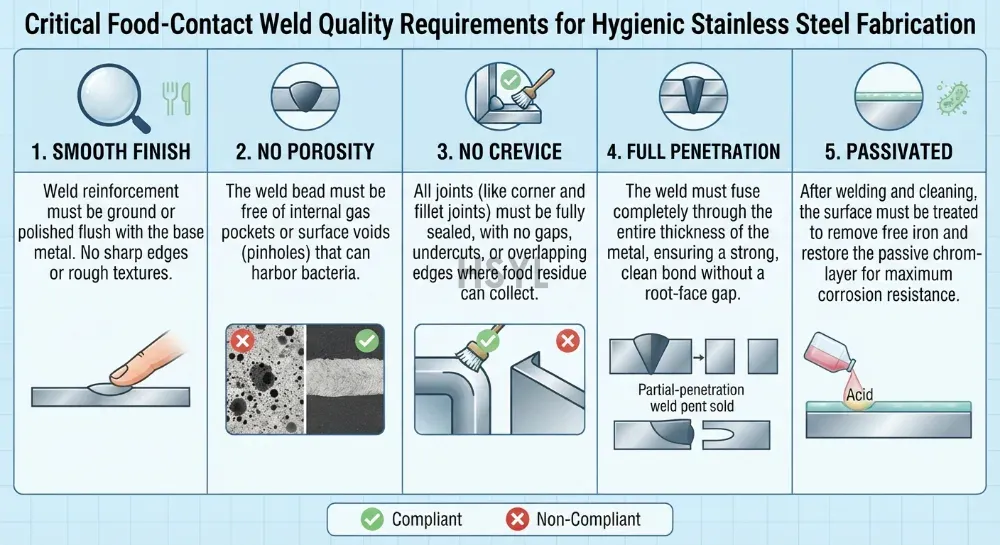
A weld on a food-contact surface must meet five requirements that a structural weld does not. The requirements are what make the weld hygienic — cleanable, corrosion-resistant, and free of bacteria-hiding sites.
- Smooth. The weld bead must be ground flush and polished to match the surrounding surface. No ridges, no valleys, no roughness.
- No porosity. Gas pockets in the weld create pits that trap bacteria and are not cleanable. Porosity is a reject defect on food-contact welds.
- No crevice. Any gap between the weld and the parent metal is a crevice. Crevices cannot be cleaned and must be eliminated by grinding or re-welding.
- Full penetration. A food-contact weld must penetrate fully through the joint — a partial-penetration weld leaves a gap on the back side that cannot be cleaned.
- Passivated. Welding disturbs the chromium-oxide layer (heat tint). Passivation restores it. A food-contact weld without passivation is not corrosion-resistant.
Manufacturing note: The five requirements are not optional. A food-contact weld that is smooth but not passivated looks clean but is not corrosion-resistant. A weld that is passivated but has porosity is corrosion-resistant but not cleanable. All five must be met, and all five must be verified before the equipment enters food contact.
Passivation After Welding
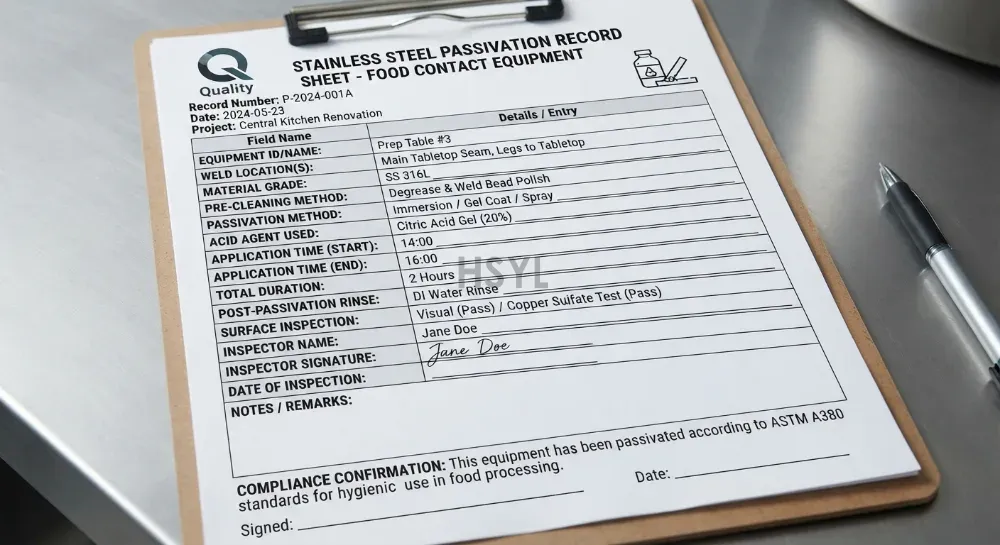
Passivation after welding restores the chromium-oxide passive layer that welding disturbed. The process is: clean the weld area of oil and debris; apply pickling paste or immersion to remove heat tint and embedded iron; rinse thoroughly; apply passivation (nitric or citric acid) to promote the passive layer; rinse and dry; inspect with visual and free-iron test. The passivation must be recorded.
The passivation record documents, for each weld or surface: equipment ID, weld location, treatment method, acid type and concentration, contact time, temperature, inspector, date, and post-treatment inspection result. The single tank electric fryer and the double-door steaming cabinet both have food-contact welds (oil tank, steam cavity) that require passivation records.
Scope, Sources and Limitations
Scope. This article covers hygienic welding and passivation for commercial kitchen stainless equipment. It covers joint types, weld process, food-contact requirements, and passivation. It does not cover stainless grade selection, heat source, or layout.
Limitations. All weld and passivation descriptions are drawn from publicly available manufacturing and metallurgical material (ASTM A380/A967, EHEDG). Actual weld procedure and passivation parameters depend on grade, thickness, and equipment design. HSYL does not publish project-specific weld procedures without verified evidence.
Source basis. Weld and passivation principles are consistent with ASTM A380/A380M-25 and ASTM A967/A967M-25, EHEDG hygienic design guidelines, and AWS welding standards.
Hygienic Joint and Passivation Resources
Three resources complement this welding content. The kitchen solutions page carries the full scope. The fryer page carries an oil-contact weld example. The steaming cabinet page carries a steam-cavity weld example.
- Commercial kitchen equipment solution — the full kitchen scope where hygienic weld and passivation requirements apply.
- Single tank single basket electric fryer — an equipment with food-contact welds on the oil tank.
- Double-door steaming cabinet with viewing window — an equipment with food-contact welds on the steam cavity.
Next Step: Audit Your Kitchen Welds
Send HSYL your equipment list, food-contact weld locations, current weld process, and passivation record format. HSYL will return a pre-filled hygienic weld requirement checklist with the joint-process-passivation framework for your equipment and a passivation record template for your fabrication.
Frequently Asked Questions
What makes a weld hygienic for food contact in commercial kitchen equipment?
What weld process is used for food-contact stainless in kitchen equipment?
Why is passivation required after welding stainless kitchen equipment?
What is a passivation record and what should it include?
Can I use MIG welding for food-contact surfaces in kitchen equipment?
Must-Read Blogs For Chain Restaurants Owner

 YL-W-01 Commercial Water Purification Equipment
 YL-W-06 Commercial Water Purification Equipment
 YL-W-05 Commercial Water Purification Equipment
 YL-W-04 Commercial Water Purification Equipment
Ready to Get Started?