
Preventive Maintenance for Retorts and Can Seamers: A Risk-Based Task and Spare-Parts Matrix
Preventive maintenance on a fish canning line is not a calendar-driven formality — it is a risk-based decision about which components, at which frequency, with which spares, and verified how. Retorts and can seamers are the two most safety-critical equipment groups on the line: a retort maintenance failure can cause under-processing; a seamer maintenance failure can cause a seam defect that leaks. A PM program that treats all tasks as equal will over-maintain low-risk components and under-maintain high-risk ones. This article builds a risk-based task matrix, a spare-parts criticality table, and a post-maintenance verification checklist for retorts and can seamers.
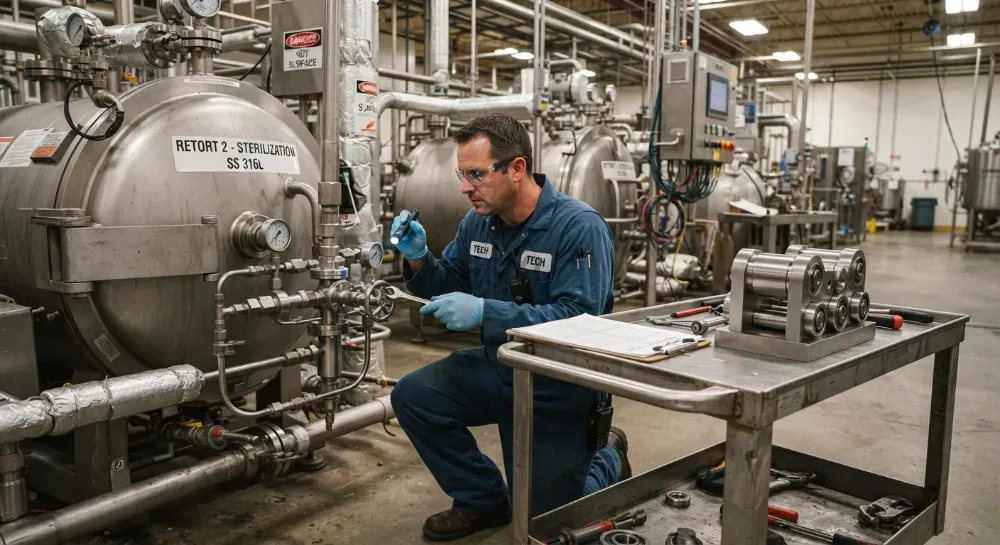
The scope covers preventive maintenance for retorts and can seamers in fish canning. It covers risk-based task selection, spare-parts criticality, and post-maintenance verification. It does not cover OEE measurement (covered separately), retort validation, or can deformation. The automatic can sealing machine page carries the seamer detail.
Risk-Based Task Matrix
The risk-based task matrix prioritizes maintenance tasks by the consequence of component failure. High-risk components (retort vent valve, seamer rolls, chuck) get more frequent inspection and shorter replacement intervals; low-risk components (cosmetic fittings, non-contact surfaces) get less. The matrix below shows the structure; the specific intervals depend on equipment type, usage, and manufacturer guidance.
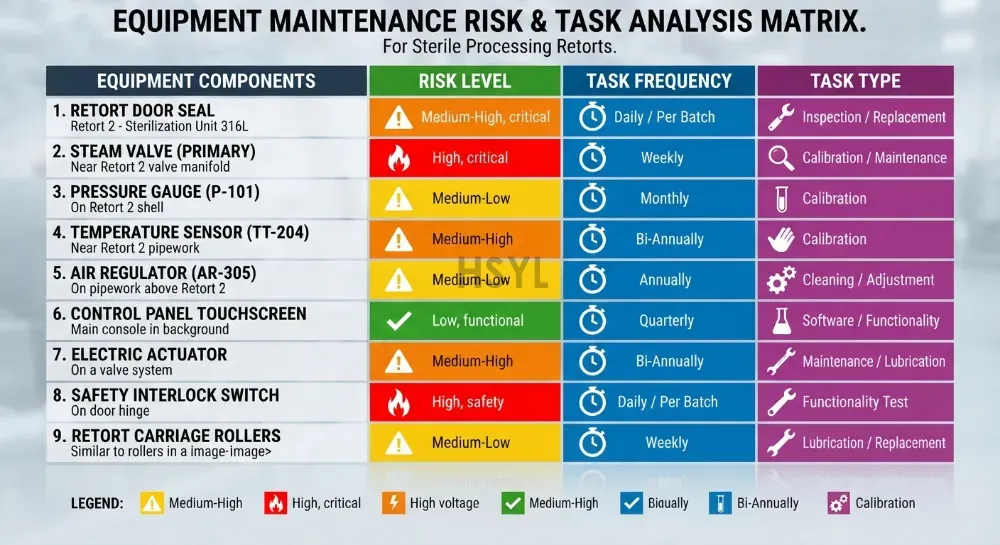
| Component | Failure consequence | Risk level | Task frequency |
|---|---|---|---|
| Retort vent valve | Trapped air, under-processing | High | Inspect every shift; scheduled service quarterly |
| Retort bleeder | Air re-accumulation, cold spots | High | Flow check every shift; clean monthly |
| Retort condensate drain | Pooling, cold zones | Medium | Inspect weekly; clean monthly |
| Seamer rolls | Seam defects (jumped, cut) | High | Profile inspection per changeover; replace per usage |
| Seamer chuck | Seam defects, can slip | High | Inspect per changeover; replace per usage |
| Seamer drive | Speed drift, stop | Medium | Lubricate per schedule; inspect monthly |
| Retort insulation | Heat loss, energy waste | Low | Inspect annually; repair as needed |
Maintenance note: Risk-based maintenance is not the same as run-to-failure. Low-risk components still get maintained — they just get maintained less often. The risk level sets the frequency and the verification depth, not whether the task is done. A PM program that skips low-risk tasks entirely will accumulate failures that could have been prevented.
Spare Parts Criticality
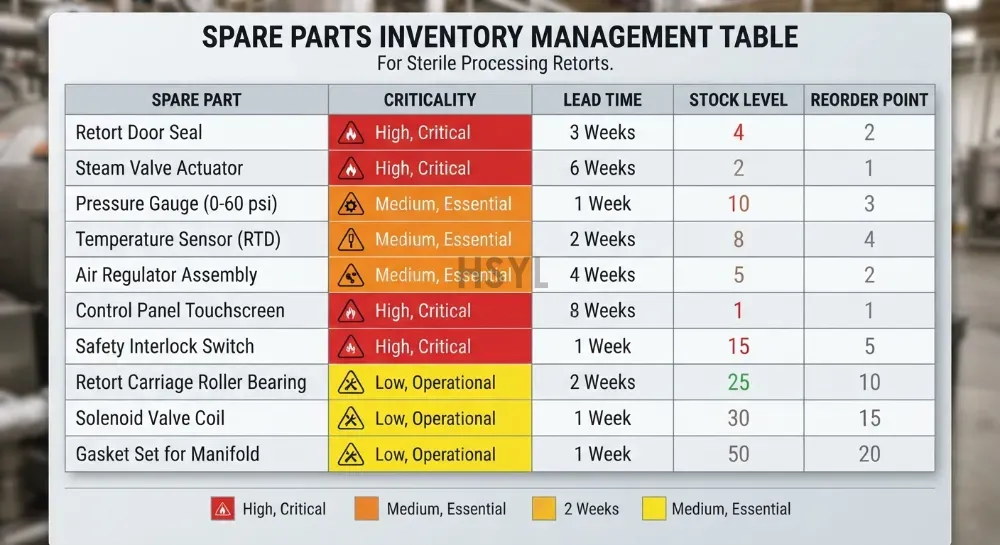
Spare parts criticality determines what to stock and at what level. A part that stops the line and has a long lead time must be stocked; a part that is non-critical and readily available does not. The criticality table below shows the structure for a retort and seamer.
| Part | Criticality | Lead time | Stock level |
|---|---|---|---|
| Seamer rolls (matched set) | Critical | 4–8 weeks | 1 set minimum on hand |
| Seamer chuck | Critical | 4–8 weeks | 1 on hand |
| Retort vent valve | Critical | 2–4 weeks | 1 on hand |
| Retort pressure relief | Critical (safety) | 2–4 weeks | 1 on hand |
| Temperature probe (retort) | Critical | 1–2 weeks | 1 on hand + calibrated spare |
| Seamer drive belt | Medium | 1–2 weeks | 1 on hand |
| Retort gaskets | Medium | 1 week | 2–3 on hand |
| Routine fittings | Low | Off-the-shelf | None — purchase as needed |
Post-Maintenance Verification
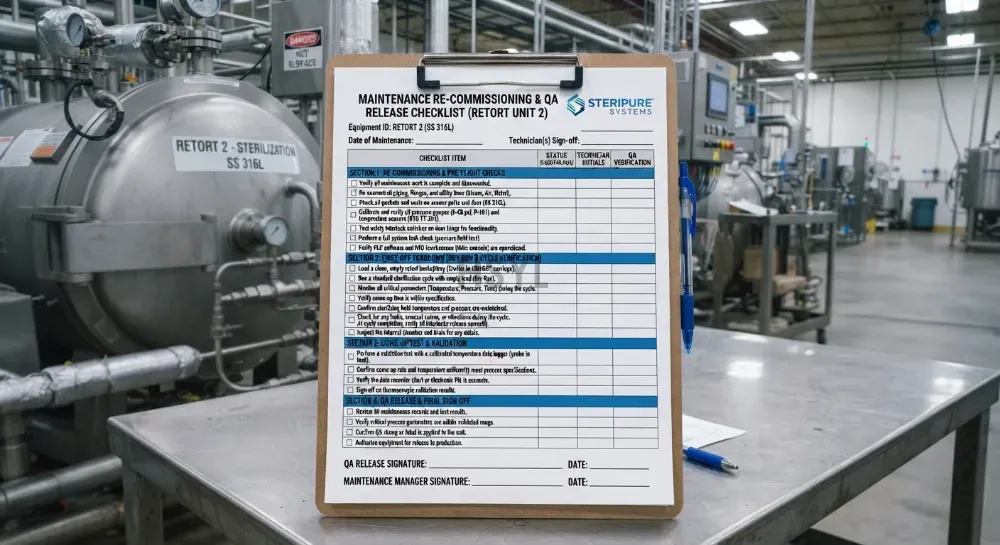
Maintenance is not complete until the equipment is verified to perform within spec after the work. The post-maintenance verification for retorts and seamers has four components.
- Re-commissioning. After any maintenance that affects retort performance, re-verify vent valve operation, bleeder flow, and condensate drainage before the next batch.
- First-off seam teardown. After any seamer maintenance (roll change, chuck adjustment, drive work), perform a first-off seam teardown before resuming production.
- Come-up time check. After retort maintenance that could affect steam distribution, run a come-up time check and compare to baseline.
- QA release. The QA authority must release the equipment for production after maintenance, based on the verification results.
A retort sterilization equipment for fish canning that has been maintained without verification is a retort of unknown status — the maintenance may have changed venting, distribution, or pressure behavior, and only verification confirms it is still within the validated condition.
Scope, Sources and Limitations
Scope. This article covers preventive maintenance for retorts and can seamers in fish canning. It covers risk-based task selection, spare-parts criticality, and post-maintenance verification. It does not cover OEE measurement, retort validation, or can deformation.
Limitations. All task frequencies and spare parts criticality are drawn from publicly available industry and equipment-maintenance material. Actual intervals depend on equipment type, usage, and manufacturer guidance. HSYL does not publish project-specific maintenance intervals without verified evidence.
Source basis. Maintenance principles are consistent with ISO 14224 (reliability data), industry preventive-maintenance frameworks, and equipment manufacturer guidance. Equipment-capability statements refer to HSYL equipment specifications.
Preventive Maintenance Resources
Two resources complement this maintenance content. The can sealing machine page carries the seamer whose rolls and chuck are critical. The retort equipment page carries the retort whose vent, bleeder, and condensate systems are critical.
- Automatic can sealing machine — the seamer whose rolls, chuck, and drive are the critical maintenance components.
- Retort sterilization equipment for fish canning — the retort whose vent, bleeder, condensate, and relief systems are the critical maintenance components.
Next Step: Build Your Risk-Based PM Program
Send HSYL your retort type, seamer model, current PM task list, and current spare parts inventory. HSYL will return a pre-filled risk-based PM task matrix with the criticality framework for your equipment and a post-maintenance verification checklist tailored to your retort and seamer.
Frequently Asked Questions
What is risk-based preventive maintenance?
Which spare parts should I stock for a fish canning retort and seamer?
What is post-maintenance verification and why is it required?
How often should I inspect retort vent valves and bleeders?
Can HSYL provide a maintenance interval schedule for my retort and seamer?
Must-Read Blogs For Chain Restaurants Owner

Ready to Get Started?