
Central Kitchen Cook-Chill and Cold Chain: From Cooking to Distribution
Cook-chill is the central kitchen's core process for extending shelf life and distributing prepared food to outlets. The chain runs from cooking through blast chilling, chilled storage, distribution, and outlet reheat — and at every stage, temperature and time are the controls that keep the food safe. A break in the chain — a slow chill, a warm storage, a delayed distribution — is a food-safety failure, not an operational delay. This article covers the cook-chill chain, the HACCP points at each stage, and the temperature control plan that makes the chain defensible.
The scope covers cook-chill and cold chain for central kitchen, from cooking to distribution handoff. It covers the chain stages, HACCP points, and temperature control. It does not cover batch cooking (covered separately), layout, or cleaning. The commercial electromagnetic cooker and the steaming cabinet are the cooking equipment that feeds the cook-chill chain.
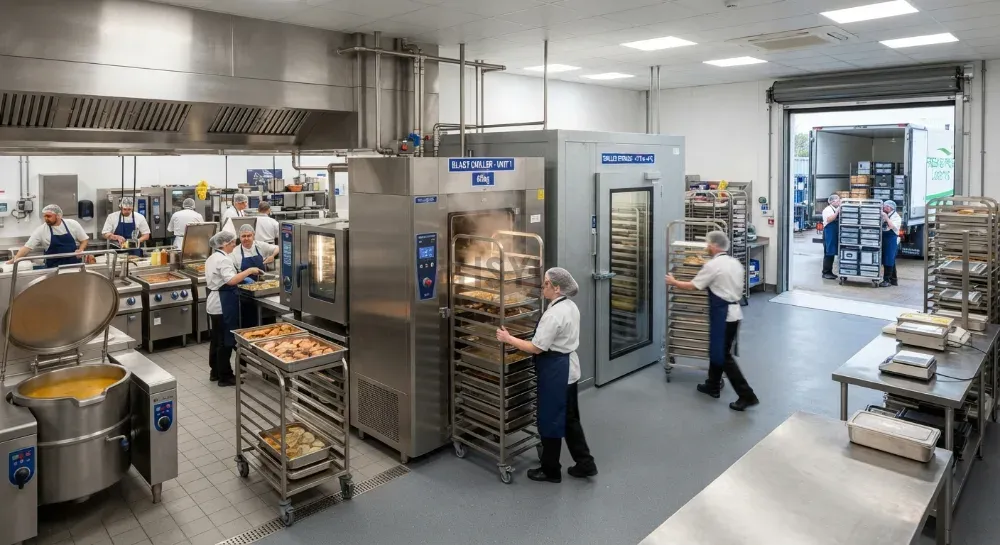
The Cook-Chill Chain
The cook-chill chain has five stages, each with a temperature and time requirement. The table below shows the structure; the specific values depend on product, regulation, and shelf-life target.
| Stage | Action | Temperature target | Time target | HACCP point |
|---|---|---|---|---|
| 1. Cooking | Cook to specified core temperature | Product-specific (e.g., 75 °C core) | Hold time per recipe | Cooking critical control point |
| 2. Blast chill | Rapid chill from cooking to chilled | From 60 °C to 4 °C or below | Typically 90 minutes or less (verify regulation) | Time-temperature critical control point |
| 3. Chilled storage | Hold at chilled temperature | 0–4 °C | Shelf life per product (days) | Storage temperature control |
| 4. Distribution | Transport to outlet at chilled temperature | 0–4 °C maintained | Defined transport window | Cold chain maintenance |
| 5. Outlet reheat | Reheat to serving temperature | Product-specific (e.g., 75 °C core) | Reheat time per recipe | Reheat critical control point |
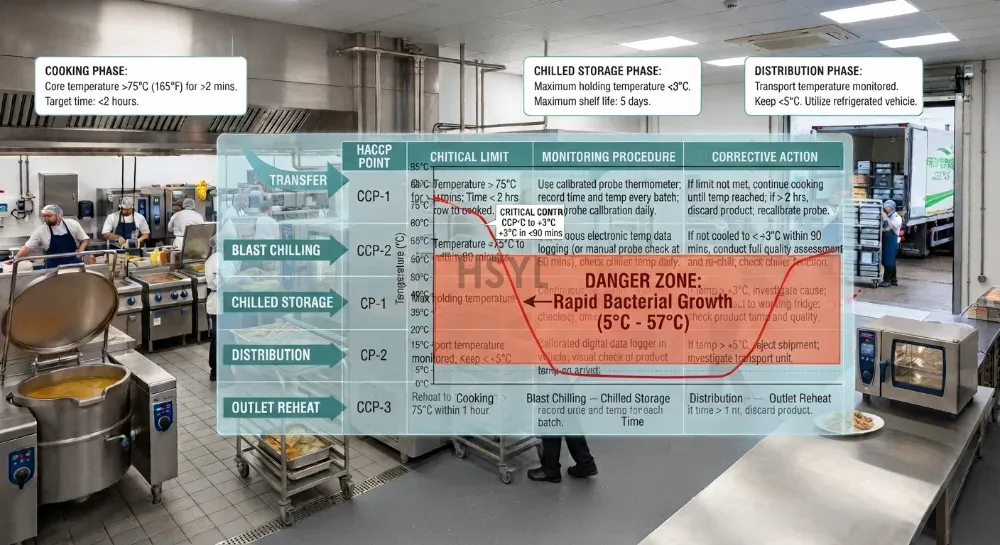
The critical stage is blast chill — the rapid chill from cooking temperature to chilled. This is the stage where the food passes through the danger zone (typically 60 °C down to 4 °C), and the time in the danger zone must be limited to prevent bacterial growth. A blast chiller that takes 4 hours to chill is not a blast chiller — it is a slow chiller, and the food is in the danger zone too long.
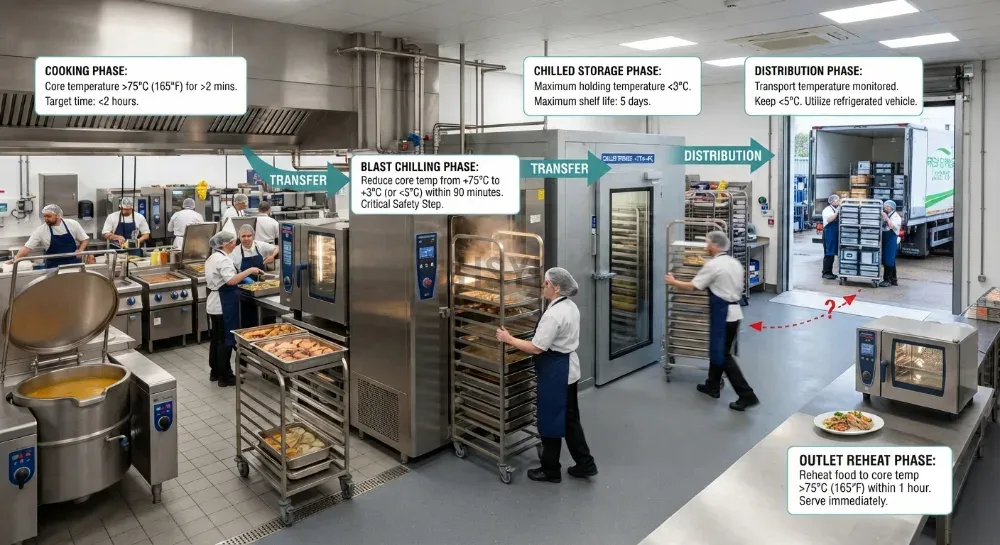
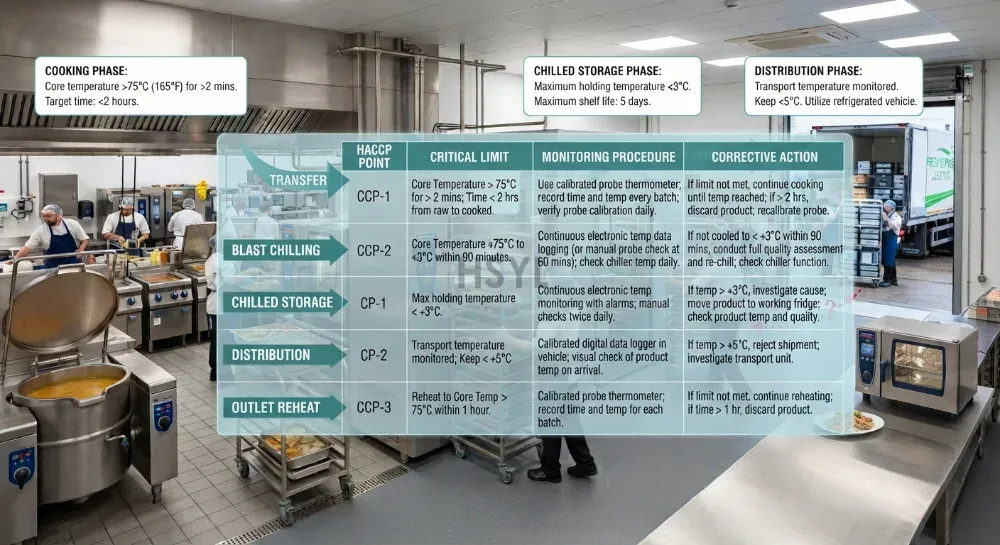
HACCP Points in the Chain
The cook-chill chain has HACCP critical control points at cooking, blast chill, and reheat. Storage and distribution are temperature-control points, not full CCPs, but they are still critical — a break in storage or distribution temperature invalidates the shelf life of the product.
Food safety note: The cook-chill chain is only as safe as its weakest stage. A blast chiller that meets the time target, followed by a storage that drifts to 8 °C, is a chain that fails — the storage drift allows bacterial growth that the blast chill prevented. The temperature control plan must cover every stage, not just the CCPs.
Temperature Control Plan
A defensible temperature control plan records temperature at every stage, with lot ID, time, and operator. The plan covers: cooking core temperature (per batch), blast chill cycle time and final temperature (per batch), chilled storage temperature (continuous monitoring), distribution temperature (per delivery, with data logger), and outlet reheat temperature (per batch). A central kitchen that does not record every stage is a kitchen that cannot defend its shelf life in an audit.
Scope, Sources and Limitations
Scope. This article covers cook-chill and cold chain for central kitchen, from cooking to distribution handoff. It covers the chain stages, HACCP points, and temperature control. It does not cover batch cooking, layout, or cleaning.
Limitations. All chain temperatures and times are drawn from publicly available food-safety and cold-chain material. Actual values depend on product, regulation, and shelf-life target. HSYL does not publish project-specific chain data without verified evidence.
Source basis. Cook-chill and cold chain principles are consistent with FDA Food Code, HACCP frameworks, and Codex food hygiene material.
Cook-Chill and Cold Chain Resources
Two resources complement this cook-chill content. The electromagnetic cooker page carries the cooking equipment that feeds the chain. The steaming cabinet page carries the steaming equipment for batch cooking.
- Commercial electromagnetic cooker — the cooking equipment at stage 1 of the cook-chill chain.
- Double-door steaming cabinet with viewing window — the batch steaming equipment that feeds the cook-chill chain.
Next Step: Build Your Cook-Chill Chain
Send HSYL your menu type, shelf-life target, distribution radius, and current chain stages. HSYL will return a pre-filled cook-chill chain framework with the HACCP point table for your product and a temperature control plan template for your distribution.
Frequently Asked Questions
What is the cook-chill process in a central kitchen?
How fast does blast chilling need to be?
What are the HACCP critical control points in cook-chill?
How do I maintain the cold chain during central kitchen distribution?
Can HSYL specify the cook-chill chain for my central kitchen?
Must-Read Blogs For Chain Restaurants Owner

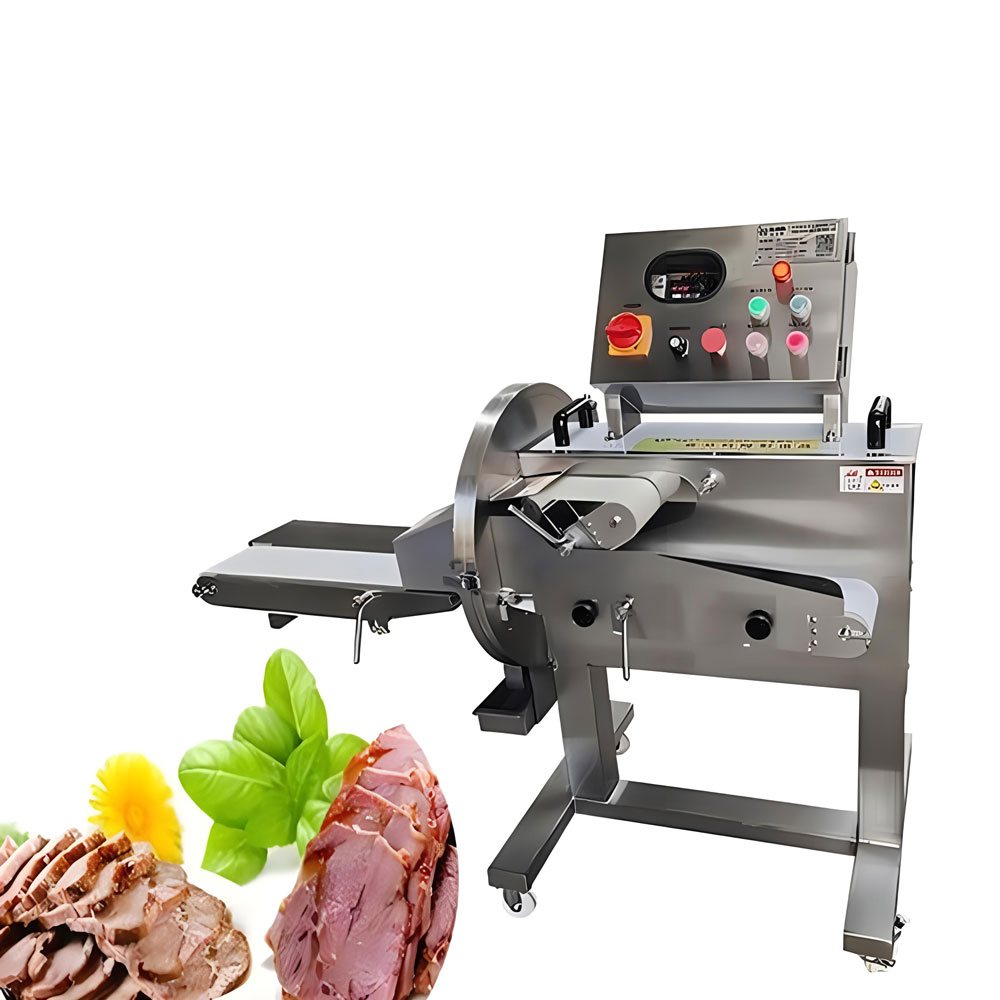 Electric Cooked Meat Slicer
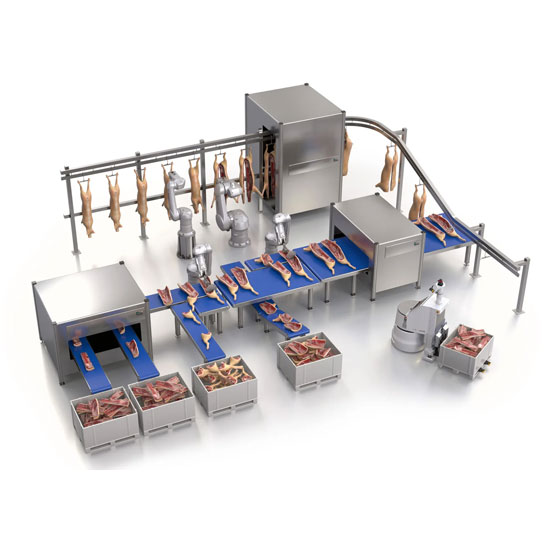 Meat Processing Line Equipment
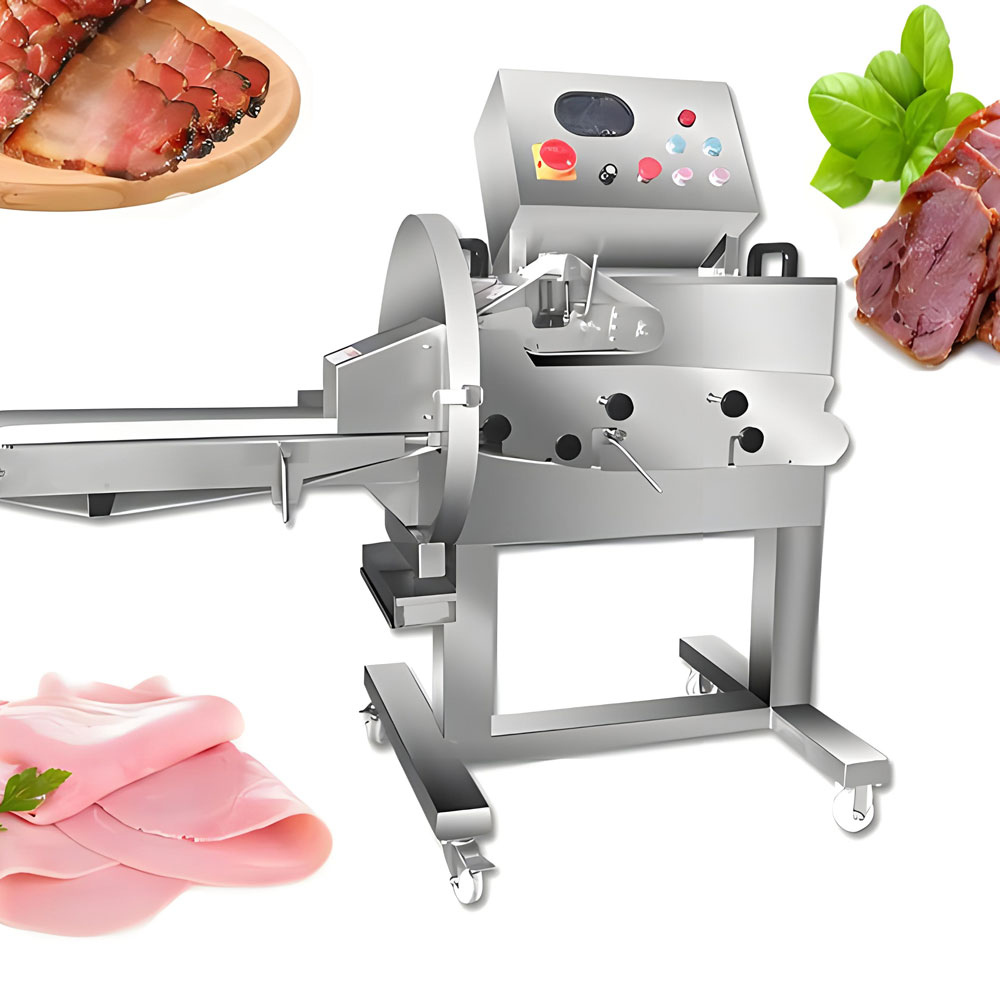 Automatic Cooked Meat Slicing Machine
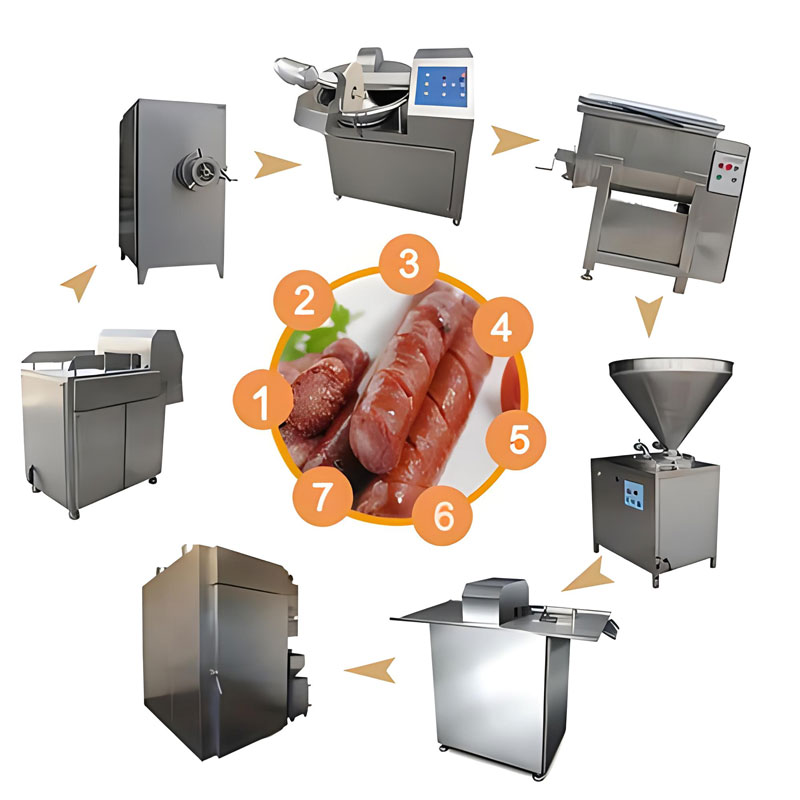 Sausage Processing Line
Ready to Get Started?