
Commercial Kitchen Cleaning Zone Design: Soil Type, Method and CIP Integration
Cleaning in a commercial kitchen is not one task — it is four tasks matched to four soil types, executed by three methods, organized into zones. Protein, fat, carbohydrate, and mineral soils each need a different cleaning chemistry and temperature; manual, COP (clean-out-of-place), and CIP (clean-in-place) methods each fit a different equipment and soil context; and the cleaning zones — wash, rinse, sanitize, store — must be laid out to prevent cross-contamination. A kitchen that cleans everything with one method and one cleaner is either under-cleaning some soils or over-working the cleaning crew. This article maps soil types to methods, designs the cleaning zones, and explains where CIP integration fits.
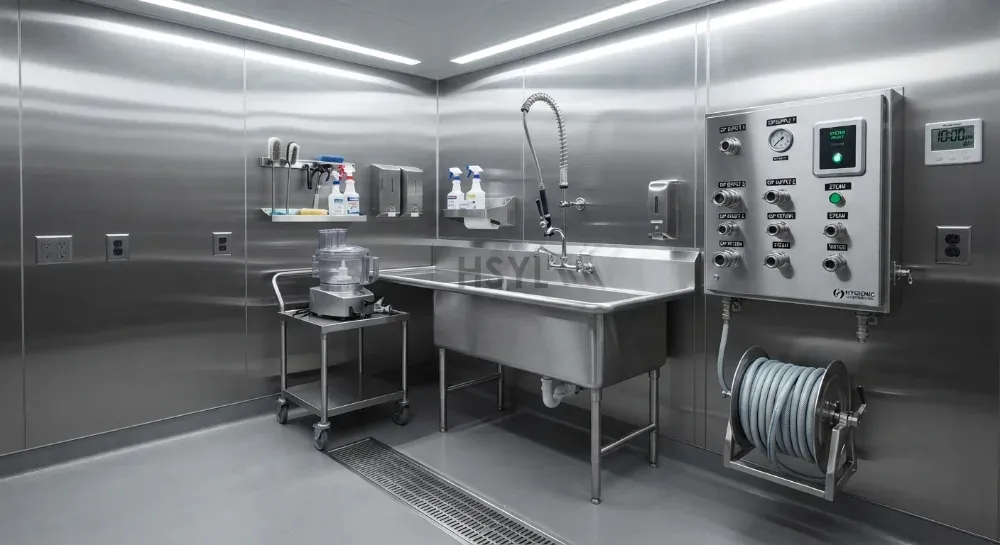
The scope covers cleaning zone design for commercial kitchen, from soil type to CIP integration. It covers soil-method matching, zone layout, and CIP. It does not cover stainless grade selection (covered separately), heat source, or layout. A compliant commercial kitchen equipment solution specifies cleaning zones and CIP scope at design, not as a retrofit.
Soil Types and Cleaning Chemistry
The four soil types in a commercial kitchen each need different cleaning chemistry. Using the wrong chemistry leaves soil behind, no matter how hard you scrub.
| Soil type | Source | Cleaning chemistry | Temperature |
|---|---|---|---|
| Protein | Meat, fish, egg, dairy | Alkaline (to denature and dissolve); chlorine for heavy protein | Warm (not hot — heat cooks protein onto surface) |
| Fat and oil | Cooking oil, grease | Alkaline with surfactant (to emulsify) | Hot (to melt and emulsify) |
| Carbohydrate | Starch, sugar, dough | Mild alkaline or neutral; surfactant for sticky sugars | Warm to hot (to dissolve sugar) |
| Mineral | Hard water scale, calcium | Acidic (to dissolve mineral) | Cool to warm (acid works cool) |
The critical mistake is cleaning protein with hot water — heat cooks protein onto the surface, making it harder to remove. Protein soils need warm water and alkaline cleaner; fat and oil need hot water and alkaline surfactant; mineral needs cool acid. A one-temperature, one-chemistry cleaning protocol is leaving soil behind on at least one soil type.
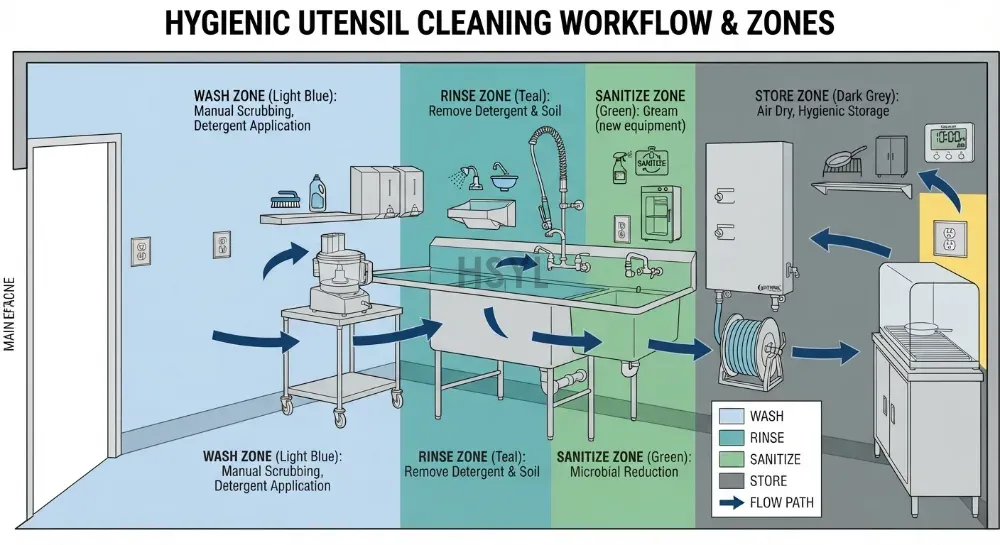
Three Cleaning Methods
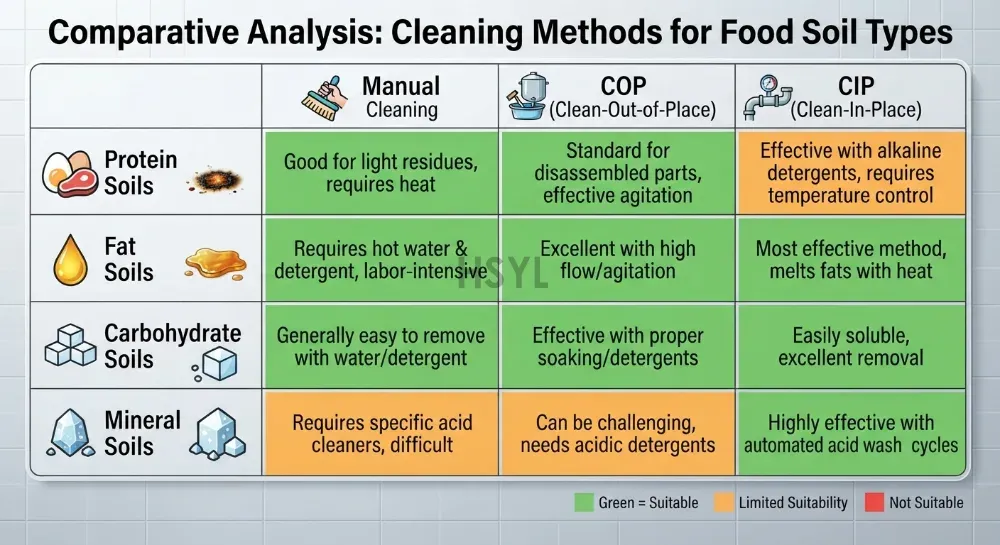
Three cleaning methods fit different equipment and soil contexts. Manual cleaning is hand-wiping and scrubbing; COP is removing parts and cleaning them out of place; CIP is automated cleaning without disassembly.
| Method | Best for | Soil type fit | Limitation |
|---|---|---|---|
| Manual | Small surfaces, tables, light soil | All soil types, with right chemistry | Labor-intensive; inconsistent; cannot reach internals |
| COP (clean-out-of-place) | Removable parts, small equipment | All soil types, with right chemistry | Requires disassembly; parts handling |
| CIP (clean-in-place) | Large equipment, tanks, pipes, sealed systems | All soil types, with right chemistry and temperature | Requires CIP-capable equipment design; higher capex |
Hygiene note: CIP is not automatically better than manual cleaning. CIP is better when the equipment is large, sealed, and CIP-capable; manual is better for small, open, accessible surfaces. A kitchen that forces CIP on equipment not designed for it gets poor cleaning and wasted chemicals. Match the method to the equipment, not the other way around.
Cleaning Zone Layout
The cleaning zone layout prevents cross-contamination between dirty and clean. The four zones — wash, rinse, sanitize, store — must flow in one direction, with no backtracking. The wash zone is where soil is removed; the rinse zone removes cleaner; the sanitize zone applies sanitizer; the store zone holds clean items until use. A kitchen that washes and stores in the same zone recontaminates the clean items.
The layout must also separate cleaning equipment (mops, brushes, squeegees) by zone — a brush used in the wash zone must not be used in the sanitize zone. Color-coding cleaning equipment by zone is the standard control.
CIP Integration
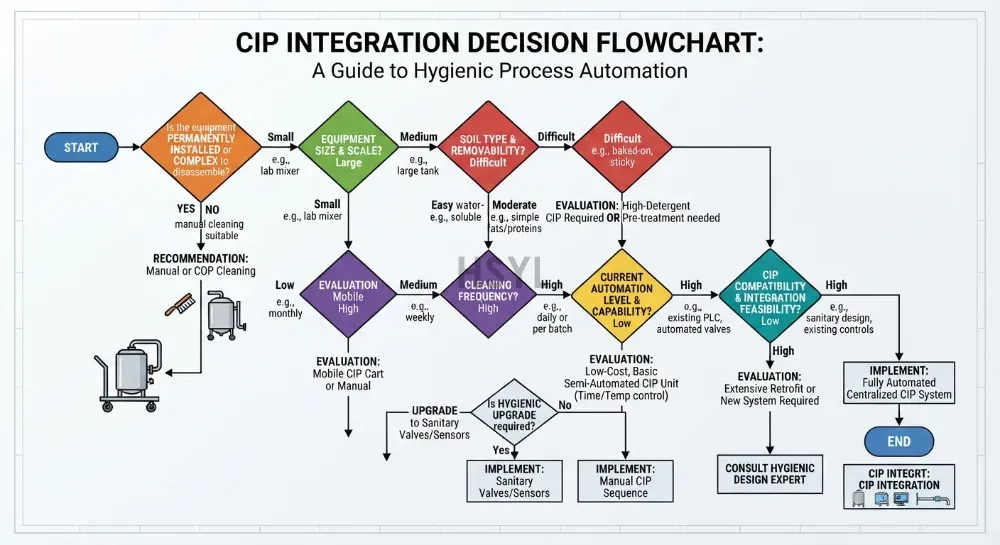
CIP integration fits where equipment is large, sealed, and used frequently enough to justify the capex. The commercial electromagnetic cooker with a sealed cooking vessel can be CIP-capable; a simple table top cannot. The CIP integration decision considers equipment size, soil type, cleaning frequency, and automation level. CIP delivers consistent cleaning with less labor, but only on equipment designed for it — retrofit CIP on non-CIP equipment is usually a failure.
Scope, Sources and Limitations
Scope. This article covers cleaning zone design for commercial kitchen, from soil type to CIP integration. It covers soil-method matching, zone layout, and CIP. It does not cover stainless grade selection, heat source, or layout.
Limitations. All soil chemistry and method descriptions are drawn from publicly available food-safety and cleaning material. Actual cleaning protocol depends on soil type, equipment, local regulation, and cleaner chemistry. HSYL does not publish project-specific cleaning protocols without verified evidence.
Source basis. Cleaning principles are consistent with FDA Food Code, EHEDG hygienic design guidelines, and industry cleaning chemistry material.
Cleaning Zone and CIP Resources
Two resources complement this cleaning content. The kitchen solutions page carries the full scope. The electromagnetic cooker page carries an equipment that can be CIP-capable.
- Commercial kitchen equipment solution — the full kitchen scope where cleaning zones and CIP integration apply.
- Commercial electromagnetic cooker — an equipment that can be CIP-capable when designed with a sealed vessel.
Next Step: Design Your Cleaning Zones
Send HSYL your kitchen zones, soil types by zone, current cleaning methods, and CIP interest. HSYL will return a pre-filled cleaning zone design with the soil-method matrix for your zones and a CIP integration assessment for your equipment.
Frequently Asked Questions
What are the four soil types in a commercial kitchen and how do they affect cleaning?
What is the difference between manual, COP, and CIP cleaning in a kitchen?
How should cleaning zones be laid out in a commercial kitchen?
When is CIP integration appropriate for commercial kitchen equipment?
Can HSYL specify the cleaning protocol for my kitchen?
Must-Read Blogs For Chain Restaurants Owner

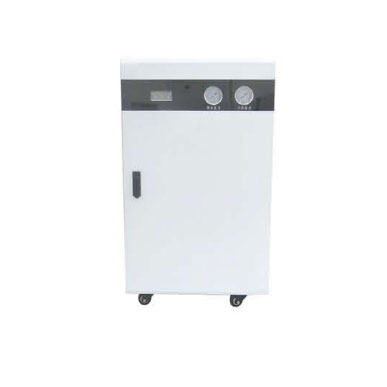 YL-W-01 Commercial Water Purification Equipment
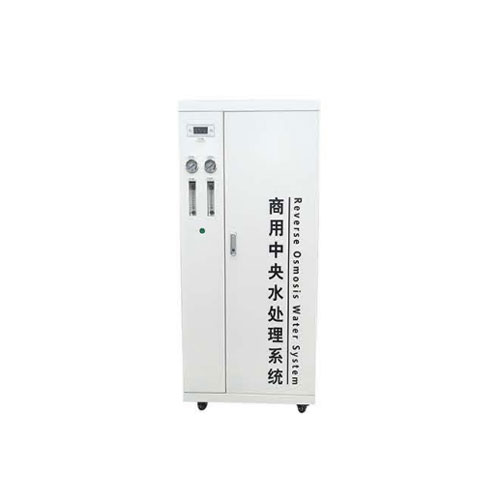 YL-W-06 Commercial Water Purification Equipment
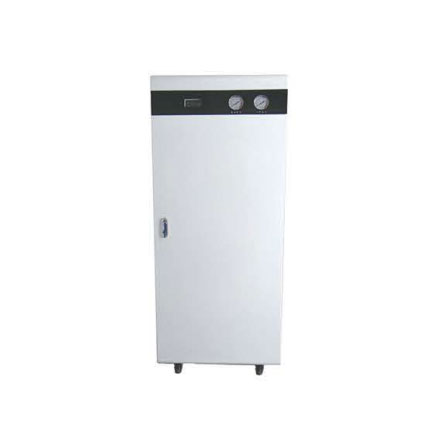 YL-W-05 Commercial Water Purification Equipment
 YL-W-04 Commercial Water Purification Equipment
Ready to Get Started?