
Hotel A La Carte and Batch Mix: Cooking for Speed and Volume
A hotel restaurant kitchen cooks two speeds at once: a la carte speed for individual covers and batch speed for volume items. The two require different logic — a la carte is per-order, fast pick-up, small batch; batch is ahead-of-time, large volume, holding. A kitchen that runs everything as a la carte cannot handle volume; a kitchen that runs everything as batch cannot handle customization. The correct approach is a mix that assigns each menu item to the right mode and runs both in the same kitchen. This article covers the a-la-carte-to-batch mix, the line speed logic, and the holding and pick-up design that makes the mix work.
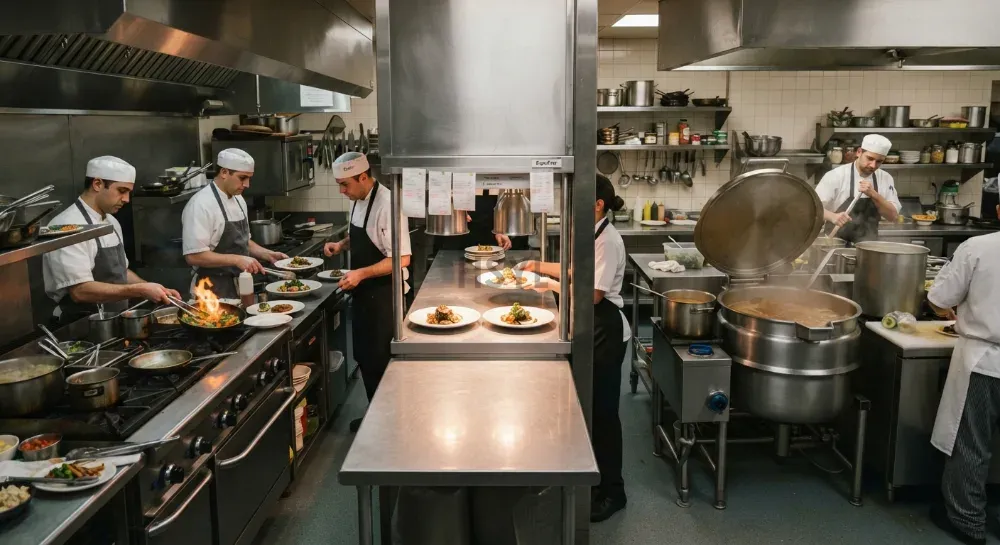
The scope covers a la carte and batch mix for hotel restaurant kitchen. It covers the mix logic, line speed, and holding and pick-up. It does not cover banquet surge (covered separately), layout, or cleaning. The commercial electromagnetic cooker is the a la carte range; the electric fryer serves both modes.
A-La-Carte-to-Batch Mix
The mix assigns each menu item to a la carte (per-order) or batch (ahead-of-time) based on volume, customization, and holding tolerance.
| Item type | A la carte (per-order) | Batch (ahead) | Mix logic |
|---|---|---|---|
| Steak, chops, customized | Yes — per-order cook to temp | No — cannot hold | A la carte only; holding destroys quality |
| Sauces and soups | No — too slow per-order | Yes — batch and hold | Batch; portion at pick-up |
| Pasta and starches | Partial — finish per-order | Yes — batch cook, finish per-order | Batch base, a la carte finish |
| Fried items | Yes — fry per-order | Partial — par-fry and finish | Mixed; par-fry for speed, finish per-order |
| Vegetables and sides | Partial | Yes — batch steam or saute | Batch; hold in steam or bain-marie |
Line Speed Logic
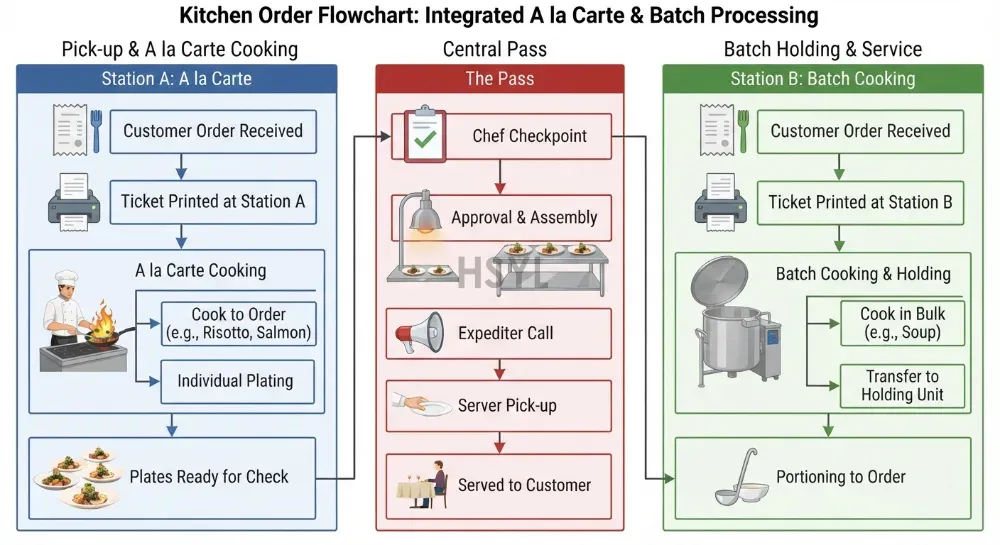
The line must run a la carte pick-up and batch holding in parallel, with the pass synchronizing the output. A la carte items are cooked per-order and picked up immediately; batch items are held and portioned at pick-up. The line speed must match the order rate — too slow, and tickets back up; too fast, and a la carte items overcook while waiting for batch items to catch up.
Operations note: The mix is not a static assignment — it shifts with service. A menu item that is a la carte at lunch may be batch at dinner, or vice versa. The mix decision belongs to the chef and the F&B team, and it must be documented per menu and per service. A kitchen that runs the same mix at every service is a kitchen that is not optimizing for the actual order pattern.
Holding and Pick-Up Design
The holding and pick-up design is what makes the mix possible. Holding cabinets hold batch items at serving temperature; the pick-up pass is where a la carte and batch items meet for plating. The design must allow: batch items to hold at temperature without quality loss for the hold duration; a la carte items to reach the pass without delay; and the pass to plate and dispatch at order rate. A hotel restaurant with a poorly designed pick-up pass will have cold batch items or overcooked a la carte items — the mix fails not at cooking, but at the pass.
Scope, Sources and Limitations
Scope. This article covers a la carte and batch mix for hotel restaurant kitchen. It covers the mix logic, line speed, and holding and pick-up. It does not cover banquet surge, layout, or cleaning.
Limitations. All mix ratios and line speed references are drawn from publicly available hotel F&B and restaurant material. Actual mix depends on menu, service model, and order pattern. HSYL does not publish project-specific mix data without verified evidence.
Source basis. Mix and line speed principles are consistent with industry hotel F&B and restaurant operations material.
Hotel A La Carte and Batch Resources
Two resources complement this mix content. The electromagnetic cooker page carries the a la carte range. The fryer page carries an equipment that serves both modes.
- Commercial electromagnetic cooker — the a la carte range for per-order cooking at speed.
- Single tank single basket electric fryer — a fryer that serves both a la carte per-order and batch par-fry modes.
Next Step: Build Your Mix
Send HSYL your menu type, service model, order pattern, and current line setup. HSYL will return a pre-filled a-la-carte-to-batch mix framework with the line speed logic for your order rate and a holding and pick-up design review for your kitchen.
Frequently Asked Questions
What is the difference between a la carte and batch cooking in a hotel kitchen?
How do I decide which menu items to cook a la carte vs batch?
Why is the pick-up pass important in a mixed a la carte and batch kitchen?
Can a hotel kitchen run everything as a la carte?
Can HSYL specify the a la carte to batch mix for my hotel restaurant?
Must-Read Blogs For Chain Restaurants Owner

 Sausage Processing Line
 Fish Meal Production Line
 Kimchi Production Line
 Fully Automatic Potato Chips Line
Ready to Get Started?