
Retort Venting and Come-Up Time: How Trapped Air Creates Cold Zones
When a retort takes too long to reach setpoint, the instinct is to check the steam supply. Often the steam is fine — the problem is air trapped in the retort that insulates the cans from the steam. Trapped air is not just a delay; it is a cold-zone creator, and cold zones are where under-processing hides. A retort that reaches setpoint with trapped air still inside is a retort that may be running cans below sterilizing temperature at specific positions, even though the average temperature looks correct. This article explains how trapped air creates cold zones, why venting and come-up time are the controls, and how to diagnose a long come-up through the vent-bleeder-condensate-steam chain.
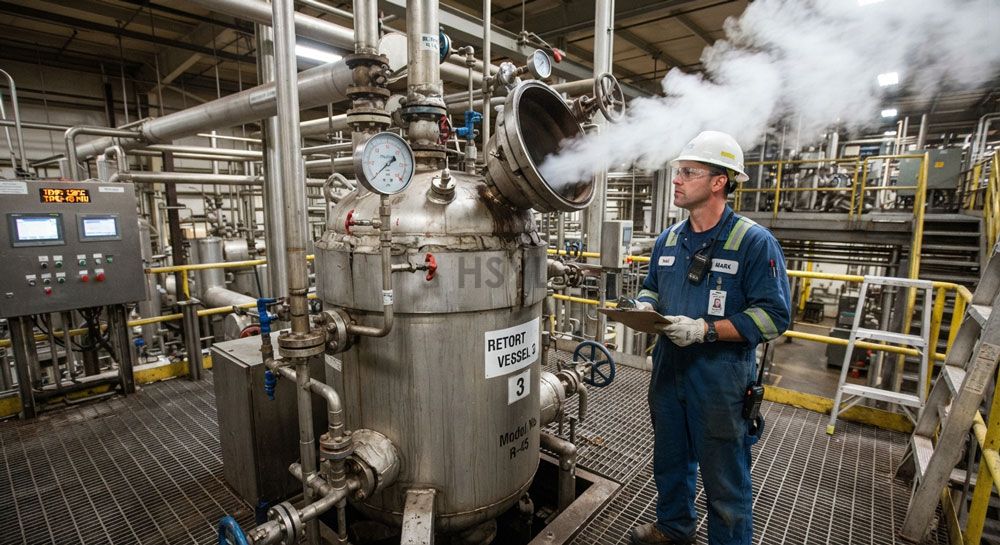
The scope covers retort venting and come-up time for fish canning retorts, from cycle start through the hold phase. It covers the trapped-air causal chain and venting diagnostic. It does not cover heat distribution vs heat penetration studies (covered separately), scheduled-process design, or retort utility optimization. The retort sterilization equipment for fish canning page carries the equipment detail.
How Trapped Air Creates Cold Zones
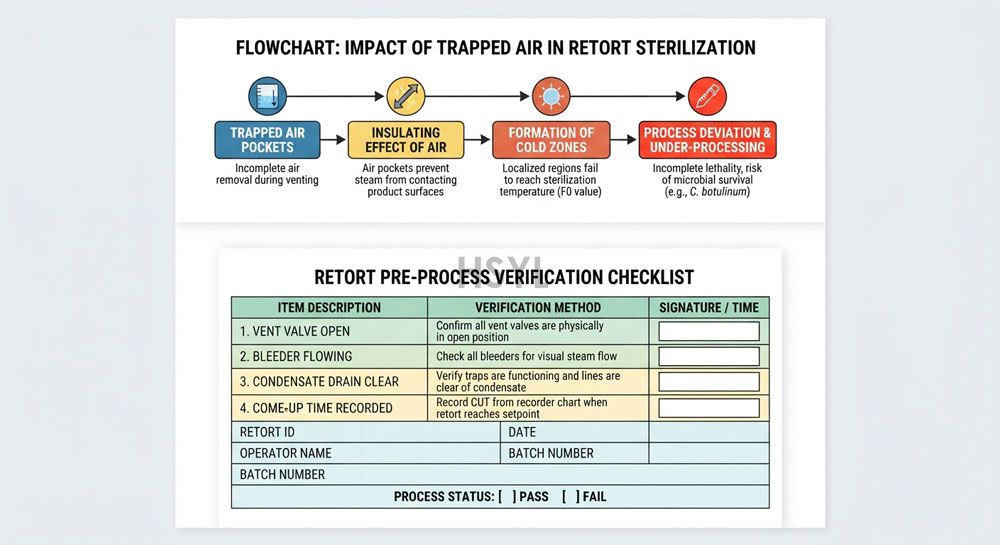
Air is a thermal insulator. When steam enters a retort that still contains air, the steam and air mix, and the mixture has different heat-transfer properties than pure steam. Air tends to collect at low points, near the door, and in corners — and wherever it collects, it insulates the cans from the steam. The result is a cold zone: a position in the retort where the cans do not reach the same temperature as the rest of the retort, even though the retort's average temperature reads correctly.
The failure mode is insidious because the retort looks like it is working. The setpoint is reached, the hold time runs, the cycle completes — but the cans at the cold spot were processed at a lower temperature than the scheduled process assumes. If a heat penetration study placed sensors at the original cold spot and the cold spot has since moved (because venting has degraded), the scheduled process may not be valid for the current cold spot.
Hazard note: Trapped air is a hidden under-processing risk. A retort that reaches setpoint with trapped air inside is not a valid process. Venting is not a warm-up formality — it is the control that removes the air before the hold begins, and the come-up time is the measurement that confirms venting worked.
Venting: Removing Air Before the Hold
Venting is the controlled opening of the retort's vent valve at the start of the cycle, allowing steam to flow through the retort and push air out through the vent. The vent stays open for a defined time (the venting period) before the valve closes and the retort pressurizes. Three rules govern defensible venting.
Rule 1: Vent long enough. The venting period must be long enough to remove the air, not just long enough to reach setpoint. A retort that reaches setpoint in 5 minutes with a short vent may still have trapped air; a retort that vents for the full scheduled period (often 5–10 minutes depending on retort size) ensures air removal.
Rule 2: Bleeders must flow. Bleeder valves (small vents that stay open through the cycle) remove non-condensable gases that accumulate during the hold. A bleeder that is closed or blocked allows air to re-accumulate, recreating the cold zone the venting removed.
Rule 3: Condensate must drain. Steam condenses on cold cans and on the retort structure. If condensate pools, it cools and creates localized cold zones. Condensate drainage is an equipment-capability question that directly affects cold-spot location.
Come-Up Time as a Diagnostic
Come-up time is the time from cycle start to the moment the retort reaches setpoint temperature (within a defined tolerance). It is a diagnostic measurement, not just a cycle parameter — a come-up time that drifts longer than baseline signals a venting or steam-supply problem.
| Symptom | Likely cause | Confirming check |
|---|---|---|
| Long come-up time, all positions | Steam supply insufficient; vent valve not opening | Steam pressure at retort inlet; vent valve operation |
| Long come-up time, specific positions | Cold spot at specific location; trapped air pocket | Multi-point temperature study; vent and bleeder at that location |
| Come-up time drifts over months | Vent valve wear; bleeder blockage; condensate drain partial block | Vent valve inspection; bleeder flow check; drain inspection |
| Come-up time normal but cold-spot drift | Distribution has changed; loading pattern changed | Heat distribution study; loading pattern audit |
A canned fish production line should track come-up time per retort batch and investigate any drift. A come-up time that drifts is not a minor parameter change — it is a signal that venting may be degraded and cold spots may have moved.
Scope, Sources and Limitations
Scope. This article covers retort venting and come-up time for fish canning retorts, from cycle start through the hold phase. It covers the trapped-air causal chain and venting diagnostic. It does not cover heat distribution vs heat penetration studies, scheduled-process design, or retort utility optimization.
Limitations. All come-up time references and venting periods are planning references drawn from publicly available regulatory and industry material. Actual values depend on retort size, type, steam supply, and loading pattern. HSYL does not publish project-specific venting schedules without verified evidence.
Source basis. Venting and come-up principles are consistent with 21 CFR Part 113, FDA Hazards Guide, Codex CXC 23-1979, and IFTPS guidelines. Equipment-capability statements refer to HSYL equipment specifications.
Retort Venting and Come-Up Resources
Two resources complement this venting content. The retort equipment page carries the sterilization system detail. The canned fish line page anchors the species-level line scope.
- Retort sterilization equipment for fish canning — the retort equipment whose vent, bleeder, and condensate systems are the control for trapped air.
- Canned fish production line — the species-level line whose retort batches depend on correct venting.
Next Step: Diagnose Your Come-Up and Venting
Send HSYL your retort type (batch still, batch agitating, or continuous), current venting schedule, typical come-up time, and any cold-spot history. HSYL will return a pre-filled venting diagnostic worksheet with the vent-bleeder-condensate-steam chain for your retort and an equipment-capability review of your venting and bleeder systems.
Frequently Asked Questions
What is retort venting and why is it necessary?
What is come-up time in a retort cycle?
How does trapped air create cold zones in a retort?
What are the symptoms of a retort venting problem?
How often should I check retort venting?
Must-Read Blogs For Chain Restaurants Owner
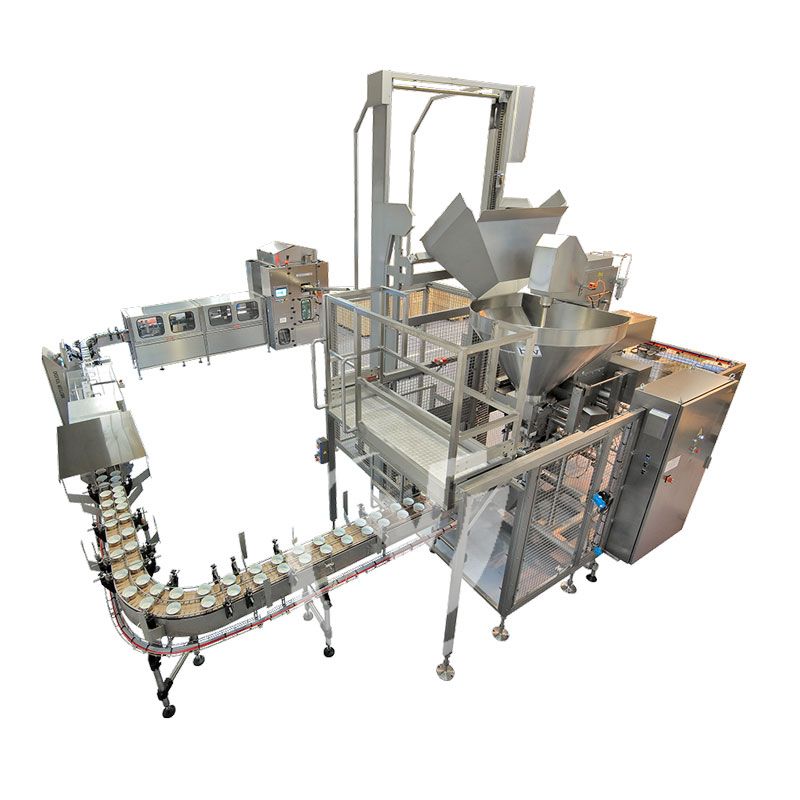

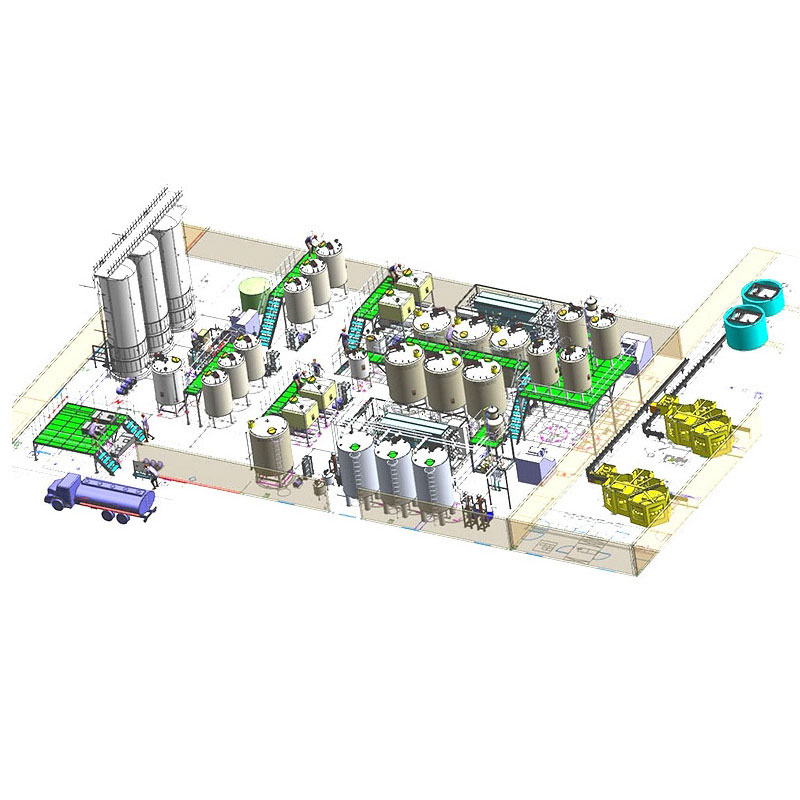
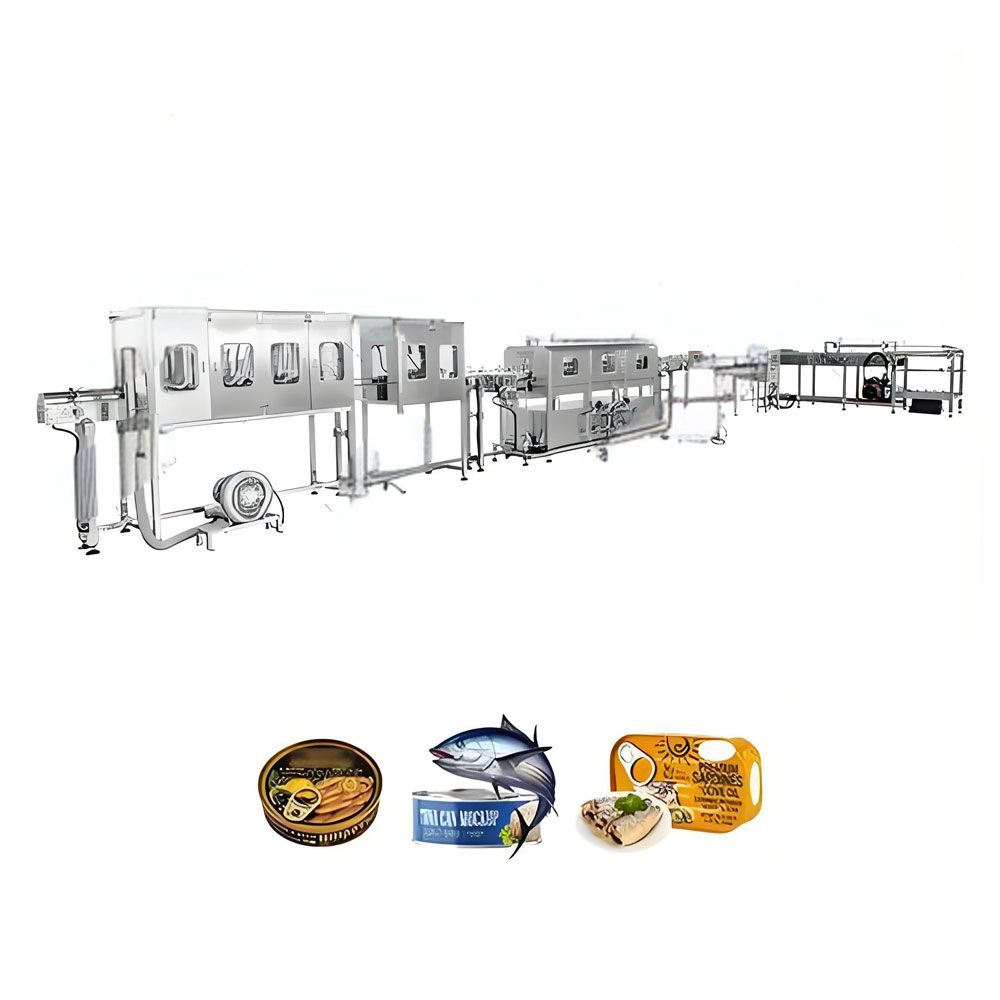 Dutch Canned Fish Production Line
Ready to Get Started?