
Vacuum, Exhausting and Headspace: What They Change Before Fish Can Seaming
The function of vacuum and exhausting in fish can seaming is not obvious — the can is sealed either way, and the food inside is the same. What changes is the residual air in the headspace, and residual air changes three things: the internal pressure during retort, the risk of paneling (can wall deformation), and the shelf-life chemistry of the product. A can with high residual air is a can that may panel in the retort, buckle under pressure, or spoil faster on the shelf. This article explains what vacuum and exhausting do, how headspace residual air changes retort and shelf behavior, and how to diagnose paneling through the vacuum-headspace-pressure causal chain.
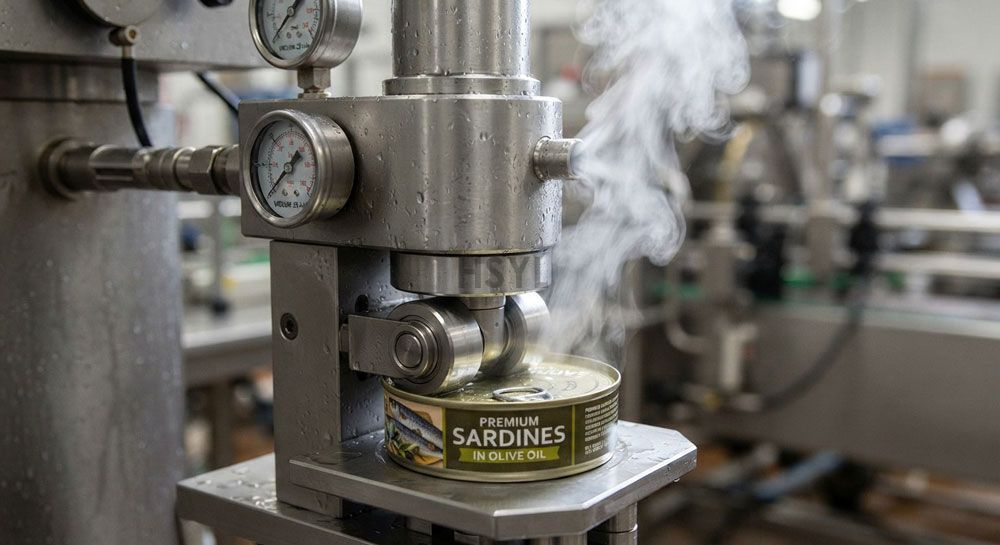
The scope covers vacuum, exhausting, and headspace from the filler to the sealed can entering the retort. It covers the causal chain to paneling and pressure defects. It does not cover filling critical factors (covered separately), seaming defect types, or retort sterilization. A compliant canned food filling and sealing line integrates vacuum and exhausting as the step that sets can internal conditions before seaming.
What Vacuum and Exhausting Actually Do
Vacuum and exhausting remove air from the headspace before the can is sealed. The objective is not to create a perfect vacuum — it is to reduce the residual air to a level where the can behaves predictably during retort and on the shelf. Three things change when residual air is reduced.
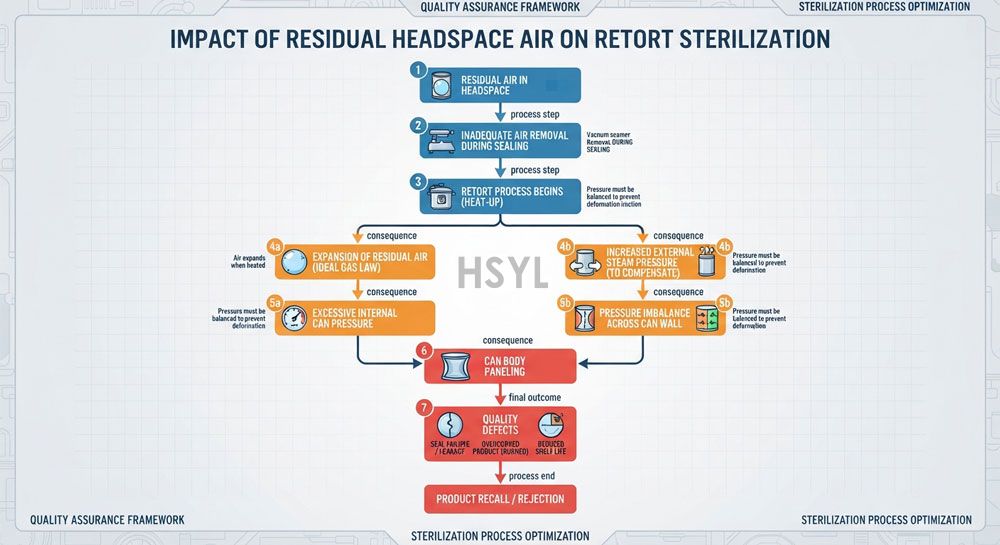
Retort internal pressure drops. Air expands when heated. In the retort, residual air in the headspace expands and pressurizes the can, working against the can wall. Higher residual air means higher internal pressure during retort, which increases the risk of paneling, peaking, or seam stress. Lower residual air means lower internal pressure, and the can is more stable through the retort.
Paneling risk drops. Paneling — the inward deformation of the can wall — happens when external pressure exceeds internal pressure during cooling. A can with low residual air has low internal pressure during cooling, which seems to increase paneling risk. But the retort overpressure system compensates by applying external pressure that tracks the internal pressure. The key is that the overpressure schedule must match the residual air level — a mismatch causes paneling.
Shelf-life chemistry improves. Oxygen in the residual air drives oxidative reactions — fat oxidation, color change, flavor loss. Lower residual oxygen means slower oxidation and longer shelf life. This is a product quality function of vacuum, separate from the retort safety function.
Exhausting Methods
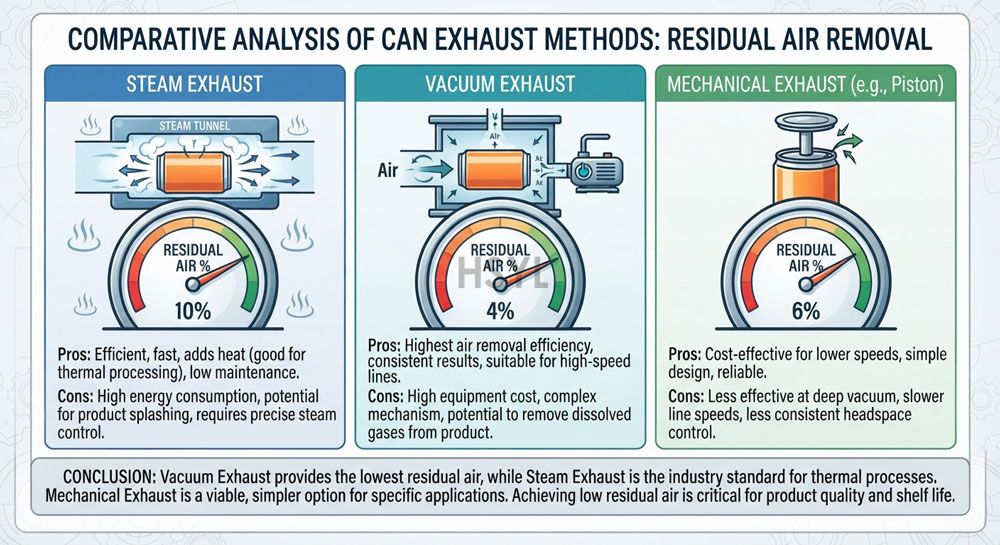
Three exhausting methods are common, each reducing residual air to a different level. The choice is an equipment and process decision.
| Method | Residual air level | Best for | Trade-off |
|---|---|---|---|
| Steam exhaust (steam injection before seam) | Low (steam displaces air, condenses on cooling) | Most canned fish products | Requires steam supply; condensation control |
| Vacuum exhaust (sealed under vacuum) | Very low | High-value products, tight shelf-life requirements | Higher equipment complexity; tighter maintenance |
| Mechanical exhaust (physical air removal) | Moderate | Simple lines, lower-value products | Less effective; rarely sufficient alone |
The Vacuum-Headspace-Pressure Causal Chain
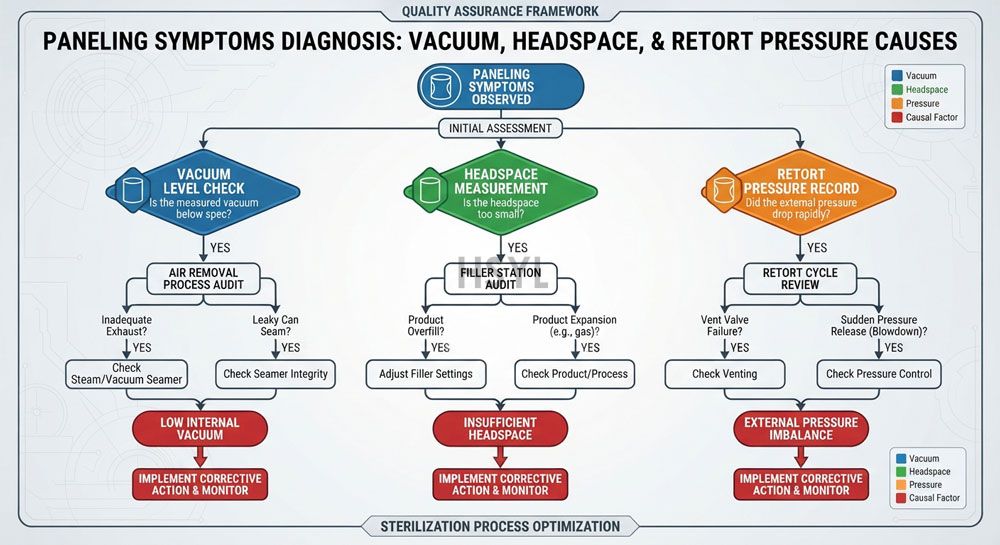
Paneling and pressure defects are not random — they trace to a mismatch in the vacuum-headspace-pressure chain. The diagnostic logic is to follow the chain from symptom to cause.
Causal note: The chain is: exhausting method → residual air level → internal pressure during retort → external overpressure schedule → pressure differential during cooling → paneling or peaking. A defect at the end of the chain is often caused by a mismatch at the beginning — a change in exhausting method that was not matched by a change in the retort overpressure schedule.
If paneling appears after a change in exhausting method, the cause is likely that the retort overpressure schedule was not updated to match the new residual air level. If paneling appears without any process change, the cause is likely exhausting drift — a steam exhaust system that is no longer delivering enough steam, or a vacuum system that is no longer holding vacuum. The automatic can sealing machine and the retort must be diagnosed together, not separately.
Headspace and the Seaming Interface
Headspace is the volume in the can above the product. It is set by fill volume and is the space where residual air lives. Too little headspace and the product can be trapped in the seam during sealing; too much headspace and the residual air volume is larger, increasing pressure and paneling risk. Headspace is both a filling critical factor (covered separately) and a vacuum function — the exhausting step removes air from the headspace, and the headspace volume determines how much air there is to remove.
Scope, Sources and Limitations
Scope. This article covers vacuum, exhausting, and headspace from filler to sealed can entering retort. It covers the causal chain to paneling and pressure defects. It does not cover filling critical factors, seaming defect types, or retort sterilization.
Limitations. All residual air levels and method descriptions are planning references drawn from publicly available industry material. Actual values depend on can size, product format, exhausting method, and equipment set. HSYL does not publish project-specific vacuum levels without verified evidence.
Source basis. Vacuum, exhausting, and headspace principles are consistent with food-science literature and industry canning material. The retort sterilization equipment for fish canning page carries the overpressure system detail.
Vacuum and Headspace Control Resources
Three resources complement this vacuum content. The filling and sealing line page carries the integrated filler-seamer. The can sealing machine page carries the seamer detail. The retort equipment page carries the overpressure system.
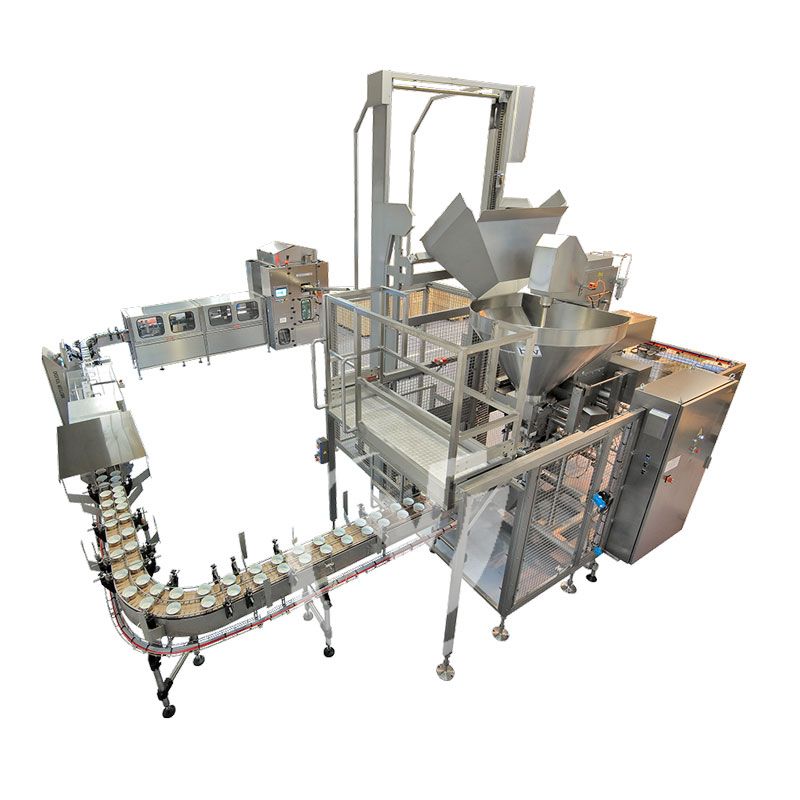
- Canned food filling and sealing line — the integrated equipment that controls vacuum, exhausting, and headspace.
- Automatic can sealing machine — the seamer equipment that forms the seal under vacuum or steam exhaust.
- Retort sterilization equipment for fish canning — the retort whose overpressure schedule must match the residual air level.
Next Step: Diagnose Your Vacuum-Headspace-Pressure Chain
Send HSYL your can size, product format, current exhausting method, current retort overpressure schedule, and any paneling or peaking symptoms. HSYL will return a pre-filled causal diagnostic worksheet with the vacuum-headspace-pressure chain for your setup and an equipment-capability review of your exhausting and overpressure systems.
Frequently Asked Questions
What does vacuum or exhausting do in fish can seaming?
What is the difference between steam exhaust and vacuum exhaust?
Why do my cans panel during retort cooling?
How does headspace affect vacuum and paneling?
Can HSYL provide the vacuum level for my canned fish product?
Must-Read Blogs For Chain Restaurants Owner

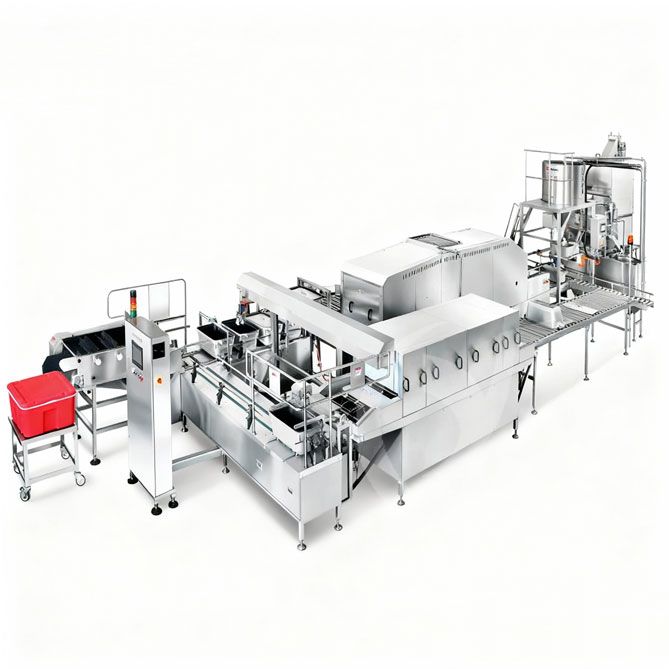
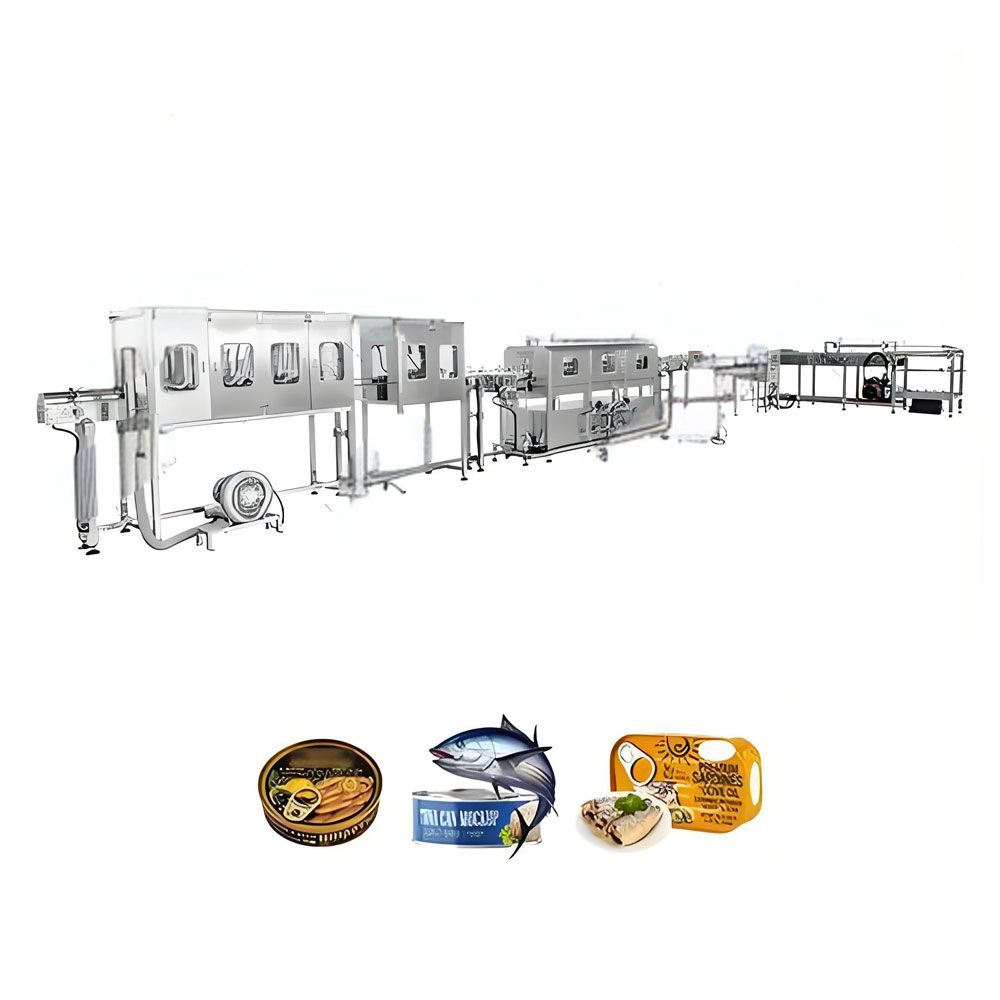 Canned Fish Production Line
 Spinach Canned Canned Food Canning Production Line
Ready to Get Started?