
Double-Seam Defect Root Causes: Droops, False Seams, Jumped Seams and Cut Seams
A double seam that looks closed is not necessarily a seam that holds. The four most common seam defects in fish canning — droops, false seams, jumped seams, and cut seams — are each visible on teardown, each caused by a different combination of seamer setup, can specification, roll wear, and handling, and each requiring a different correction. A seamer that produces one defect type is not producing a random error; it is producing a specific signal that points to a specific root cause. This article maps each defect type to its root causes and correction actions, and explains the teardown measurements that identify each.
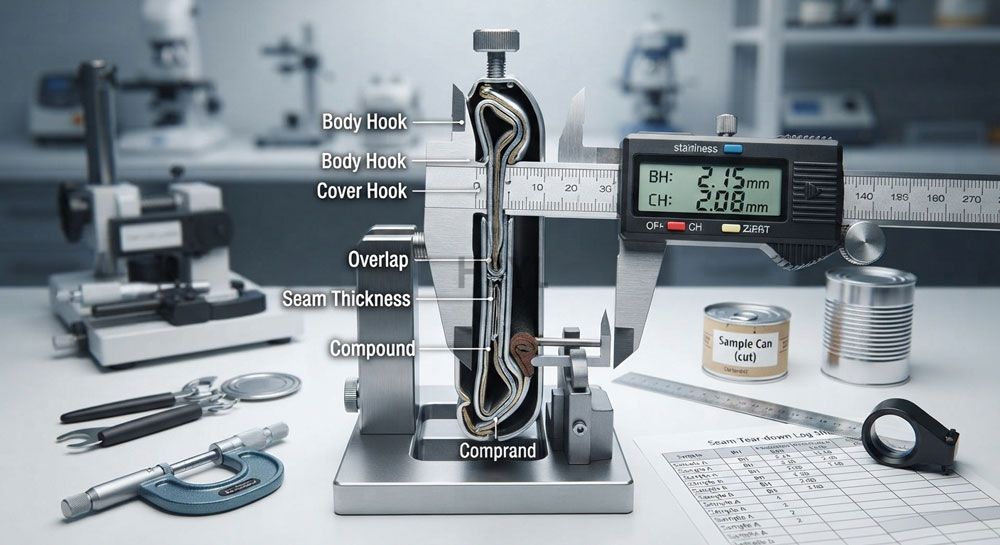
The scope covers double-seam defect root causes for fish canning, from seamer output to teardown diagnosis. It covers the four defect types, their root causes, and correction actions. It does not cover seaming critical factors (covered separately), retort sterilization, or can coating. The automatic can sealing machine page carries the seamer equipment detail.
The Four Defect Types and Their Signatures
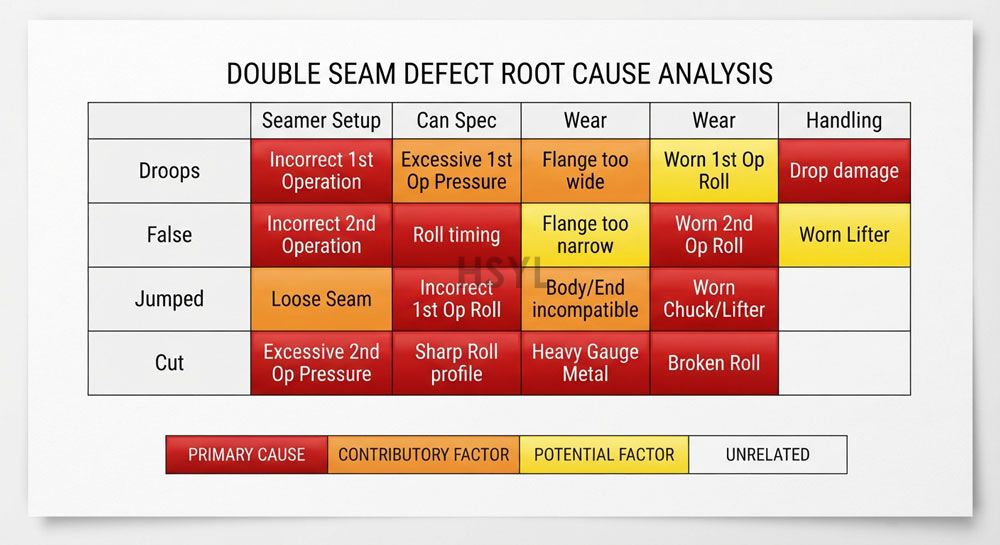
Each defect type has a visible signature on teardown, and each points to a different root cause. The table below is the diagnostic starting point.
| Defect type | Visible signature | Primary root cause | Correction direction |
|---|---|---|---|
| Droops | Excessive material hanging below the seam at one point | Excessive seaming pressure or soft can body | Reduce pressure; verify can body hardness |
| False seams | Hook appears formed but cover and body hooks not interlocked | Insufficient first-operation roll pressure; misaligned rolls | Verify first-op roll setup; check roll alignment |
| Jumped seams | Periodic gap or skip along the seam | Roll jumping over seam due to chuck or roll wear, or can slip | Inspect chuck and roll wear; verify can hold |
| Cut seams | Cut or score mark on the cover hook or body hook | Roll edge sharp or worn into the seam | Inspect roll profile; replace worn roll |
Teardown Measurements That Identify Defects
A double seam teardown measures five parameters: body hook length, cover hook length, overlap, tightness (percent), and pressure ridge. Each defect type shows a different pattern of deviation in these parameters.
- Body hook length. Too short signals insufficient first-operation formation; too long signals over-formation.
- Cover hook length. Too short signals insufficient second-operation pressure; too long signals over-pressure.
- Overlap. The amount by which body hook and cover hook overlap. Low overlap is the direct cause of false seams and leak risk.
- Tightness (percent). The measure of how tightly the seam is compressed. Low tightness causes droops and false seams; excessive tightness causes cut seams.
- Pressure ridge. The visible ridge formed on the can body by the seaming roll. Its shape and continuity diagnose jumped seams and roll-wear issues.
QA note: A first-off seam teardown is required at every changeover and after any seamer adjustment. A seamer that runs without first-off approval is a seamer that may be producing defects that are only caught at retort — when the cans are already sealed, filled, and committed.
Correction Actions by Defect Type
Each defect type has a specific correction path, and the correction must be verified by a new first-off teardown before production resumes.
Droops signal excessive pressure or soft can body. Reduce second-operation pressure in small increments, verify can body hardness against spec, and re-run first-off teardown. If droops persist, inspect the roll profile for wear that changes the pressure curve.
False seams signal insufficient first-operation formation or roll misalignment. Verify first-operation roll setup against spec, check roll alignment, and re-run first-off. False seams are a serious defect — the seam appears formed but is not interlocked, creating a leak risk.
Jumped seams signal roll or chuck wear, or can slip during seaming. Inspect chuck and roll for wear, verify can hold mechanism, and check for can-body deformation that allows slip. Jumped seams are periodic — they appear at intervals that correspond to the worn portion of the roll or chuck.
Cut seams signal a roll edge that is cutting into the seam. Inspect the roll profile for sharpness or wear, replace the worn roll, and re-run first-off. Cut seams are a direct food-safety risk — the cut can penetrate the hook and create a leak path.
Scope, Sources and Limitations
Scope. This article covers double-seam defect root causes for fish canning, from seamer output to teardown diagnosis. It covers the four defect types, root causes, and correction actions. It does not cover seaming critical factors, retort sterilization, or can coating.
Limitations. All defect descriptions and teardown parameters are drawn from publicly available industry and standards material (FDA Container/Closures Guide, CFIA Metal Can Defects). Actual defect rates and correction settings depend on seamer type, can spec, and product. HSYL does not publish project-specific defect rates without verified evidence.
Source basis. Defect definitions and teardown principles are consistent with FDA Container and Closures Inspection Guide and CFIA Metal Can Defects manual. Equipment-capability statements refer to HSYL equipment specifications. The canned fish production line page carries the line scope.
Reviewer and date. QA & Seamer Specialist, HSYL. Last technical review: 2026-07-28.
Double-Seam Defect Resources
Two resources complement this defect content. The can sealing machine page carries the seamer equipment. The canned fish line page anchors the line scope.
- Automatic can sealing machine — the seamer whose setup, roll, and chuck condition drive defect types.
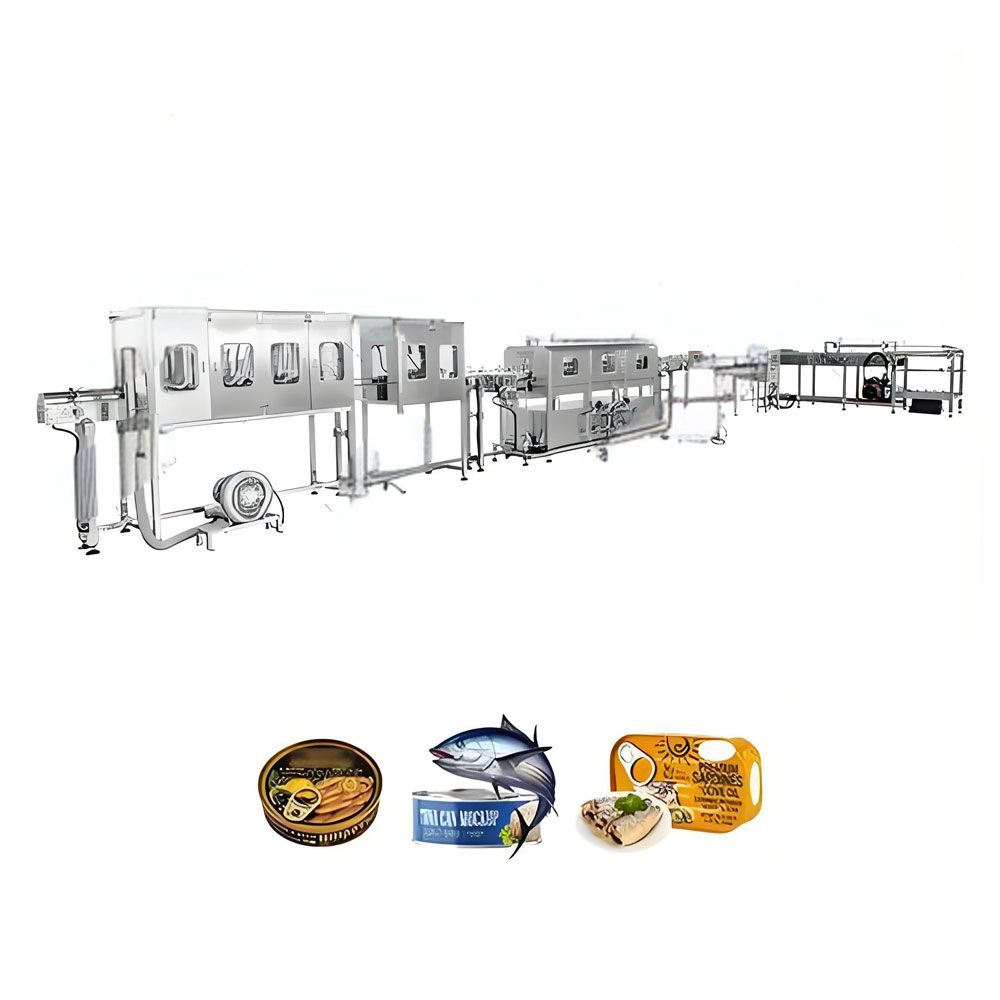
- Canned fish production line — the species-level line scope that the seaming step serves.
Next Step: Build Your Defect Diagnostic
Send HSYL your can size and type, seamer model, current defect symptoms, and recent teardown measurements. HSYL will return a pre-filled defect diagnostic worksheet with the root-cause matrix for your defect types and a seamer-capability review that covers roll, chuck, and pressure setup.
Frequently Asked Questions
What causes droops in a can double seam?
What is a false seam and why is it dangerous?
How do I identify a jumped seam?
What is a cut seam and how do I fix it?
How often should I perform a double-seam teardown?
Must-Read Blogs For Chain Restaurants Owner

 Canned Fish Production Line
 Cucumber Canning Production Line
 Double-Door Sterilizer
Ready to Get Started?