
Thawing Frozen Tuna for Canning: Time-Temperature Control, Drip Loss and Line Capacity
A frozen tuna block arrives at the cannery at -18 °C, and the continuous line downstream needs fish at 0–4 °C at a fixed rate of two tonnes per hour. Between those two states sits the thawing step — the buffer that converts a frozen, intermittent supply into a chilled, continuous feed. Get the thawing method, time-temperature control, or buffer capacity wrong, and the line either starves for feed or receives fish with high drip loss, uneven texture, and elevated histamine risk. This article covers the three engineering decisions that define a cannery thawing step: method selection, time-temperature control, and buffer sizing for continuous line feed.
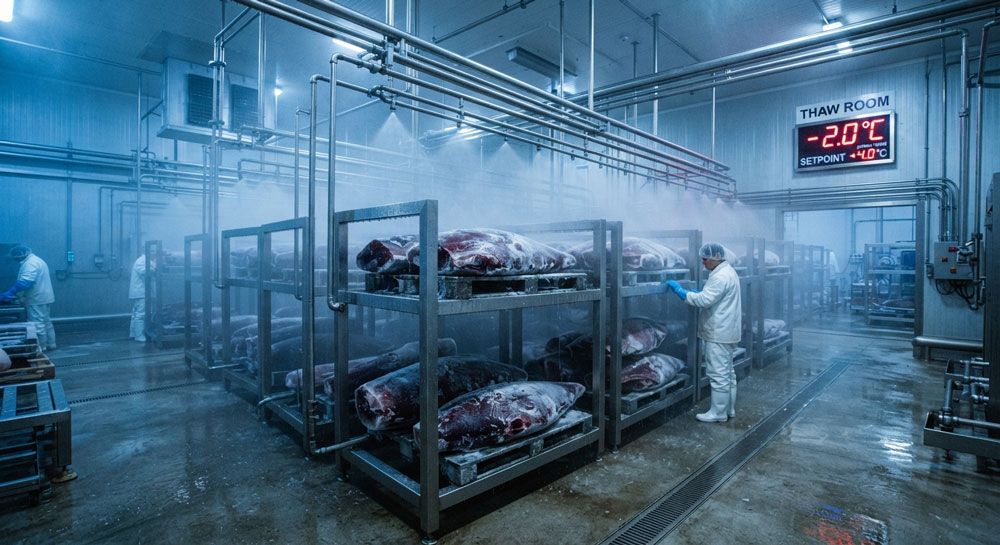
The scope covers thawing of frozen tuna from frozen storage through to the continuous line feed entry. It covers drip loss, time-temperature, and buffer capacity. It does not cover mass balance (covered separately), receiving inspection, or precooking. A compliant canned tuna processing production line integrates thawing as the first buffer between intermittent frozen supply and continuous downstream flow.
Three Thawing Methods and Their Trade-Offs
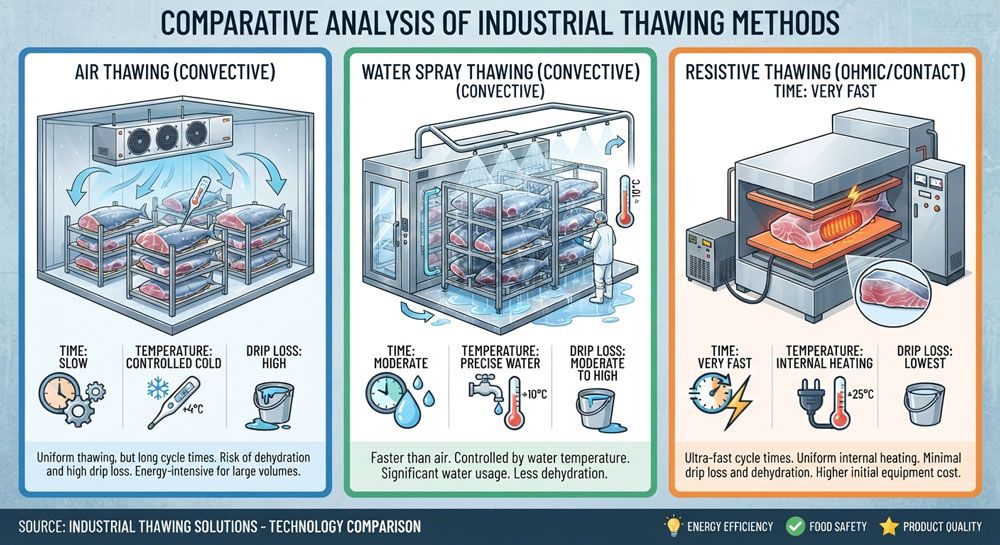
The thawing method sets the ceiling for drip loss, throughput, and capital cost. Three methods are common in tuna canneries, each with a different trade-off profile.
| Method | Typical time | Drip loss reference | Capital cost | Best for |
|---|---|---|---|---|
| Air thawing (still or forced) | 12–24 hours | Higher (slow protein relaxation) | Low | Small canneries with flexible scheduling |
| Water spray thawing | 4–8 hours | Moderate | Medium | Medium canneries needing daily throughput |
| Resistive / microwave thawing | 1–3 hours | Lowest | High | Large canneries with continuous feed demand |
The drip loss figures are planning references, not guarantees. Actual drip loss depends on freezing method, fish size, fat content, and thawing temperature control. A 2% difference in drip loss on a 20-tonne-per-day line is 400 kg of apparent weight loss per day — and because drip loss is water and soluble protein, it directly affects saleable yield. The method choice is therefore a capital-versus-yield decision, and the correct answer depends on line scale and raw material cost.
Time-Temperature Control During Thawing
Thawing is a histamine-sensitive step. The fish passes through the 4–10 °C band during thawing — the same band where histamine formation accelerates if time-temperature is not controlled. Three time-temperature rules govern a defensible thawing program.
Rule 1: Thaw at controlled temperature, not ambient. Air thawing at ambient room temperature (20–25 °C) puts fish in the histamine formation window for hours. Thawing rooms should be held at 4–8 °C for air thawing, and spray water should be at 4–10 °C for water thawing. The thawing room is a refrigerated space, not a warm room.
Rule 2: Limit total time in the marginal band. The cumulative time fish spends between 4 and 10 °C during thawing must be limited and recorded. A thawing program with no time limit in the marginal band is an uncontrolled histamine risk. The HACCP plan should specify a maximum thawing time for each method and fish size.
Rule 3: Move fish to chilled hold immediately after thawing. Thawed fish must not sit at ambient temperature waiting for the next step. The thawing step ends when core temperature reaches 0–2 °C, and the fish moves to chilled hold (0–4 °C) within a defined window.
Engineering note: Thawing is both a buffer step and a histamine control point. The time-temperature history during thawing must be recorded and linked to the lot's receiving record. A thawing room without temperature monitoring and time recording is not a defensible histamine control.
Drip Loss Measurement
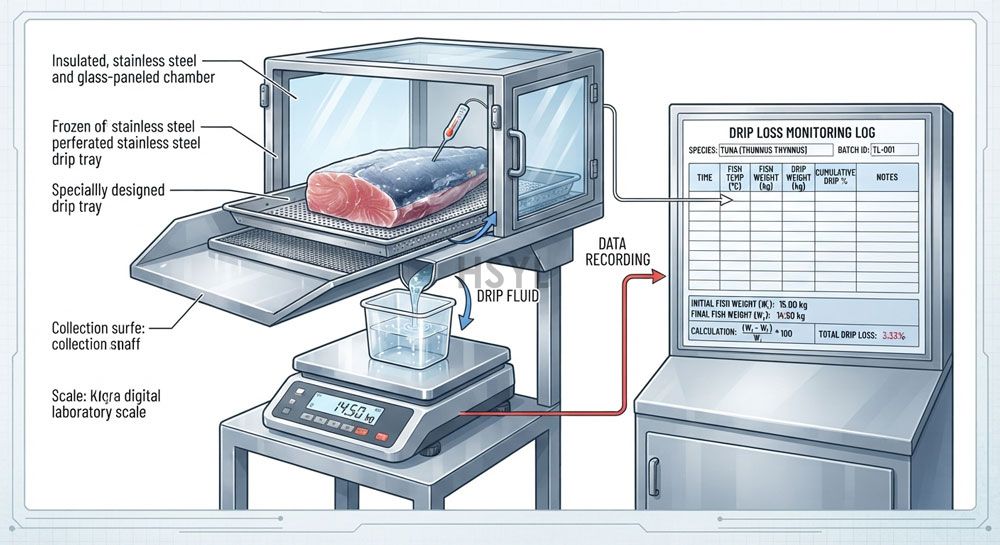
Drip loss is the weight difference between the frozen fish entering thawing and the thawed fish leaving it, expressed as a percentage of frozen weight. It is the primary yield metric for the thawing step, and it must be measured, not assumed. The measurement protocol is straightforward.
Weigh a representative sample of frozen fish before thawing (record lot ID, fish count, and total weight). Place the sample on a drip tray that allows water to drain away from the fish. After thawing, weigh the same sample again. The drip loss percentage is (frozen weight − thawed weight) ÷ frozen weight × 100. Run this measurement per thawing batch and track the result against method, fish size, and season.
A canned fish production line yield audit should include drip loss as the first node after receiving — a 2% drip loss reduction on a 20-tonne line recovers 400 kg of fish per day that would otherwise be lost as water and soluble protein.
Buffer Capacity Sizing
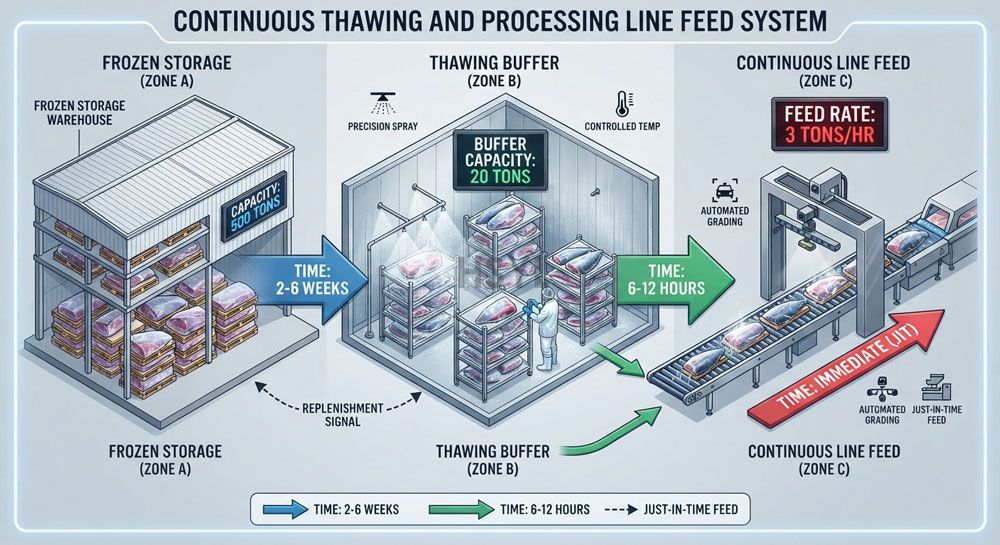
The thawing step is a buffer between intermittent frozen supply and continuous line feed. A continuous canning line runs at a fixed rate (e.g., 2 tonnes per hour of thawed fish); frozen tuna arrives in blocks that are thawed in batches (e.g., 4–8 hours per batch). The buffer must be large enough to keep the line running while the next batch thaws.
Buffer capacity is sized on three inputs: line feed rate (tonnes per hour), thawing batch time (hours), and a safety margin for batch-to-batch variability. The minimum buffer is line feed rate × thawing batch time — enough thawed fish to keep the line running for one full batch time. A safer buffer adds 50–100% margin to account for thawing time variance, fish size variability, and line stoppages. A fish speed cleaning machine downstream of thawing also needs feed at a controlled rate, so the buffer must serve both the line and the cleaning step.
Scope, Sources and Limitations
Scope. This article covers thawing of frozen tuna for canning, from frozen storage through to continuous line feed entry. It covers method selection, time-temperature control, drip loss measurement, and buffer sizing. It does not cover mass balance, receiving inspection, precooking, or retort sterilization.
Limitations. All drip loss percentages, thawing times, and temperature thresholds are planning references drawn from publicly available industry and food-science material. Actual values depend on freezing method, fish size, fat content, season, and equipment set. HSYL does not publish project-specific thawing data without verified evidence. A defensible thawing program for your plant requires measurement at your facility.
Source basis. Thawing method and time-temperature principles are consistent with FDA Fish and Fishery Products Hazards and Controls Guidance, 21 CFR Part 123, and food-science literature on frozen fish thawing. Equipment-capability statements refer to HSYL equipment specifications.
Reviewer and date. Process Engineering & QA, HSYL. Last technical review: 2026-07-28.
Thawing Process and Capacity Resources
Three resources complement this thawing content. The tuna line page carries the full tuna-specific equipment scope. The canned fish line page frames the species-level line. The fish cleaning machine page carries the post-thawing wash equipment.
- Fully automatic canned tuna processing production line — the tuna-specific line that the thawing step feeds into.
- Canned fish production line — the species-level line scope.
- Fish speed cleaning machine — the post-thawing wash equipment that standardizes the transition to butchering.
Next Step: Size Your Thawing Buffer
Send HSYL your frozen tuna form (block, IQF, or whole), typical fish size, line feed rate in tonnes per hour, and current thawing method. HSYL will return a pre-filled thawing buffer sizing worksheet with reference drip loss ranges for your method and a time-temperature control plan for your HACCP record.
Frequently Asked Questions
What is the best thawing method for frozen tuna in a cannery?
How long does it take to thaw frozen tuna for canning?
What is drip loss and why does it matter?
How do I size a thawing buffer for a continuous canning line?
Is thawing a histamine control point?
Must-Read Blogs For Chain Restaurants Owner

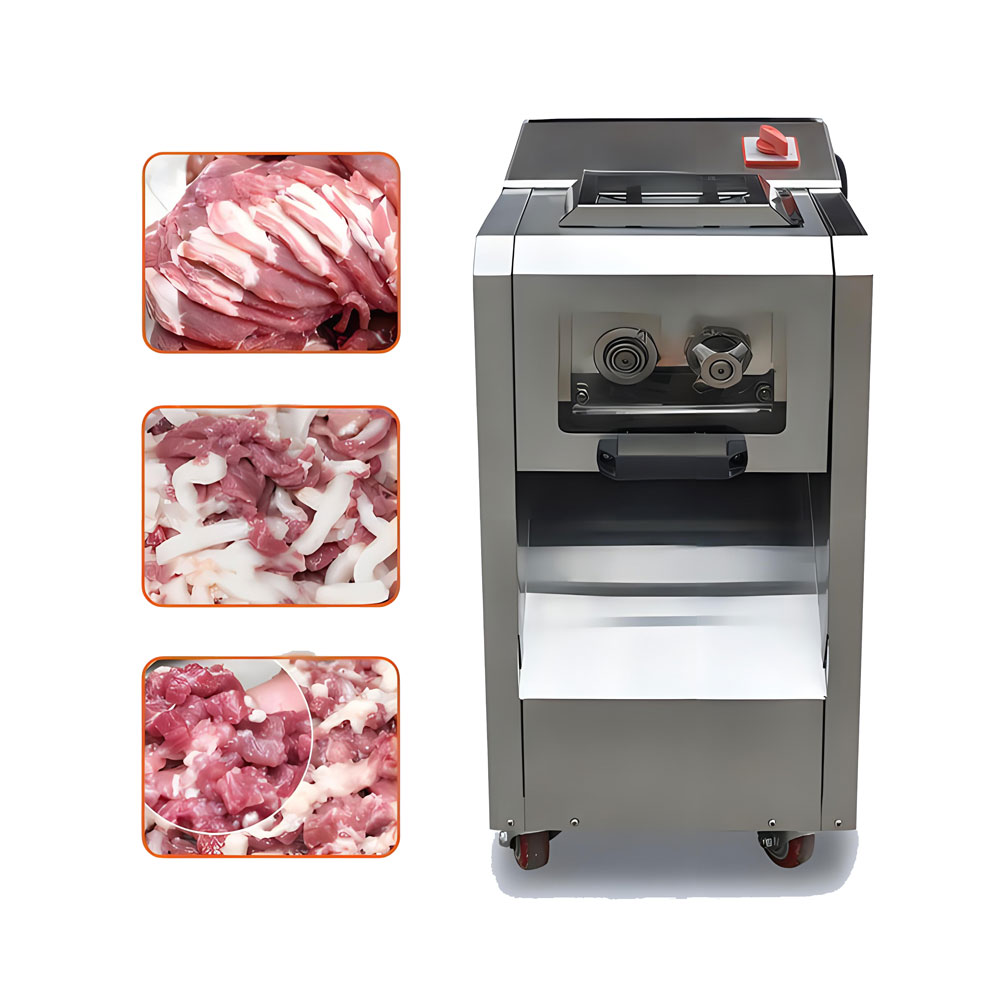 Frozen Meat Cutting Machine
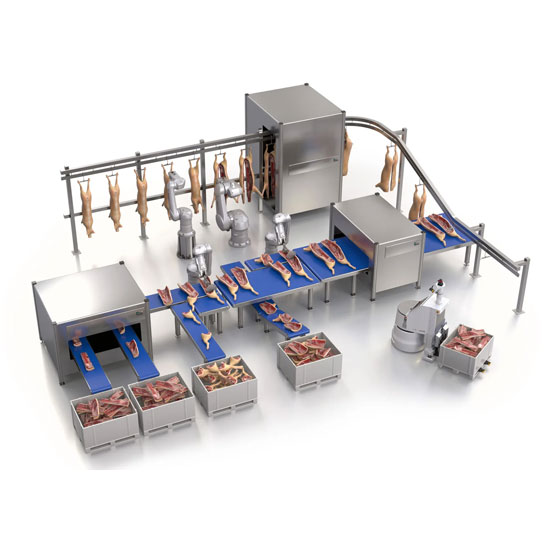 Meat Processing Line Equipment
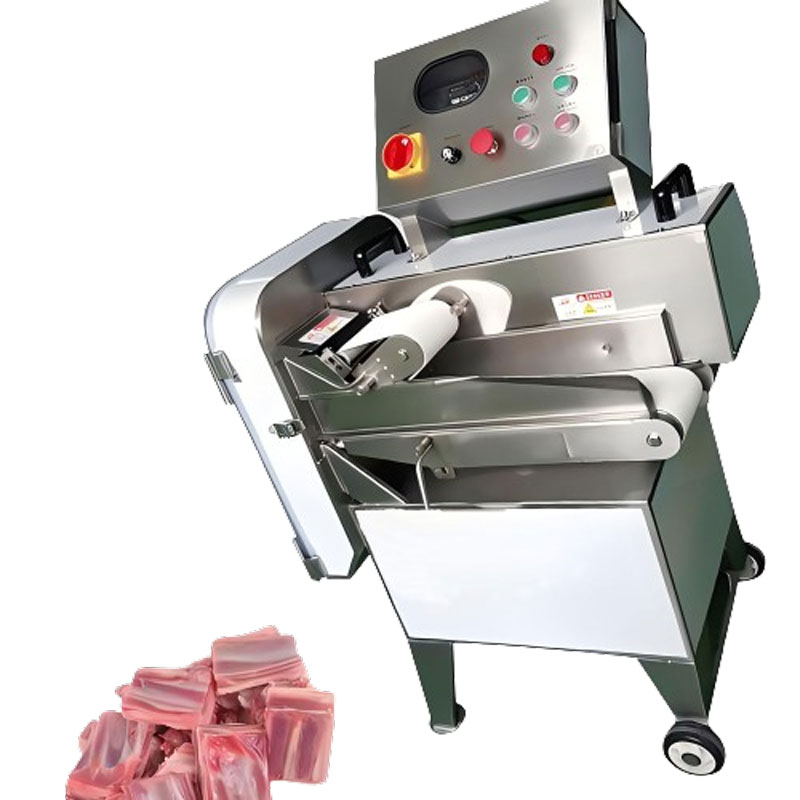 Frozen Meat Ribs Dicing Machine
 Frozen Meat Roll Cutting Machine
Ready to Get Started?