
Why Cans Panel, Peak or Buckle During Retort and Cooling
Can deformation — paneling, peaking, or buckling — is not a single defect with a single cause. The three phenomena are driven by different directions of pressure differential, and each traces to a different combination of overpressure schedule, headspace, and can body strength. A line that treats all deformation as "a retort problem" will not find the cause, because the three types require different diagnostics. This article maps each deformation type to its pressure-headspace-strength cause and explains how to diagnose which variable is out of balance.
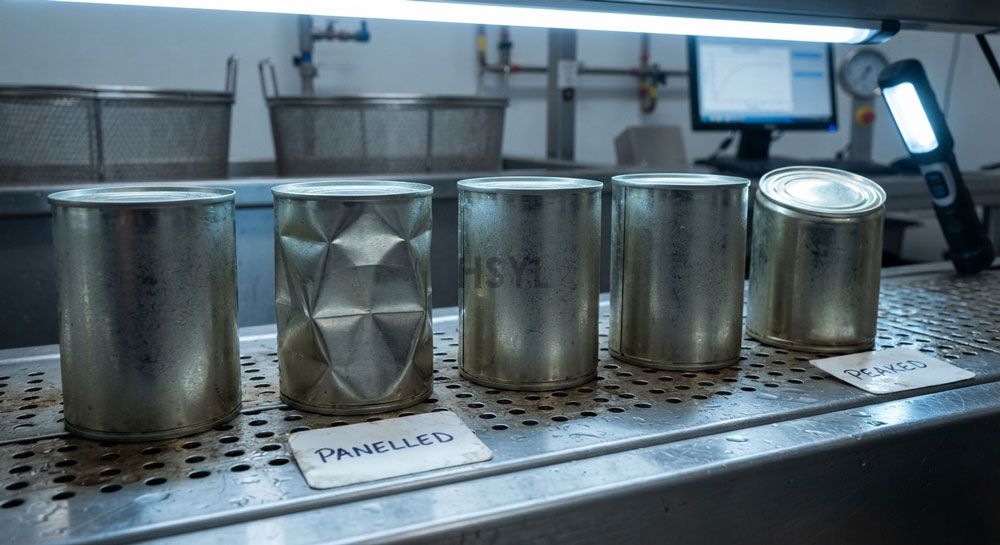
The scope covers can deformation during retort and cooling for fish canning, from retort pressurization through cooling. It covers paneling, peaking, and buckling and their causes. It does not cover double-seam defects (covered separately), retort venting, or retort utility optimization. The automatic can sealing machine and the retort equipment pages carry the equipment detail.
Three Deformation Types and Their Pressure Directions
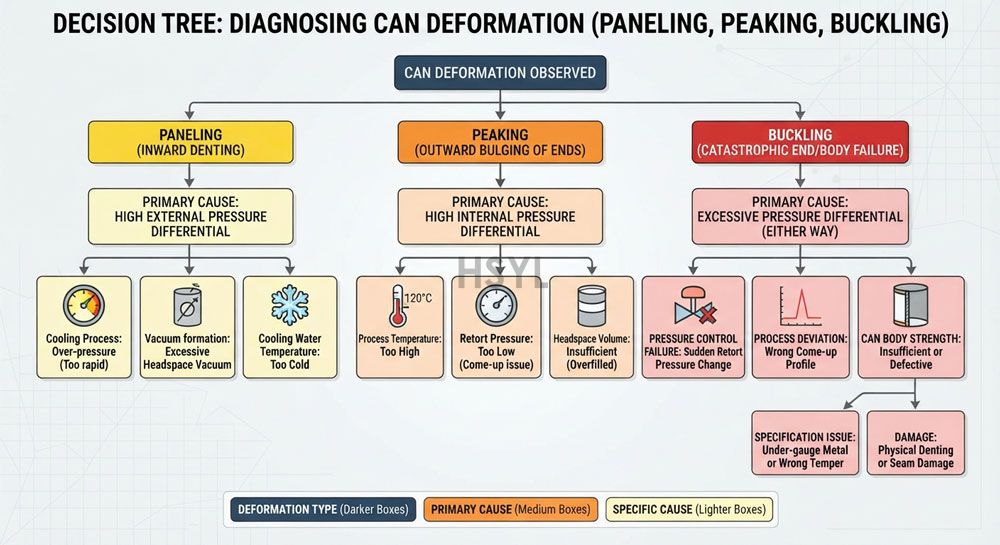
The three deformation types are distinguished by the direction the can wall moves, and each direction indicates a different pressure differential.
| Type | Wall direction | Pressure direction | Primary cause |
|---|---|---|---|
| Paneling | Inward (wall caves in) | External > internal | Overpressure too high during cooling; low headspace; thin can body |
| Peaking | Outward at ends (ends dome) | Internal > external during heating | High headspace air; insufficient overpressure during heating; low can end strength |
| Buckling | Outward at body (wall bows) | Internal > external during heating | High internal pressure; weak can body; insufficient overpressure |
The Pressure-Headspace-Strength Triangle
The three causes — pressure differential, headspace, and can body strength — form a triangle. A deformation problem can be caused by any one of the three, or by a mismatch between them. The diagnostic discipline is to measure all three, not to assume one is the cause.
Pressure differential is governed by the retort overpressure schedule. The overpressure must track the internal pressure during heating (to prevent peaking and buckling) and must release in a controlled way during cooling (to prevent paneling). An overpressure schedule that is correct for one can size and headspace may be wrong for another.
Headspace is the volume of air in the can. High headspace means more air to expand during heating, higher internal pressure, and higher peaking/buckling risk. Low headspace means less internal pressure during cooling and higher paneling risk if overpressure is not reduced correspondingly.
Can body strength is the structural resistance of the can to deformation. A can body that is below spec (thin wall, low temper) will deform at a lower pressure differential than a can that meets spec. Can strength is a packaging supply variable, not a process variable — but if the can supply drifts, the process must compensate or the deformation rate rises.
Diagnostic note: The three variables interact. A paneling problem that appears after a headspace reduction is not caused by the headspace reduction alone — it is caused by the headspace reduction without a matching overpressure schedule reduction. The fix is to match the overpressure schedule to the new headspace, not to reverse the headspace change.
Diagnosing by Deformation Type
Each deformation type has a diagnostic path that starts from the visible symptom.
Paneling appears during cooling, when external pressure exceeds internal. The diagnostic path: verify overpressure schedule tracks the internal pressure drop during cooling; verify headspace is not below spec (low headspace = low internal pressure during cooling); verify can body strength meets spec. The retort sterilization equipment for fish canning overpressure system is the primary control for paneling.
Peaking appears during heating, when internal pressure exceeds external at the can ends. The diagnostic path: verify headspace is not above spec (high headspace = more expanding air); verify overpressure is applied early enough in the heating phase; verify can end strength meets spec. Peaking is often the first signal that headspace has drifted high.
Buckling appears during heating, when internal pressure exceeds external at the can body. The diagnostic path: verify internal pressure is not excessive (high headspace, high fill temperature); verify can body strength meets spec; verify overpressure is sufficient during heating. Buckling is often a can-supply problem masquerading as a process problem.
Scope, Sources and Limitations
Scope. This article covers can deformation during retort and cooling for fish canning, from retort pressurization through cooling. It covers paneling, peaking, and buckling and their causes. It does not cover double-seam defects, retort venting, or retort utility optimization.
Limitations. All deformation descriptions and pressure relationships are drawn from publicly available packaging and industry material. Actual deformation thresholds depend on can size, can spec, product, and overpressure schedule. HSYL does not publish project-specific deformation rates without verified evidence.
Source basis. Deformation principles are consistent with FDA Container and Closures Inspection Guide, CFIA Metal Can Defects manual, and packaging engineering literature. The canned fish production line page carries the line scope.
Can Deformation and Pressure Resources
Three resources complement this deformation content. The can sealing machine page carries the seamer that sets headspace. The retort equipment page carries the overpressure system. The canned fish line page anchors the line scope.
- Automatic can sealing machine — the seamer whose headspace and vacuum control affect internal pressure.
- Retort sterilization equipment for fish canning — the retort whose overpressure schedule must match headspace and can strength.
- Canned fish production line — the species-level line scope that the deformation diagnosis serves.
Next Step: Diagnose Your Deformation
Send HSYL your can size and spec, current overpressure schedule, headspace target, fill temperature, and deformation symptoms (paneling, peaking, or buckling). HSYL will return a pre-filled deformation fault tree with the pressure-headspace-strength diagnosis for your setup and an equipment-capability review of your retort overpressure system.
Frequently Asked Questions
What is the difference between paneling, peaking, and buckling?
Why do my cans panel during cooling?
Why do my can ends peak during heating?
How does can body strength affect deformation?
Can HSYL provide the overpressure schedule for my can size?
Must-Read Blogs For Chain Restaurants Owner

 Edible Mushroom Canned Food Production Line
 Chicken Soup Canned Production Line
 Cucumber Canned Production Line
 Canned Beans Production Line
Ready to Get Started?